China, ASEAN to pool strength in blue economy Hainan expected to function as strategic hub for the emerging common market
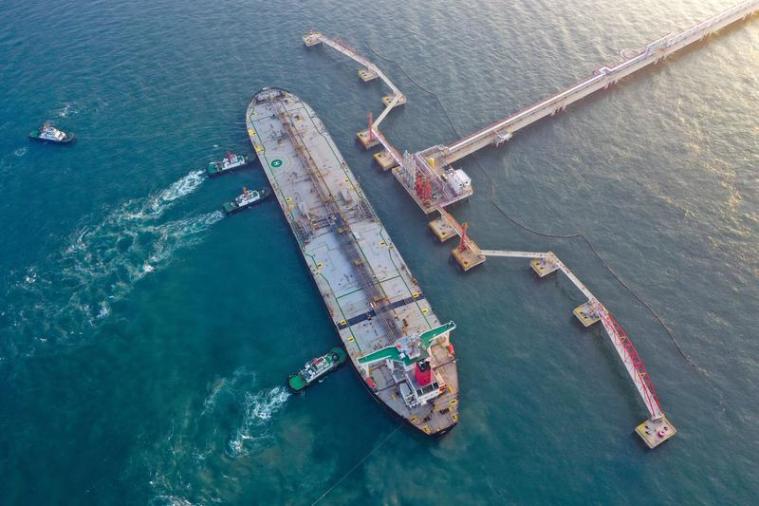
An aerial drone photo shows a vessel carrying 179,000 tons of petrochemical raw materials berthing at Yangpu Port in Danzhou, South China's Hainan province, Dec 18, 2025. [Photo/Xinhua]
There is immense potential for China and the Association of Southeast Asian Nations to deepen cooperation in the blue economy sector and build a more integrated common market, a move that will strengthen regional resilience against external shocks and inject fresh momentum into regional growth, officials and experts said on Sunday.
Speaking at the China-ASEAN Blue Economy Cooperation Dialogue in Haikou, the capital of Hainan province, they said that rising geopolitical uncertainties, growing protectionism and mounting energy and supply chain risks have underscored the need for both sides to further explore cooperation potential in the areas of marine energy, port logistics, shipping, marine tourism and coastal industries.
Against this backdrop, the Hainan Free Trade Port, with its unique location and policy advantages, is expected to serve as a strategic hub for deeper China-ASEAN blue economy cooperation, they added.
According to the World Bank, the blue economy, also known as the marine economy, refers to the "sustainable use of ocean resources for economic growth, improved livelihoods and jobs, while preserving the health of ocean ecosystems".
Wang Bin, a member of the Standing Committee of the Hainan Provincial Committee of the Communist Party of China and head of the provincial Party committee's Publicity Department, said that Hainan serves as an important gateway for China's opening-up to ASEAN.
"Hainan is making every effort to promote high-quality marine development and play an active role in China-ASEAN cooperation," he said.
Sharing a similar view, Lyu Bin, president of the China Oceanic Development Foundation, said the Hainan FTP offers a rare opportunity to address bottlenecks that have constrained China-ASEAN blue economy integration, thanks to its unique opening-up arrangements and policy environment.
Chi Fulin, president of the China Institute for Reform and Development, said that such foundational strengths allow Hainan to function as a strategic hub for the emerging China-ASEAN blue economy common market.
"A China-ASEAN blue economy common market would put the region in a stronger position to weather external shocks and sustain stable growth," Chi said. "It would also open up new room for cooperation and promote closer integration of industrial and supply chains."
Hainan's burgeoning marine economy is also bolstering confidence in the push for deeper regional cooperation. The province's gross ocean product rose 7.9 percent year-on-year in 2025, making it one of the mainstays of local growth, official data showed.
Emerging sectors are driving the expansion, with the deep-sea oil and gas industry posting robust gains in reserves and output. The independently developed Deep Sea No 1 gas field, China's first ultra-deepwater project, recently completed its 100th crude oil shipment since its commissioning in 2021.
Optimism shared
That optimism over the common market on the blue economy was also shared by officials and experts from ASEAN countries.
Unny Sankar Ravi Sankar, minister of economic affairs at the Malaysian embassy in China, said the blue economy offers one of the most promising pathways for China and ASEAN to build a more integrated common market.
"The blue economy will transform the development landscape of the entire region," Sankar said.
China and ASEAN together form one of the world's most dynamic maritime regions, creating vast room for deeper blue economy cooperation and regional integration, said Rokhmin Dahuri, Indonesia's former minister of marine affairs and fisheries.
Yet the promising outlook also underscores the need to address the structural challenges facing the blue economy.
Dahuri said the sector is still confronted with pressing challenges, including overfishing, marine pollution, habitat degradation and biodiversity loss.
To deal with these challenges, he said, there is a need to strike a balance between economic growth and environmental protection.
"China can play an important role in cutting-edge technologies, including artificial intelligence, smart digital applications, drones and robotics," Dahuri said, adding that such technologies could help countries tap the potential of the blue economy in a more sustainable way.
(Source: China Daily)