Think tanks' report debunks fallacies of 'SCS arbitration award,' validates China's legitimate position on maritime rights
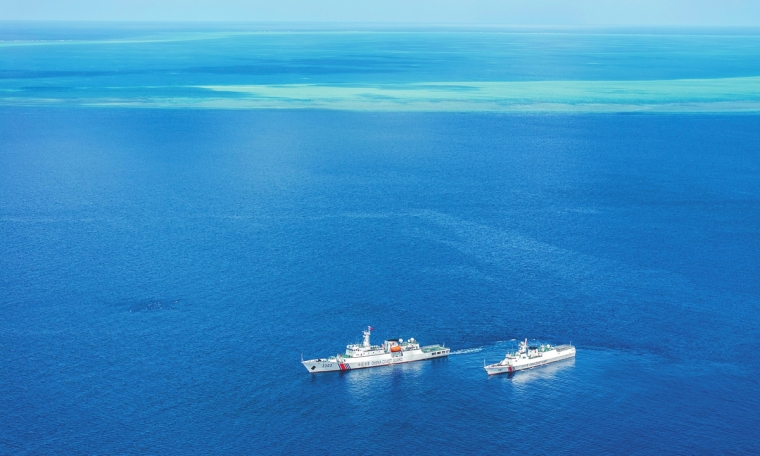
China Coast Guard vessels patrol the waters near China's Huangyan Dao in the South China Sea on July 8, 2026 (drone photo). Photo: Xinhua
Against the backdrop of 10 years since the issuance of the so-called "South China Sea Arbitration Award," a political farce cloaked in "legal" pretense that undermines peace and stability in the region, Chinese think tanks hosted the Roundtable Dialogue on South China Sea Security in Hong Kong Special Administrative Region on Monday and released a report titled "A New Critique of the South China Sea Arbitration Award," exposing and refuting the fallacies and harms of the "arbitration award."
Legal professionals and scholars from various countries and regions attended the event on Monday. The event was co-hosted by the Huayang Center for Maritime Cooperation and Ocean Governance and the National Institute for South China Sea Studies (NISCSS).
The newly issued report further lays bare grave flaws of the so-called "South China Sea arbitration award" in multiple aspects, including legal interpretation and application, factual findings and evidence admission. It helps relevant regional and non-regional countries clearly see the true nature and hazards of the award.
Meanwhile, it demonstrates that China's position of rejecting all claims and actions predicated on the award is a just and legitimate move to uphold its own rights and claims in the South China Sea, safeguard peace and stability, and uphold the international rule of law.
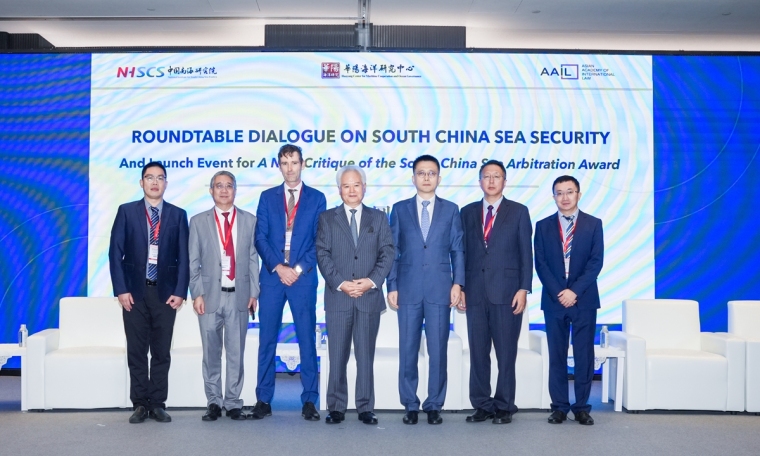
Guests pose for photos at the Roundtable Dialogue on South China Sea Security held in Hong Kong Special Administrative Region on July 13, 2026. Photo: courtesy of the Huayang Center for Maritime Cooperation and Ocean Governance
Examining legal loopholes
Global Times reporters obtained the report from organizers on Monday. The 96-page English version delivers a comprehensive legal reassessment of the 2016 illegitimate "arbitration." Based on a decade of state practice, international jurisprudence and global academic research, the report verifies that doubts and criticisms over the award far outweigh the superficial recognition given to it by a handful of states.
The report first addresses the procedural flaws of the tribunal: the proceeding violated the core international law principle of state consent, ignored China's reliance on the optional exceptions to jurisdiction under Article 298 of UNCLOS, and overstepped its jurisdiction to judge territorial sovereignty over maritime features, rendering the "award" void ab initio.
Substantively, the report refutes the tribunal's distorted interpretation of Article 121 of UNCLOS and historic rights, citing extensive global state evidence.
Countries including the US, Japan, France and Australia publicly back the award yet maintain maritime claims over tiny insular features that contradict the tribunal's standards, revealing that their statements are driven solely by geopolitical gains, and that the award merely serves as a pretext for external powers to meddle in the South China Sea, the report notes.
The report cites international judicial precedents as further proof: the International Court of Justice (ICJ) and International Tribunal for the Law of the Sea (ITLOS) deliberately shun references to the "award" in multiple maritime delimitation cases, while leading international law scholars and former tribunal judges have widely criticized the tribunal's flawed reasoning, proving the "arbitration award" carries no universal jurisprudential weight.
The report concludes that states - including several that have publicly supported the 2016 award and urged its acceptance by China - have largely ignored the key legal findings of the SCS Tribunal in their own practices regarding small island features and historic claims.
Chen Xiangmiao, a research fellow at the NISCSS, told the Global Times that the report was co-compiled with British law firm Fietta LLP. Adopting an impartial third-party professional perspective, it systematically dissects the award's legal loopholes from both statutory and technical practical angles.
According to Chen, all participating scholars reached the consensus that the 2016 arbitration made fundamental misinterpretations of UNCLOS Article 121 governing maritime entitlements of maritime features and misjudged their legal status.
Ding Duo, director of the Research Center for International and Regional Issues at the NISCSS, told the Global Times on Monday that this report aims to eliminate the toxic fallout of the arbitral award from an academic perspective.
The report seeks to expose the grave fallacies and defects of the "award" across multiple dimensions, including the interpretation and application of law, factual findings and evidence admission. It also aims to enable relevant regional and non-regional countries to clearly see the true nature and hazards of the "arbitration award," said Ding, who attended Monday's event.
Looking back on the South China Sea situation over the decade since the award was issued, it has acted as a troublemaker undermining peace and stability in the region, a disrupter straining bilateral ties between China and relevant states, and a stumbling block hindering the full and effective implementation of the Declaration on the Conduct of Parties in the South China Sea as well as the orderly advancement of negotiations on the Code of Conduct in the South China Sea, Ding said.
Resolute counterattack
Against the provocations made by the Philippines and some non-regional countries a decade on from the "arbitration award" farce, China has adopted firm countermeasures in diplomacy, maritime rights safeguarding and legal spheres.
Ahead of the latest think tanks' report, the Chinese Foreign Ministry issued a statement on Sunday regarding a joint statement from 14 countries that hyped the "arbitration award." The ministry expressed firm objection to the "arbitration award," criticizing it for violating fundamental principles of international law and failing to resolve maritime issues between China and the Philippines, instead exacerbating tensions in the region.
China's Embassy in the UK, the Chinese Mission to the European Union, and the Department of Asian Affairs of the Foreign Ministry also refuted and condemned relevant remarks on the "arbitration" made by the US, EU, Japan, the Philippines and other parties on Sunday.
Notably, among the 14 countries that signed the joint statement, the Philippines is the sole ASEAN member state, and the Philippines and Japan are the only two Asian signatories. Experts point out that their backing of the so-called award stems not from respect for international law, but political manipulation.
The Chinese Embassy in Japan has lodged a solemn protest and expressed strong opposition over the Japanese Foreign Minister's remarks marking the 10th anniversary of the so-called "South China Sea arbitration award" and Japan's joint statement with other countries on the matter, according to a post published by the embassy's official WeChat account on Monday.
While the Philippines and certain other parties keep hyping the arbitration farce, the overwhelming majority of ASEAN members prioritize their bilateral ties with China and regional stability, said Chen.
"A decade on, a growing number of nations have recognized the damage wrought by the illegitimate 'arbitration award' on regional stability. Instead of resolving maritime disputes, it has only fueled heightened tensions across the region," said the expert.
In an article published in People's Daily on Sunday, Jing Quan, China's ambassador to the Philippines, said clearing the arbitration's "lingering toxic legacy" was a matter of utmost urgency.
He said the "arbitration" is thoroughly illegal from the start, and serves as a "toxic thorn" wedged between China and the Philippines that offers external forces a pretext to interfere in regional affairs.
According to Chen, China has recently rolled out a series of diplomatic statements and research reports that expose the award's legal loopholes and adverse regional impacts, sending a clear and resolute signal. While certain forces keep fabricating and hyping the false narrative that China is violating international law, China's determination and concrete measures to safeguard its lawful maritime rights and interests will never falter.
"The Philippines will most likely continue its provocative moves. Nevertheless, the international community has generally seen through the numerous defects of the illegitimate arbitration award. In the long run, it will only be further ignored and discarded by the international community," Chen said.
Relevant parties should engage in consultations and exchanges within multilateral frameworks to forge consensus and set up maritime crisis control mechanisms, so as to defuse regional tensions, rather than take the unlawful award as a basis for settling maritime disputes, the expert noted.
On Monday, the Chinese Foreign Ministry released a video titled "What the South China Sea Waves Tell Us", in which it states: "China has the confidence and determination to work with relevant parties to overcome distractions, bridge differences, guard the blue waters, and coexist in harmony."
(Source: Global Times)