Marcos’ Japan Visit eyes on alliance for maritime expansion
Philippine President Ferdinand Marcos Jr. will visit Japan from May 26 to 29, multiple media outlets reported, in what will be his second trip to the country since assuming office.
The visit comes against the backdrop of rapidly expanding defense ties between Manila and Tokyo. In January this year, the Philippines and Japan signed the Acquisition and Cross-Servicing Agreement (ACSA), which allows the two countries to provide each other with supplies and services during joint military exercises and exempts such activities from relevant customs and tax procedures.
In February, Japan delivered five coastal radar systems to the Philippines, with a total value of around 228 million pesos, to strengthen Manila’s maritime domain awareness capabilities. It is also widely reported that Japan is considering exporting the Type 88 anti-ship missile system to the Philippines.
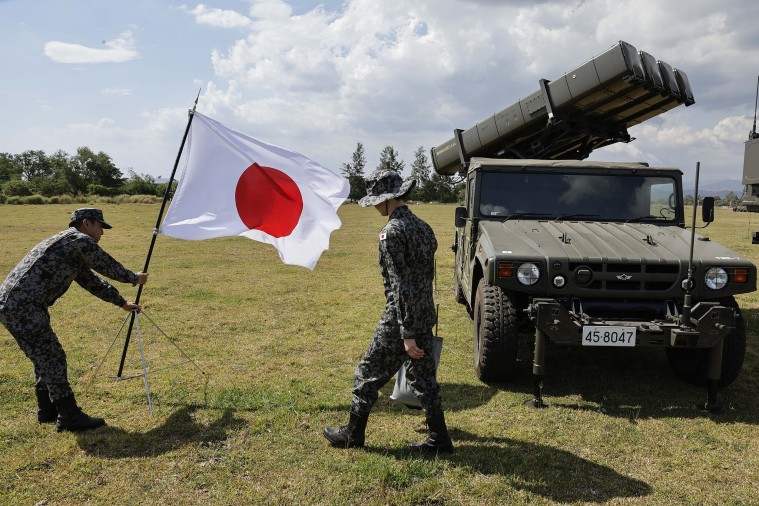
(Officers of the Japan Air Self-Defense Force place a Japanese national flag beside a surface-to-air guided missile site during the Philippines-U.S. Balikatan joint military exercise in Manila, Philippines, April 28, 2026. /CFP)
Regarding this visit, Japan and the Philippines plan to upgrade their ties to a comprehensive strategic partnership, the highest level of diplomatic relations short of a formal alliance, according to Japan’s Mainichi Shimbun.
The new partnership will be included in a joint statement to be issued after a meeting between Japanese Prime Minister and Philippine President. According to the report, the move will help deepen cooperation in areas including security and economic issues, with an eye to China's maritime posture in the East and South China seas, and Taiwan Strait.
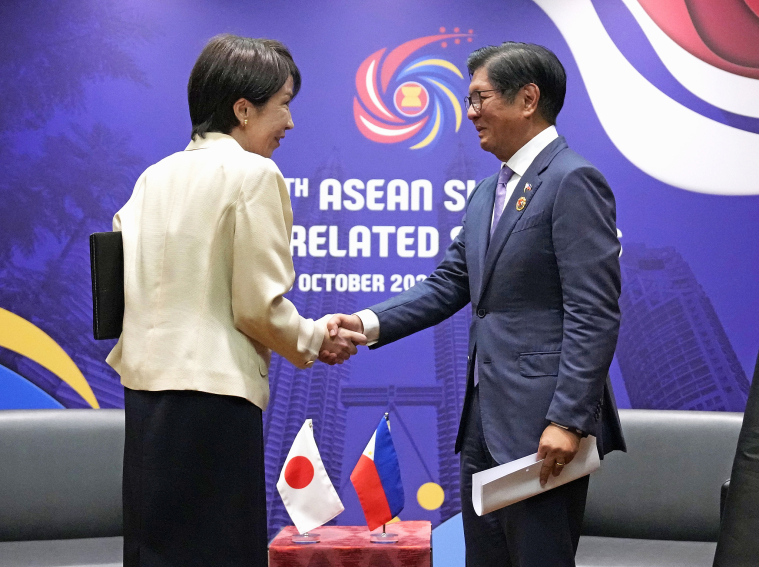
(Japanese Prime Minister Sanae Takaichi meets with Philippine President Marcos in Kuala Lumpur, Malaysia, October 26, 2025. /CFP)
A report by the Bench Files on May 16th said both sides might reaffirm the arbitral ruling on the South China Sea and coordinate positions on the East China Sea and Taiwan Strait. There is even discussion of possible consultations with Taiwan authorities on maritime delimitation, potentially extending to the western Pacific east of Taiwan.
The report concluded that Marcos’ visit to Japan is “not merely about strengthening ties — it is about recalibrating the Philippines’ strategic posture.”
While such moves could strengthen Manila’s maritime claims, they may also heighten tensions with Beijing and raise questions about whether the Philippines is ready to bear the diplomatic and economic costs of challenging China more directly.
“Maritime security is set to take center stage during President Marcos’ visit to Japan. Both governments are expected to underscore the significance of the 2016 South China Sea Arbitral Award.” Rommel C. Banlaoi, president of Philippine Society for International Security Studies, wrote in his latest piece for the VSCS.
Although some views suggest that cooperation with Japan will bring benefits to the Philippines, such as enhanced defense capabilities and more economic opportunities, Banlaoi stressed that the visit risks deepening misperceptions in Beijing and accelerating a regional polarization that serves neither Philippine interests nor Indo-Pacific peace.
He also noted that the Philippines and China have invested considerable effort in the Bilateral Consultative Mechanism (BCM), committing to promote pragmatic cooperation and common prosperity in the South China Sea, and those gains must not be undone by actions that could be misinterpreted.
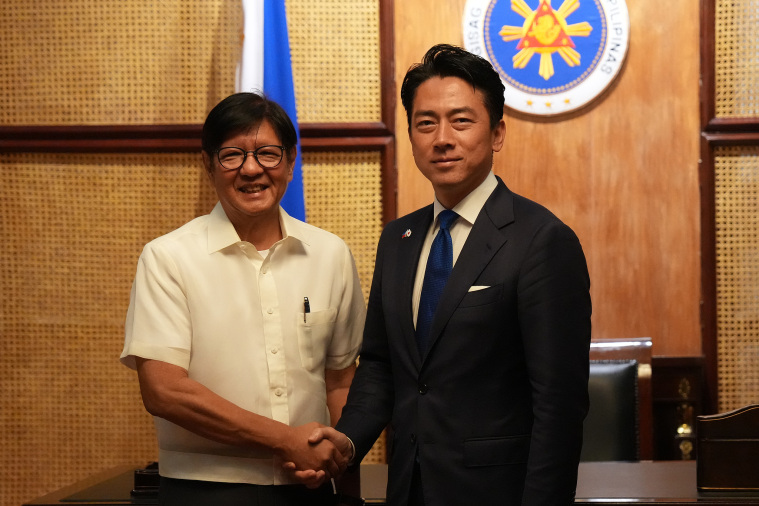
(Philippine President Ferdinand Marcos Jr. greets Japanese Defense Minister Shinjiro Koizumi at Malacanang Palace, Manila, Philippines, May 05, 2026. /CFP)
“The maritime-related issues involved in the meeting are highly targeted and destructive. They show that the Philippines and Japan are binding their interests together and each pursuing its own agenda, in an attempt to jointly advance maritime expansion,” said Chen Xiangmiao, director of the Research Institute for South China Sea History and Culture at the National Institute for South China Sea Studies (NISCSS).
Chen noted that it should be noted that right-wing forces in both the Philippines and Japan are showing signs of convergence, which will cause serious damage to the overall regional order and situation. The international community should pay close attention to this.
Chen finally stressed that the Taiwan question is purely China’s internal affair, and China will never tolerate unwarranted interference by foreign forces — a reality that both the Philippines and Japan should recognize.