Authoritative Analysis | Why the Philippines' So-Called South China Sea "Territorial Claims" Are Destined to Remain an Illusion
On July 8, the China Institute for Marine Affairs under China's Ministry of Natural Resources released the report Historical and Legal Critique of the Philippines' Territorial Claims in the South China Sea (hereinafter referred to as "the Report"). The Report reviews the historical evolution of the Philippines' territorial limits and analyzes its intentions and successive attempts to expand its territorial claims. It concludes that the Philippines' attempt to extend its territorial limits beyond those defined by a series of legally binding international treaties to encompass Huangyan Dao and certain islands and reefs of the Nansha Qundao lacks any basis in historical fact, clearly contravenes the rules of international law governing the acquisition of territory, and has no historical and legal foundation.
How were the Philippines' territorial limits historically defined? Do the various "grounds" invoked by the Philippines to support its territorial claims in the South China Sea comply with the rules of international law? What impact would the Philippines' unlawful actions have on the post-World War II international order and the existing international legal system? To address these questions, the Voice of the South China Sea (VSCS) spoke with Luo Huanxin, associate research fellow at the Institute of International Law of the Chinese Academy of Social Sciences; Chen Xidi, one of the drafters of the Report and assistant research fellow at the China Institute for Marine Affairs under China's Ministry of Natural Resources; and Peter T. C. Chang, former deputy director of the Institute of China Studies at the University of Malaya.
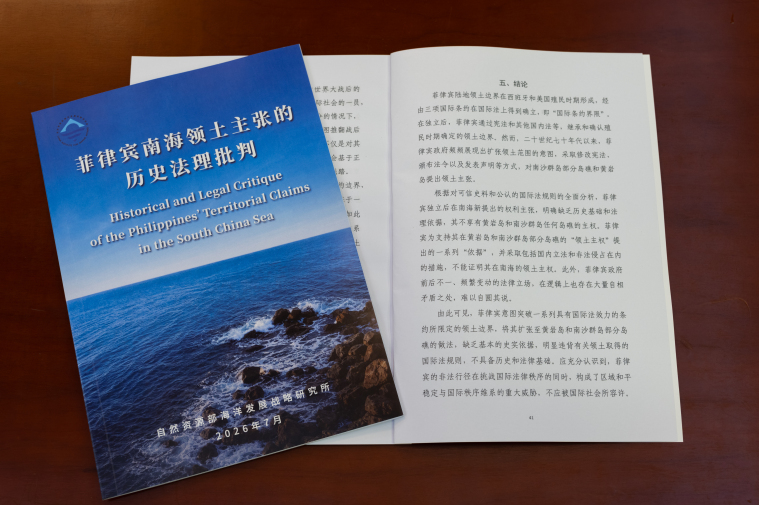
(The report Historical and Legal Critique of the Philippines' Territorial Claims in the South China Sea was released on July 8. /Photo by Shen Shi)
VSCS: The Report concludes that the territorial claims put forward by the Philippines in the South China Sea after its independence clearly lack any historical or legal basis, and that the Philippines has no sovereignty over any island or reef of the Nansha Qundao or over Huangyan Dao. What are the main grounds for this conclusion?
Chen Xidi: The Philippines has repeatedly stirred up tensions in the South China Sea while spreading distorted historical and legal narratives on diplomatic occasions. The international community urgently needs an authoritative assessment, grounded in credible historical evidence and international law to set the record straight. The Report draws on three categories of evidence. First, historical evidence, including the texts of the three international treaties that define the territorial limits of the Philippines, archives of the U.S.-Spain negotiations, and a large number of official maps, diplomatic correspondence, and government gazettes published by the Philippines and the United States during the colonial period and after Philippine independence. Second, legal evidence, including the rules of international law governing the acquisition of territory, international instruments such as the United Nations Charter, the United Nations Convention on the Law of the Sea, and the Vienna Convention on the Law of Treaties, as well as jurisprudence such as the Island of Palmas Case and Territorial and Maritime Dispute (Nicaragua v. Colombia). Third, the Philippines' own official acts and statements, including constitutional provisions, legal documents, official maps and diplomatic statements. These materials, in fact, constitute compelling counter-evidence to the Philippines' current claims.
VSCS: From a historical perspective, how were the Philippines' territorial boundaries defined?
Luo Huanxin: The Philippines' territorial limits were established during the Spanish and American colonial periods and defined by a series of international treaties. These treaty-defined limits are commonly known as the “Philippine Treaty Limits” and are also referred to in Philippine legal and cartographic discourse as the “International Treaty Limits”. The relevant treaties include the 1898 Treaty of Paris, formally the Treaty of Peace Between the United States and Spain; the 1900 Treaty of Washington, formally the Treaty between the United States and Spain for the Cession to the United States of any and all islands of the Philippine Archipelago lying outside the lines described in Article III of the Treaty of Peace of December 10, 1898; and the 1930 Convention between the United States and Great Britain regarding the boundary between the Philippine Archipelago and the State of North Borneo. In 1935, the Constitution of the Commonwealth of the Philippines defined its "national territory" by reference to those treaty-based limits. The 1898 Treaty of Paris expressly defined the north-central territories ceded by Spain as lying between 118°E to 127°E longitude. Judged by those treaty-defined coordinates, both Huangyan Dao and the Nansha Qundao lie entirely outside the Philippines' legally defined territorial limits. In the decades that followed, Philippine-U.S. bilateral treaties and Philippine domestic legislation repeatedly reaffirmed the territorial definition set out in the 1935 Constitution.
VSCS: In recent years, the Philippines has invoked "geographical proximity" as one of its principal justifications in asserting so-called "sovereignty" over certain islands and reefs of the Nansha Qundao and Huangyan Dao, seeking to mislead public opinion. In international legal practice, can "geographical proximity" serve as a basis for territorial claims? By repeatedly hyping the so-called "principle of proximity" in disregard of international law, what impact have the Philippines' actions had on the international rule of law and international order?
Chen Xidi: "Geographical proximity" cannot serve as a legal basis for territorial claims. This is a settled principle of international law. International judicial precedents have made it clear that there is no rule of international law under which a state may claim territorial sovereignty over islands or reefs merely on the basis of geographical proximity. By repeatedly hyping the so-called "principle of proximity" in disregard of the rules of international law, the Philippines is seriously undermining the international rule of law. If the notion that "proximity determines sovereignty" were generally accepted, the certainty of territorial boundaries would disappear, and the fundamental principle that territorial integrity shall be inviolable in international relations would be reduced to an empty slogan. For the public, the Philippines' hype is intended to create the false perception that "geography equals entitlement," thereby misleading the international community's understanding of issues of territorial sovereignty.
VSCS: The Report notes that the Philippines has sought to advance a territorial claim over Huangyan Dao by invoking such purported grounds as "discovery and occupation" and so-called "effective control," while citing the ancient Murillo Map and a series of pieces of other purported evidence. From historical and legal perspectives, how should these "grounds" and "evidence" be assessed?
Luo Huanxin: To support its unlawful claim, the Philippines has strained to invoke the doctrine of "occupation" and such purported evidence as ancient maps. The so-called "evidence" put forward by the Philippines lacks both official status and factual accuracy, and even contains information that runs counter to its own claim. The "Panacot" shown on the Murillo Map is not present-day Huangyan Dao, but rather a depiction of coastal features near Luzon Island. Moreover, an annotation in the center of the map states that the northern area from Zamboanga to Caraga belonged to Spain. This indicates that southern Mindanao, the Sulu Archipelago and other areas shown on the map had not yet come under Spanish sovereignty at the time, still less Huangyan Dao, which lies far away in the South China Sea. It is therefore untenable, both historically and logically, for the Philippines to rely on such maps to justify an expansion of its territorial claims. Moreover, both official U.S.-published maps of the Philippine Islands and official maps published by the Philippines itself for decades after independence consistently placed Huangyan Dao outside Philippine territory.
Huangyan Dao is China's inherent territory and has never been terra nullius. China was the first to discover and name Huangyan Dao, incorporate it into its territory, exercise sovereign jurisdiction over it, and carry out long-term development and use. The relevant historical records date back to ancient times and have continued without interruption. In the context of clearly established sovereignty, the Philippines' so-called "effective control" has no room for application.
VSCS: In recent years, we have seen the Philippines attempt to entrench the illegal award rendered in the so-called "South China Sea Arbitration" through domestic legislation such as the so-called "Philippine Maritime Zones Act." What does this attempt to use domestic law to challenge international law reveal about the Philippines strategy and intentions?
Peter T. C. Chang: First, the Philippine government seeks to incorporate the illegal award rendered in the so-called "South China Sea Arbitration" into its domestic legal system. Through the so-called "Philippine Maritime Zones Act" and related legal instruments, it attempts to give domestic legal effect to its unlawful claims over Huangyan Dao and certain maritime features of the Nansha Qundao, and to package the "South China Sea Arbitration " award as a legal basis for advancing those unlawful claims. Second, the Philippines has packaged these "new laws" as products consistent with the United Nations Convention on the Law of the Sea, in an attempt to bolster the international legitimacy of its position. This so-called "rules-based" narrative has received support from the United States and its allies. The relevant legislation reflects the Philippines' broader strategic alignment with the United States, with the aim of counterbalancing China's influence in the region. This approach risks internationalizing the dispute and drawing the Philippines deeper into great-power rivalry, thereby creating hidden dangers for regional peace and stability.
VSCS: In recent years, the Philippines has continued to take a series of provocative actions in the South China Sea. What impact will these actions have on peace and stability in the South China Sea region?
Peter T. C. Chang: The Philippines has continued to make unlawful claims over Huangyan Dao and certain maritime features of China's Nansha Qundao. It has also repeatedly distorted historical facts, misapplied international law, and taken provocative actions. These actions have not facilitated dialogue; instead, they have eroded mutual trust, contravened the spirit of the Declaration on the Conduct of Parties in the South China Sea, and made it more difficult to advance consultations on a substantive Code of Conduct in the South China Sea. The negative impact is not limited to the political level. It also continues to affect fisheries, shipping, energy development, tourism, investment, and other fields, impeding regional economic cooperation and ultimately harming the livelihoods and well-being of people across the region.
Luo Huanxin: A series of moves by the Philippines have continued to mislead international public opinion. By seeking to expand and internationalize its pursuit of self-interest, the Philippines has seriously threatened peace and stability in the South China Sea region. It has become a destabilizing factor affecting the economic and social development of neighboring countries. It has also challenged the post-World War II international order and constitutes contempt for and violation of international law based on the United Nations Charter.