Authoritative Analysis | Why Is the So-Called "South China Sea Arbitration" a Political Manipulation?
On July 16, the report "Legal Critique of the South China Sea Arbitration Awards—‘The South China Sea Arbitration Awards Are Not International Law'" (hereinafter referred to as "the Report") was released. Jointly prepared by scholars of the international law of the sea from the National Institute for South China Sea Studies, Jinan University, Ocean University of China, and Shanghai Maritime University. The Report analyzes the tribunal's abuse of jurisdictional, defects in its award on the merits, and the invalidity of the award. It systematically examines the international law issues arising from the so-called "South China Sea Arbitration" and seeks to clarify several misconceptions about the case within the international community. The Report concludes that the tailor-made "Arbitral Tribunal" became a geopolitical tool of extra-regional powers such as the United States and Japan, and that its "Award" was, in essence, political manipulation carried out under the guise of law. How did the "South China Sea Arbitration Award" distort international law? Why is the "Award" said to be nothing more than an unlawful and invalid piece of paper riddled with fundamental errors? To explore these questions, Voice of the South China Sea (VSCS) of China Media Group interviewed Xu Qi, head of the Report's research team and deputy dean of the Institute of Foreign-Related Rule of Law at Jinan University; Zhang Qiyue, assistant director of the Institute for Global Governance Studies at the Shanghai Institutes for International Studies; and Sourabh Gupta, a member of the United States Council for Security Cooperation in the Asia-Pacific (USCSCAP) and senior fellow at the Institute for China-America Studies (ICAS).
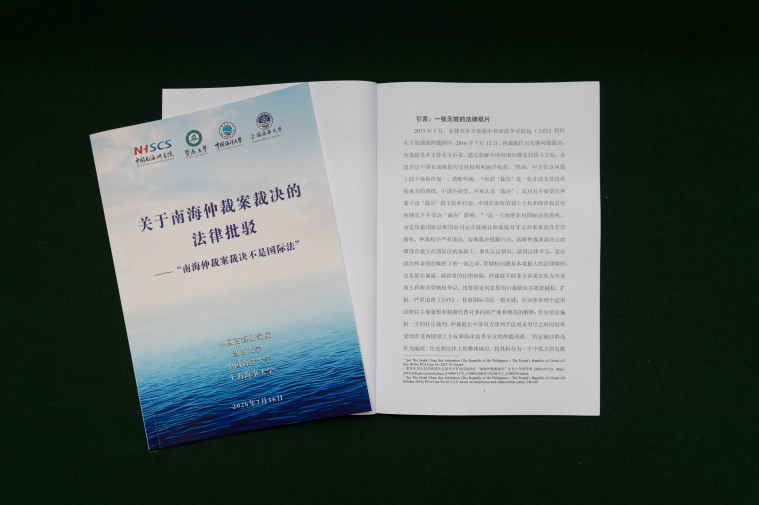
The report "Legal Critique of the South China Sea Arbitration Awards—‘The South China Sea Arbitration Awards Are Not International Law'" was released on July 16. Photo by Shen Shi
VSCS: Why does the Report place particular emphasis on dissecting and rebutting the "Arbitral Tribunal"?
Xu Qi: The "Arbitral Tribunal" lies at the heart of the invalidity of the "Award." Unless its illegality is first exposed, the "Award" cannot be fundamentally discredited. China's refusal to recognize the "Award" is not intended to evade the merits of the dispute. Rather, China rejects the "Arbitral Tribunal's" assertion of jurisdiction from the outset. Without examining the matter, the "Arbitral Tribunal" accepted the Philippines' assertion that the dispute did not concern territorial sovereignty or maritime delimitation, and proceeded to bring disputes beyond its jurisdiction within its purview. As a result, the arbitration lacked a valid jurisdictional basis from the very beginning. Such arbitration, conducted beyond the limits of international law, has no legitimacy. An unlawfully constituted "Arbitral Tribunal" has no authority to pronounce on China's rights.
VSCS: The Report notes that China had lawfully excluded certain categories of disputes from compulsory procedures pursuant to the United Nations Convention on the Law of the Sea (UNCLOS), and that China and the Philippines had agreed to settle their disputes through bilateral consultation. The so-called "South China Sea Arbitration" therefore did not satisfy the jurisdictional prerequisites for arbitration. Why did the "Arbitral Tribunal" nevertheless proceed with the case at the unilateral request of one party, and by what means did it circumvent these restrictions to hear the case?
Zhang Qiyue: The "Arbitral Tribunal" mainly resorted to two unlawful means to bypass procedural constraints. First, it deliberately distorted the dispute settlement mechanism in Part XV of UNCLOS. It disregarded China's lawful 2006 declaration under Article 298 of UNCLOS excluding certain categories of disputes from compulsory procedures, and repackaged the essence of the China-Philippines disputes in the South China Sea, namely disputes over territorial sovereignty over islands and reefs and maritime delimitation, as purported "disputes concerning the interpretation and application of UNCLOS," thereby asserting compulsory jurisdiction. Second, it disregarded the consensus already reached among the States concerned to settle South China Sea disputes through negotiation and consultation. At the multilateral level, Article 4 of the 2002 Declaration on the Conduct of Parties in the South China Sea (DOC), adopted by China and ASEAN countries, explicitly provides that "the Parties concerned undertake to resolve their territorial and jurisdictional disputes by peaceful means, through friendly consultations and negotiations by sovereign states directly concerned, in accordance with universally recognized principles of international law, including the 1982 UN Convention on the Law of the Sea." At the bilateral level, China and the Philippines committed in bilateral documents, including the Joint Statement between the People's Republic of China and the Republic of the Philippines concerning Consultations on the South China Sea and on Other Areas of Cooperation and the Joint Statement of the China-Philippines Experts' Group Meeting on Confidence-Building Measures, to "resolve disputes through friendly consultations and negotiations." These documents have binding force and constitute dispute settlement arrangements under Article 281 of UNCLOS, which allows States Parties to agree to seek settlement of disputes through peaceful means of their own choice. The "Arbitral Tribunal's" ultra vires conduct was therefore a blatant violation of the principle of State consent.
VSCS: How was the "Arbitral Tribunal" constituted at the time? Why is this "tailor-made" arbitral panel considered to have lost all credibility?
Xu Qi: Political manipulation was evident throughout the "Arbitral Tribunal," from its composition to its operation. It therefore had no legal basis for rendering an impartial award. First, the selection of arbitrators was single-handedly arranged by Shunji Yanai, then president of the International Tribunal for the Law of the Sea. Yanai had long served as chairman of the Japanese Advisory Panel on the Reconstruction of the Legal Basis for Security under the Abe administration. His political background had an evident connection of interests with the case, violating the fundamental requirement of arbitrator independence under Annex VII of UNCLOS. Second, four of the five arbitrators on the "Arbitral Tribunal" were from Europe, while the remaining arbitrator had lived in Europe for many years. No one was from an Asian country. This serious imbalance in regional representation made it difficult for the panel to objectively appreciate the South China Sea's complex history and geopolitical realities. Third, the Philippines unilaterally initiated the "arbitration" and bore all costs. Since the Tribunal's operating funds came directly from one party to the dispute, such financial dependence raised serious doubts about its ability to remain neutral. Some arbitrators abandoned independent judgment throughout the proceedings, and their arbitral opinions catered to the instructions and demands of the political forces behind them. This "tailor-made" arbitral panel completely forfeited its credibility from its very establishment through the issuance of the jurisdictional award. How can an "Arbitral Tribunal" selected by parties with vested interests, funded by one side, and severely lacking in regional representation have any credibility? China therefore naturally cannot accept or recognize such an "award."
Sourabh Gupta: The Tribunal's credibility would have been significantly enhanced had its membership been more representative, for example, through the inclusion of arbitrators from the Asia-Pacific region. Four of the five arbitrators came from Europe. Having them decide a legal dispute between two Asian countries was itself an inappropriate political arrangement. The funding arrangement was also unusual, as the Philippines unilaterally bore all the costs, contrary to established international arbitration practice.
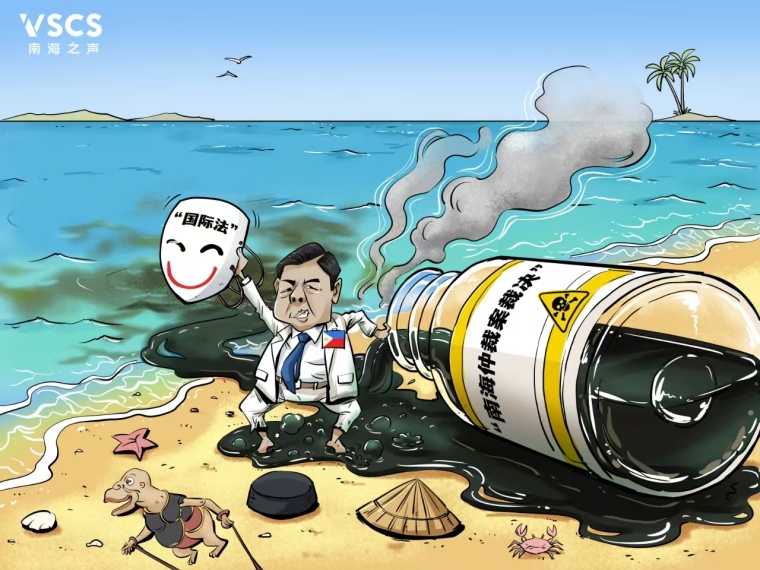
South China Sea Cartoon Commentary: The Toxic Legacy of "Philippine Lawlessness"
VSCS: During the proceedings, what glaring errors did the "Arbitral Tribunal" make at key stages that undermined the professionalism of the proceedings and ultimately destroyed its credibility?
Zhang Qiyue: At the jurisdictional stage, the "Arbitral Tribunal" disregarded the fact that the Philippines' submissions were, in substance, disputes over territorial sovereignty over islands and reefs and maritime delimitation between China and the Philippines. It also ignored China's lawful declaration under Article 298 of UNCLOS excluding certain categories of disputes from compulsory procedures. By wrongly concluding that it had jurisdiction over the Philippines' submissions, it thereby engaged in ultra vires adjudication. At the merits stage, the "Arbitral Tribunal" committed a series of manifest errors in its application of the law, its findings of fact, and its assessment of the evidence. In applying the law, it deliberately distorted the text of UNCLOS by construing the word "or" in Article 121, paragraph 3, namely "human habitation or economic life of their own," as "and," requiring an island to meet both conditions simultaneously while imposing more stringent standards for each. This was contrary to the rules of treaty interpretation set out in Article 31 of the Vienna Convention on the Law of Treaties. In its findings of facts, the "Arbitral Tribunal" disregarded the historical and geographical integrity of Nansha Qundao, treating it as a collection of individual islands and reefs and denying their maritime entitlements one by one. This was inconsistent with multiple judicial precedents of the International Court of Justice and also amounted to a denial of China's historic rights. In its assessment of the evidence, the "Arbitral Tribunal" violated the principle that the party asserting a claim bears the burden of proof. It even took it upon itself to gather evidence for the Philippines from archives in third countries, including the United Kingdom and France, while disregarding China's extensive historical documentation, in violation of the principle of judicial neutrality. These systematic errors permeate the "Award" and demonstrate that the "Arbitral Tribunal" had completely abandoned professional standards.
Sourabh Gupta: The "Arbitral Tribunal" should have proactively refrained from addressing some of the sovereignty-sensitive issues raised by the Philippines, and it had ample room to do so. Instead, it deliberately misinterpreted core provisions of UNCLOS and forcibly expanded its jurisdiction to cover sovereignty-related issues. All indications suggest that the arbitrators had predetermined their final conclusion at the very outset of the proceedings. What followed was merely backward reasoning, assembling arguments to support the predetermined outcome of the "award."
VSCS: The Report notes that more than a decade has passed since the issuance of the "South China Sea Arbitration Award," yet the Philippines has gained no substantive benefits, while the situation in the South China Sea has instead become increasingly complex. Over the past decade, what lasting negative impacts and deep-seated security risks has this illegal "Award" posed to the region?
Xu Qi: The "South China Sea Arbitration Award" is illegal, null and void, and without binding force. China's position of neither accepting nor recognizing it has remained consistent and unwavering. The passage of time cannot confer legitimacy on an illegal "Award." The "Award" contains serious errors in jurisdiction, legal interpretation and application, and factual findings. The "Arbitral Tribunal" exceeded its jurisdiction and wrongly interpreted and applied UNCLOS. Its purported "Award" was invalid from the outset. This illegal "Award" has continued to be used by certain extra-regional countries as a political tool, providing a purported "legal basis" for their military intervention and "Freedom of Navigation Operations" in the South China Sea. It has heightened regional tensions and undermined efforts by China and ASEAN countries to jointly safeguard peace and stability in the South China Sea. The "Award" has also interfered with the implementation of the DOC and run counter to the "dual-track approach" to resolving South China Sea disputes, under which disputes are to be resolved through negotiation and consultation among directly concerned parties, while China and ASEAN countries jointly safeguard peace and stability in the South China Sea. It has caused substantive harm to regional cooperation. China's refusal to accept or recognize the "Award" is precisely a justified action to uphold the authority and integrity of UNCLOS. It is the Philippines' unilateral initiation of arbitration and the "Arbitral Tribunal's" ultra vires proceedings that truly disregard the spirit of UNCLOS and amount to political manipulation.
Zhang Qiyue: Over the past decade, every invocation of the illegal "Award" has seriously undermined peace and stability in the South China Sea. Before and after the "Award" was issued, the U.S. Department of State released a series of Limits in the Seas reports that systematically challenged China's straight baselines around Xisha Qundao (Report No. 117), China's historic rights within the dashed line (Report No. 143), and China's archipelagic baselines system (Report No. 150). These reports provided legal support and strategic guidance for the Philippines and other South China Sea claimants. During the arbitration, the United States privately funded expert witnesses involved in the proceedings. After the "Award" was issued, it relied on the "Award" to justify its "Freedom of Navigation Operations" and military activities in the South China Sea. Although the United States is not a party to UNCLOS, it presents itself as a defender of the Convention while accusing China of failing to comply with the "Award" and the international rule of law. The facts fully demonstrate that lasting peace and stability in the South China Sea can be achieved only by completely discarding this illegal "Award" and returning to the right track of advancing negotiations on the Code of Conduct in the South China Sea while resolving disputes through dialogue and consultation.