Footage Captures Philippine Crew Dumping Waste at Ren’ai Jiao, Chinese Expert Warns of Severe Ecological Damage
Shortly after Philippine authorities falsely accused Chinese fishermen of using “cyanide” at Ren’ai Jiao last week — an allegation later dismissed by Chinese sources — new footage released Wednesday by the China Coast Guard captures yellow smoke billowing from the BRP Sierra Madre, the Philippine warship illegally grounded on the reef.
Personnel aboard the vessel are seen burning garbage and dumping waste into the ocean, a practice they have repeatedly engaged in. Experts warned such acts pose a grave threat to the surrounding marine ecosystem.
According to the Global Times, reporters observed that the footage shows Philippine personnel disposing of waste through both burning and dumping. The yellow smoke produced during the burning process suggests the materials may contain toxic substances and are undergoing incomplete combustion. The smoke, drifting over the reef, is likely to cause long-term environmental damage. Meanwhile, personnel were seen dumping black powder-like solid substances directly onto the reef flat, which could inflict irreversible harm on coral reefs and marine life.
Comparing the footage with previously released Chinese evidence, reporters noticed that personnel from the illegally grounded Philippine vessel gathered on the forward deck to conduct garbage burning—an act reappeared more than one year after such overt activity occurred, said the Global Times.
A source revealed that the China Coast Guard has launched routine rights-protection patrols in waters around Ren'ai Jiao, using multiple technical means to monitor in real time the Philippine vessel’s ecologically damaging activities. China has repeatedly exposed the Philippines’ waste dumping and burning that harm the reef, and such acts had temporarily subsided under public pressure.
However, with large amounts of accumulated garbage onboard, Philippine personnel have ultimately resorted to burning and dumping to handle daily waste. This highlights the rudimentary nature of waste disposal methods on the illegally grounded vessel and underscores the ongoing, irreconcilable damage to the reef's ecosystem. The rusting vessel has become the largest source of pollution at the reef, and removing it is essential for effective environmental protection.
"This is not the first time such behavior has occurred," Mi Chenxi, a researcher at the China Institute for Marine Affairs of Ministry of Natural Resources, said during an interview with the Global Times. "When the Philippine warship was grounded in 1999, the impact, crushing, cutting, and abrasion caused by the vessel inflicted devastating damage on the coral reef ecosystem in the area. The Chinese government has lodged repeated representations and consistently demanded the removal of the vessel. The Philippine side has repeatedly promised to tow it away, but has yet to fulfill that commitment, instead attempting large-scale repairs and reinforcement."
Mi added that China has adopted multiple measures in managing, enforcing, and protecting Ren'ai Jiao, reflecting humanitarian principles while firmly safeguarding territorial sovereignty and maritime rights. China has also conducted scientific research and released reports, including an investigation into the ecological damage caused by the grounded vessel.
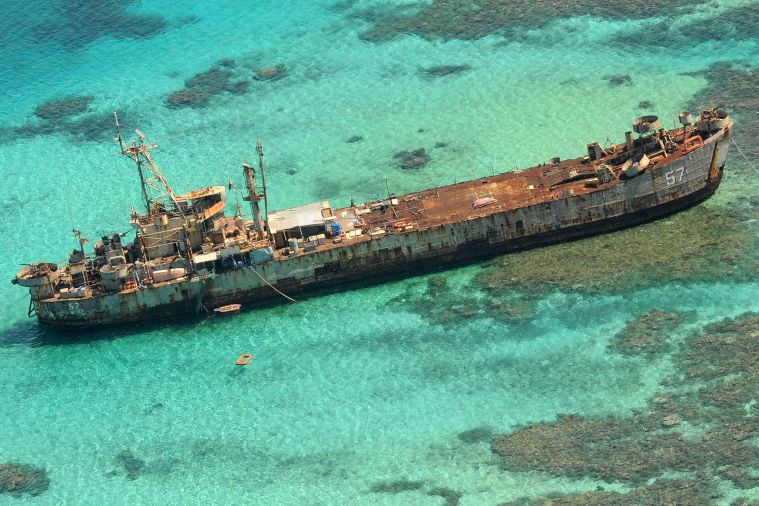
(An aerial view shows the Philippines warship BRP Sierra Madre that has been grounded since 1999 at China's Ren'ai Jiao. /CFP)
The report, named "Investigation Report on the Coral Reef Ecosystem Damage Caused by the Illegally Grounded Vessel at Ren'ai Jiao," released in 2024 by the South China Sea Ecological Center and the South China Sea Development Research Institute under China's Ministry of Natural Resources, revealed satellite remote sensing data from 1999 to 2024 and field surveys conducted between April and June 2024, provides a scientific assessment of the ecological damage.
It found that since the grounding of the Philippine warship BRP Sierra Madre in 1999, the coverage of reef-building corals on the reef flat and lagoon slope has decreased by 38.2 percent compared with 2011 levels, with a decline of up to 87.3 percent within a 400-meter radius of the vessel. Elevated levels of heavy metals such as mercury, copper, and zinc, as well as oil pollutants, were detected in surrounding waters, alongside coral debris, dead corals, and Philippine-origin waste.
According to the report, corrosion of the vessel releasing heavy metals, discharge of domestic sewage, and disposal of fishing-related waste are the primary causes of ecosystem degradation. It recommends that the Philippines remove the grounded vessel to eliminate pollution sources and prevent continued cumulative damage to the coral reef ecosystem.
"Over the past 27 years, coral coverage around the vessel has declined sharply," Mi said. "Corrosion and structural damage to the ship, along with the discharge of waste oil, sewage, and the burning and dumping of garbage, have led to abnormal increases in heavy metals, hydrocarbons, and active phosphates in the waters, inhibiting coral growth and recovery. Pollutants from waste burning directly entering the sea threaten reef-dwelling organisms, disrupt marine food chains, reduce biodiversity, and damage the coral ecosystem."
Dai Fan, vice dean of the School of International Studies at Jinan University, said during an interview with the Global Times that judging from the footage, the actions of personnel aboard the illegally grounded vessel go beyond simple waste disposal and appear "irresponsible and provocative."
"We know the Philippines regularly sends vessels to deliver supplies and also to remove waste. There is no necessity to dispose of garbage in this way," Dai said, adding that such behavior is not only highly damaging to the reef environment but also irrational.
Chinese Foreign Ministry spokesperson Guo Jiakun said at a press briefing on the Aril 13 that the Philippines illegally grounded its vessel on Ren'ai Jiao and has caused great damage to the eco-environment there, which has been confirmed by relevant reports.
"The main culprit behind the ecological damage is the illegally grounded Philippine vessel," Dai added. "Each additional day it remains there worsens the environment and leads to more coral death. The dumping of unidentified black substances and the spread of yellow smoke further exacerbate environmental harm. The Philippines should refrain from repeating such actions and remove the vessel as soon as possible."
(Source: Global Times)