Illusions and Traps: The Philippines' "Japan Card"
Tokyo pulled out all the stops for Philippine President Ferdinand R. Marcos Jr. during his visit in late May. There was an imperial banquet hosted by the Emperor and Empress, the unusual honor of addressing both houses of the National Diet, and a carefully staged joint statement after talks with the Japanese prime minister.
The whole package was designed to put a bright gloss on Japan-Philippines friendship. Yet for Marcos, whose approval ratings have fallen to their lowest point since he took office in 2022, the lavish reception said less about the Philippines' diplomatic clout than about Japan's strategic impatience.
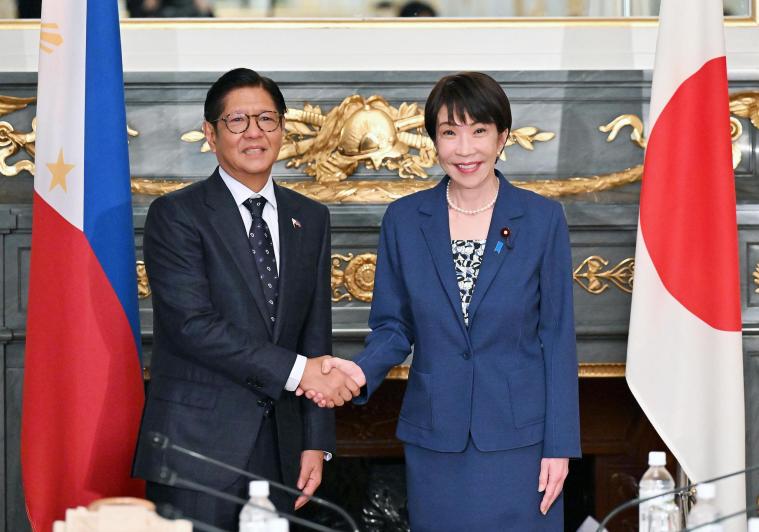
(Japanese Prime Minister Sanae Takaichi and Philippine President Ferdinand Marcos Jr. shake hands before their talks at the State Guest House in Tokyo on May 28, 2026. /CFP)
Some Japanese media outlets were quick to point out that Marcos was among the few foreign leaders in recent years to be received in Japan as a state guest. But as he stood before the Diet and spoke warmly of the two countries moving "from reconciliation to mutual trust," a more uncomfortable question hung in the air: were the Japanese politicians listening below who are eager to turn the Philippines into a "forward outpost" really thinking about friendship, or were they thinking several moves ahead on a geopolitical chessboard?
The visit produced a long list of headline items. The two sides upgraded their relationship to a Comprehensive Strategic Partnership, the highest tier in the Philippines' diplomatic framework. They agreed to begin negotiations on the General Security of Military Information Agreement (GSOMIA), pledged to move faster on discussions over the export of Japan Maritime Self-Defense Force frigates, and announced Japanese investment commitments worth US$3.4 billion. At first sight, Manila seemed to have come away with concrete gains. But a closer look tells a different story. Warships, intelligence sharing, and supply-chain cooperation—almost every item on the agenda is bound up with hard-edged geopolitical calculations. Behind the language of cooperation may lie a strategic trap.
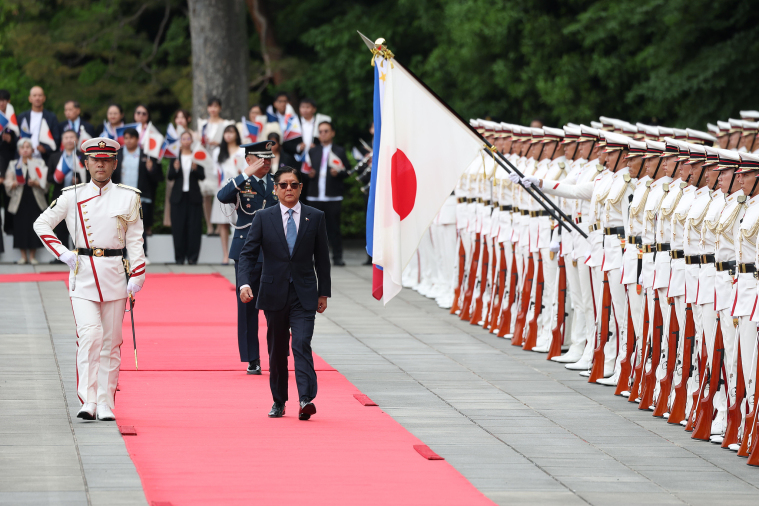
(Philippine President Marcos attends the welcoming ceremony at the Imperial Palace in Tokyo on May 27, 2026. /CFP)
Japan's Agenda: Moving the Philippines Closer to the Front Line
Japan's sudden enthusiasm for the Philippines is not hard to understand. In 2016, the two countries signed the Agreement Concerning the Transfer of Defense Equipment and Technology. In 2022, they launched a "2+2" foreign and defense ministerial dialogue. In 2024, they signed the Japan–Philippines Reciprocal Access Agreement. Now they have launched negotiations on the GSOMIA. Step by step, Japan's security relationship with the Philippines has deepened in parallel with Tokyo's own rightward turn and its widening ambitions in the Asia-Pacific.
This April, Japan revised the Three Principles on Transfer of Defense Equipment and Technology and the accompanying Implementation Guidelines, further loosening restrictions on arms exports and, in principle, opening the door to exports of finished defense equipment, including lethal weapons. Before Marcos's trip, Manila publicly welcomed the move, calling it a new stage in bilateral defense ties. Looking back, the substance of that "new stage" is now unmistakable: under the cover of cooperation with the Philippines, Japan is pushing past the military taboos imposed by its pacifist constitution.
The GSOMIA would give Tokyo and Manila a legal framework for sharing sensitive defense information, institutionalizing intelligence cooperation between the two countries. The Reciprocal Access Agreement has already provided a legal basis for the Japan Self-Defense Forces to enter and use Philippine bases more easily. The Acquisition and Cross-Servicing Agreement helps cover mutual logistical support during exercises and potential contingencies. Put together, these arrangements form a chain: equipment transfers, intelligence sharing, military access and logistical support. The Philippines is not simply buying Japanese weapons; it is taking on Japan's demand for military projection.
During this year's Balikatan ("shoulder-to-shoulder") joint exercises, the number of Japanese Self-Defense Forces personnel surged from 140 observers last year to 1,400 troops. Japan also sent the helicopter destroyer JS Ise and conducted live-fire launches of Type 88 surface-to-ship missiles in northern Luzon, marking the first time since World War II that Japan had projected firepower from foreign soil. Against the backdrop of the Pentagon's shift in the Western Pacific away from traditional forward defense and toward a more dispersed and resilient deterrence posture, Japan is trying to step in as Washington's "deputy sheriff" in the region and fill the power gap. Yet instead of being alarmed, the Marcos administration has effectively endorsed this shift by welcoming a "more active role" for Japan in regional security.
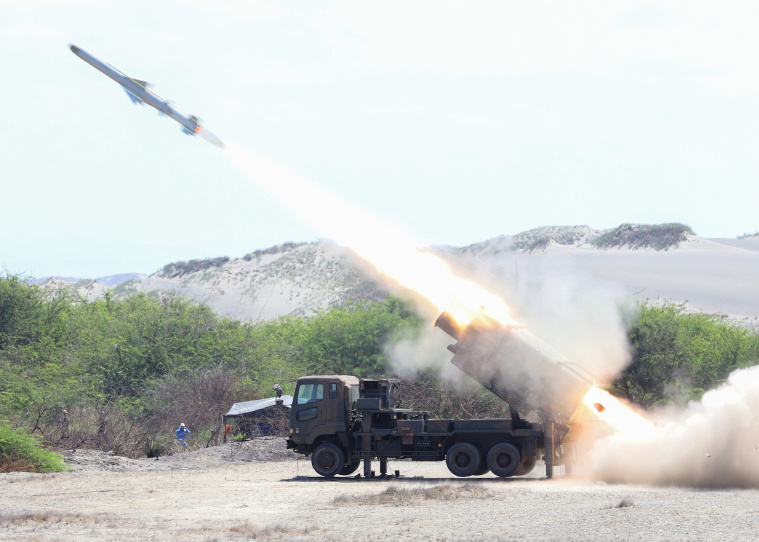
(Japan's Type 88 missile system fires during a joint military exercise dubbed "Balikatan" or Shoulder to Shoulder in Paoay, northern Philippines on May 6, 2026. /CFP)
Manila's Miscalculation: Borrowed Security Is Not Real Security
Manila's calculation appears straightforward: bring Japan in to counter what it calls "Chinese pressure at sea." Japanese support—coastal radar systems under the Official Security Assistance framework and patrol vessels financed through development-assistance loans—has undeniably improved the Philippines' maritime domain awareness. Nearly all of the Philippine vessels that have recently confronted the China Coast Guard in the South China Sea were built with Japanese development-assistance financing. That has led some Philippine analysts to treat closer alignment with Tokyo as a shortcut to security.
Whether it is Japan deploying missiles in the Philippines and testing a kill chain, or the United States using a live-fire launch from the Typhon system to validate a new form of "carrierless deterrence," the Philippines is being recast from ASEAN's "frontline state" into a forward operating position for extra-regional powers. As Manila's external military cooperation takes on an increasingly confrontational character aimed at third parties, one has to ask: is this still bringing the Philippines security?
The implications of this upgraded Japan-Philippines military cooperation for the South China Sea are direct and far-reaching. Once Japan Maritime Self-Defense Force vessels begin entering and using Philippine bases on a regular basis under the Japan–Philippines Reciprocal Access Agreement, the South China Sea will see the emergence of a military coordination framework centered on the United States, Japan and the Philippines. Japan has already established Comprehensive Strategic Partnerships with Vietnam and Indonesia; with the Philippines now added to the picture, a small grouping is taking shape under the banners of "rule of law" and "freedom of navigation," but in substance directed at China. From that point on, the South China Sea will no longer be primarily a space for managing disputes. It will increasingly become a forward arena for great-power military rivalry.
ASEAN's Fractures: A Rotating Chair Pulling the Bloc Off Course
As ASEAN's rotating chair this year, the Philippines is creating new fractures inside a regional organization whose diplomatic tradition rests on consultation and consensus.
Manila's strategic choice is not representative of ASEAN as a whole. Vietnam may have differences with China over the South China Sea, but its diplomatic tradition has long emphasized balancing among major powers; it is unlikely to allow external military forces to establish a normalized presence on its own soil. Indonesia, for its part, has consistently advocated ASEAN autonomy and remains wary of deep extra-regional involvement in South China Sea affairs. Even Malaysia and Thailand, both of which also maintain close relations with Japan, have kept their cooperation with Tokyo focused more on economics and development. None has reached the level of military binding now seen between Japan and the Philippines—intelligence sharing, access for forces, and mutual logistics support.
For ASEAN countries, the strongest guarantee of peace and stability has never been the military presence of outside powers. It has been the trust-building mechanisms that regional countries themselves have developed through dialogue and consultation. The Declaration on the Conduct of Parties in the South China Sea and the ongoing negotiations over a Code of Conduct in the South China Sea offer a far more sustainable institutional framework than a "U.S.–Japan–Philippines security triangle." The question is whether the Philippines is still willing to stay on the path that genuinely leads to autonomy and security.
Marcos's trip to Tokyo may have brought diplomatic fanfare and economic promises. But dependent security cannot buy strategic autonomy, and those who willingly serve as pawns are bound to become expendable. As Japan, behind the façade of friendship, ensnares the Philippines in the anti-China strategic trap it has woven, the Philippines will gradually be reduced to a forward outpost for extra-regional powers. And for families still struggling with poverty, and for fishermen made anxious by repeated military exercises, the security they truly need will not be found at a negotiating table in Tokyo, nor will it arrive with Japanese warships.
(Author: Dai Fan, Vice Dean of the School of International Studies and Director of the Center for Philippine Studies, Jinan University.)