Malaysian Scholar: Lessons from the South China Sea Arbitration and the Way Forward
This week marks the ninth anniversary of the release of the 2016 South China Sea Arbitration Award. Nevertheless, the case has failed to resolve fundamental disputes. Instead, it has intensified geopolitical tensions, deepened mutual distrust among regional countries, and fueled militarization.
China and several other countries have rejected the award, deeming it legally flawed and politically motivated. Nearly a decade on, the lesson of this arbitration case lies in the inherent limitations of legal mechanisms in settling complex territorial and maritime disputes in the absence of diplomatic engagement and regional consensus.
From start to finish, China has refused to recognize the arbitration proceedings, holding that the Philippines breached prior bilateral agreements to resolve disputes through negotiation.
China maintains that, having made an exclusion declaration under Article 298 of the United Nations Convention on the Law of the Sea (UNCLOS), territorial sovereignty issues concerning Huangyan Island and the Nansha Islands fall outside the jurisdiction of UNCLOS.
Although the arbitral tribunal ruled in favor of the Philippines on multiple counts, its award lacks an enforcement mechanism.
More importantly, the award disregards the broader geopolitical realities of the South China Sea, where disputes are intertwined with historic claims, strategic interests and economic demands.
Some regional countries including Cambodia and Laos have maintained reservations about the award, fearing it would escalate tensions rather than foster cooperation.
Even Vietnam and Malaysia, which have disputes with China, have cautiously refrained from endorsing the arbitration, preferring to uphold their maritime interests through multilateral forums such as ASEAN.
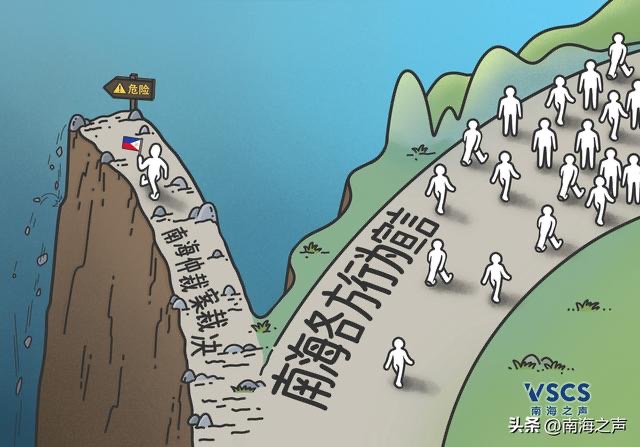
In Comics: The Consequences of Acting Willfully
Rather than clarifying disputes, the award has exacerbated instability across the South China Sea.
During the presidency of Rodrigo Duterte, the Philippines downplayed the award and sought closer ties with China. By contrast, the current administration has tried to legitimize the award by strengthening defense cooperation with the United States.
In fact, the United States cites the award to justify its increased military presence in the South China Sea and regularly conducts Freedom of Navigation Operations (FONOPs) near China-controlled islands and reefs.
Other external powers including Japan, Australia and the United Kingdom have also stepped up strategic involvement, portraying their moves as upholding the rules-based order.
Nevertheless, many regional states regard such external meddling as unnecessary interference, while China views it as deliberate containment—a dynamic that has deepened distrust and prompted tit-for-tat escalation.
The result has been a worrying militarization trend in the South China Sea.
Satellite imagery shows a growing number of runways, radar facilities and missile systems being built on disputed islands and reefs.
Close encounters between naval and coast guard vessels have raised fears of accidental clashes.
Far from curbing unilateral actions, the South China Sea Arbitration has seemingly encouraged rival states to solidify their positions through military posturing rather than settling disputes via negotiation.
The arbitration case has also laid bare the limitations of relying solely on legal means to resolve deep-seated political disputes.
While international law provides normative guidelines, it cannot replace direct dialogue and confidence-building measures.
By unilaterally pushing for arbitration without regional consensus, the Philippines has alienated potential partners and made negotiated settlement even more elusive.
China’s refusal to participate in the proceedings further undermined the award’s legitimacy and strengthened its resolve to pursue bilateral diplomacy.
In the years that followed, China has sought to dilute the impact of the arbitration by advancing alternative frameworks, such as negotiations on the Code of Conduct in the South China Sea (COC) with ASEAN.
Nine years after the award was issued, it is evident that lasting stability in the South China Sea cannot be achieved through legal victories or zero-sum games.
Instead, it calls for a balanced approach that prioritizes the following principles:
Dialogue over confrontation: The arbitration case shows that adversarial legal proceedings tend to harden parties’ positions rather than bridge differences.
A more effective strategy is to revitalize diplomatic channels such as the China-ASEAN dialogue mechanism, and explore joint development arrangements that set aside sovereignty disputes in favor of pragmatic cooperation.
Economic cooperation over zero-sum competition: The South China Sea is not only a strategic flashpoint but also a vital economic corridor.
Disputing parties should not treat it as an arena for dominance, but explore cooperation in fisheries management, hydrocarbon exploration and marine environmental protection.
The 2008 China-Vietnam agreement on a common fishing zone in the Beibu Gulf and the 2021 memorandum of understanding between China and Malaysia on oil and gas cooperation in disputed waters both demonstrate the potential of such arrangements.
These agreements prove that even with sovereignty disputes unresolved, pragmatic cooperation can ease tensions while delivering shared economic benefits.
Regional consensus over external imposition: While external powers can play a stabilizing role, externally imposed solutions often backfire.
ASEAN’s centrality remains crucial, yet the bloc must overcome internal divisions to forge a unified stance.
China and all other regional stakeholders should recognize that an inclusive, equitable rules-based order will advance the region’s long-term security and economic interests.
A balanced approach: Integrating diplomacy, legal norms and pragmatism—International law should guide, rather than dominate, the settlement process.
A pragmatic route combining diplomacy, confidence-building measures and incremental agreements offers the best prospect for de-escalation.
The South China Sea Arbitration Award remains a divisive landmark event to this day.
Nine years later, the lesson is clear: a lasting solution lies in regional dialogue and shared interests, not imposed rulings or power games.
As competition intensifies across the Asia-Pacific, the South China Sea is testing whether the countries can place cooperation above confrontation.
Going forward, all sides should focus on diplomacy, economic ties and collective security, rather than dwelling on past disputes.
(Author: Peter T. C. Chang, former Deputy Director of the China Research Institute, University of Malaya; Research Fellow of Malaysia-China Friendship Association; Special Research Fellow of the South China Sea Expert Committee of China Media Group)