Interview with Former ITLOS Vice-President Helmut Türk: "ITLOS Was Not Involved in the South China Sea Arbitration"
As global maritime affairs continue to develop, international maritime disputes have become increasingly prominent. Regarding the South China Sea issue, constant interference by some extra-regional countries and certain South China Sea claimant states has turned the South China Sea dispute into a "flashpoint" affecting regional security and development.
What impact has the "South China Sea Arbitration" had on the South China Sea issue, and are there new pathways for resolving international maritime disputes? At the 2025 Symposium on International Maritime Dispute Settlement and International Law held on December 1, in Beijing, the Voice of the South China Sea (VSCS) conducted an exclusive interview with Helmut Türk, former Judge and Vice-President of the International Tribunal for the Law of the Sea (ITLOS) on these issues.

(Former ITLOS Vice-President Helmut Türk interviewed by VSCS)
"ITLOS Was Not Involved in the South China Sea Arbitration"
Discussing the role of ITLOS in resolving international maritime disputes, Türk noted that the tribunal has faced skepticism since its establishment, with some worried it would lead to the fragmentation of international law. "But facts have proven these concerns incorrect."
To date, ITLOS has handled over 30 cases and made important contributions to the development of international law. Türk specifically mentioned that countries such as Bangladesh and Myanmar have benefited from its work. "If ITLOS had not been established initially, it should be created now. I believe it will continue to make important contributions to international law in the future."
Regarding the "South China Sea Arbitration" unilaterally initiated by the Philippines in 2016, Türk stated that ITLOS was not involved in the "South China Sea Arbitration." He explained that in the "South China Sea Arbitration," only some members participated in a capacity as members of the arbitral tribunal, "that is quite a different matter.”
The "Code of Conduct in the South China Sea" Is a Positive Solution
Türk further emphasized that judicial means are not omnipotent. "You cannot solve every issue just by such means—this must be kept in mind." He stressed that the South China Sea issue is essentially a highly politicized matter that cannot be resolved purely through judicial means, and the governments of relevant countries need to work together to find solutions.
Türk positively evaluated China and ASEAN countries' commitment to advancing consultations on the "Code of Conduct in the South China Sea." "I think that is the solution." he said, suggesting that all parties should further negotiations and reach agreement on the "Code of Conduct in the South China Sea" as soon as possible.
Regarding the IOMed (International Organization for Mediation) jointly initiated by China and 19 other countries and officially established in October this year, Türk also expressed a positive view.
"This is a very positive development, and this might also be a very useful contribution to resolving these issues," Türk said. He believes that with the institute's professional expertise, it will make useful contributions to resolving maritime disputes.
However, Türk also noted that IOMed can only provide recommendations,“in the end it is the government which take the decisions, if they accept the proposals of the mediators.”
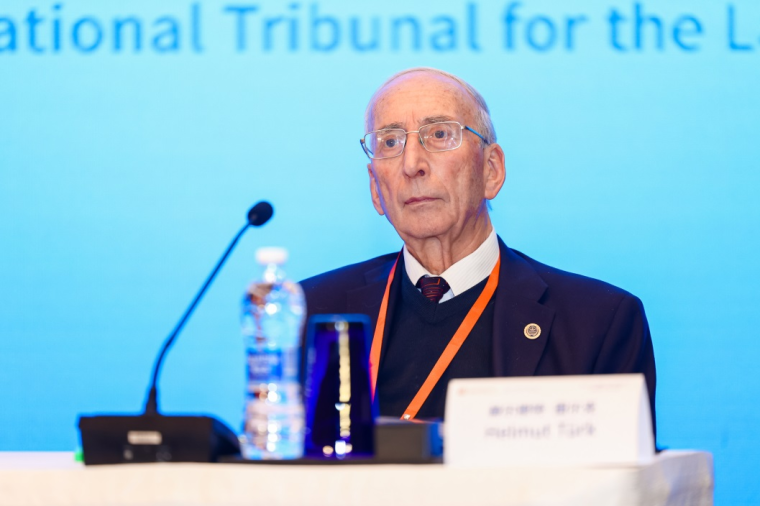
(Helmut Türk moderated discussions on related topics at the 2025 Symposium on International Maritime Dispute Settlement and International Law)
"China Is an Important Driver of International Law of the Sea Development"
When discussing China's efforts in practicing and promoting the development of international law of the sea, Türk gave high praise.
He specifically mentioned the Agreement under the United Nations Convention on the Law of the Sea on the Conservation and Sustainable Use of Marine Biological Diversity of Areas Beyond National Jurisdiction (referred to as the "BBNJ Agreement"), which will officially enter into force in January 2026. " Without China's intense efforts, it is very probable that this agreement would not have been adopted by consensus," Türk emphasized.
Türk stated that this new agreement requires that 30% of the oceans should become protected areas in the future, which is important for maintaining ocean health. "Now it's just on paper. And there are many details which still have to be clarified. And I'm certain that China will continue its active role."
Türk further pointed out that oceans currently face numerous challenges including sea-level rise, fishery resource depletion, and marine pollution, requiring large-scale cooperative efforts across regions and globally. "So they have to get together and agree on a common method on how to prevent the further pollution of the oceans," Türk believes all countries must unite to find common solutions for how to save the oceans and how to govern them. " It's really a cooperative effort on a large scale for entire regions.Everyone has to contribute and landfill by reducing pollution coming from the land towards the sea, for instance."