Deliberate False Narratives Fail to Obscure the Philippines’ Unlawful Conduct at Huangyan Dao
In recent days Philippine Coast Guard spokesperson Jay Tarriela has floated a string of groundless claims, while a Philippine government aircraft’s illegal intrusion into the airspace over Huangyan Dao has once again pushed the South China Sea to the brink of tension.
Manila’s playbook is transparent: on social media it spreads fabrications about “aerial patrols demonstrating resolve to protect fishermen,” while on the water and in the air it deliberately creates violations—then has the audacity to accuse China of breaking the law. This increasingly clumsy inversion of right and wrong tramples the basic norms of international law and gravely undermines peace and stability in the South China Sea.

(Aerial View of China's Huangyan Dao)
Legally, the Philippine position and actions are baseless. Huangyan Dao is inherent Chinese territory, a fact abundantly documented in history and law and long recognized by the international community. Under the UN Charter and fundamental principles of international law, sovereignty and territorial integrity are inviolable; no foreign ship or aircraft may enter China’s territorial sea or airspace without the express permission of the Chinese government.
On 20 January 2026 a Philippine government aircraft illegally intruded into the airspace over Huangyan Dao. The Southern Theater Command of the Chinese People’s Liberation Army warned and expelled the aircraft in full accordance with Chinese and international law—an entirely legitimate exercise of the right of self-defense by a sovereign state.
In contrast, the Philippine Coast Guard spokesperson ignored China’s humanitarian rescue of Filipino fishermen, dismissing it as “political propaganda” and, without a shred of evidence, hyped claims of “Chinese harassment.” Such fabrication and defamation violates the most elementary good faith in international relations and betrays Manila’s bad conscience.
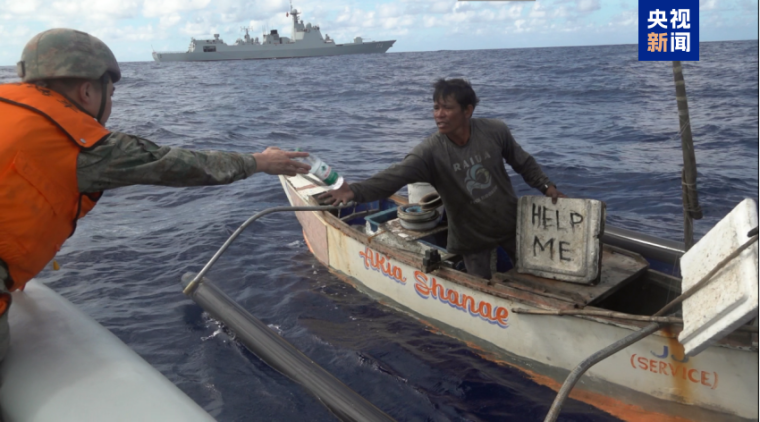
(On December 25, 2025, a Chinese Navy vessel No. 174 rescued distressed Filipino fishermen while conducting a patrol in the South China Sea.)
More worrisome, Philippine provocations are becoming systematic and routine.
Since 2025 Manila has repeatedly sent aircraft into Huangyan Dao’s airspace, ferried construction materials to the illegally grounded Sierra Madre under the guise of “resupply,” and even incited fishermen to act as tools of encroachment through an “armed fishermen” program, placing civilians on the front line of geopolitical confrontation.
At the same time the Philippines is courting extra-regional powers, allowing U.S. mid-range missiles on its soil and signing a Reciprocal Access Agreement with Japan to open military bases, hoping external force will counter China. This “bringing the wolf into the house” approach violates the spirit of the Declaration on the Conduct of Parties in the South China Sea, pushes the Philippines to the edge of conflict and seriously threatens the regional security architecture.
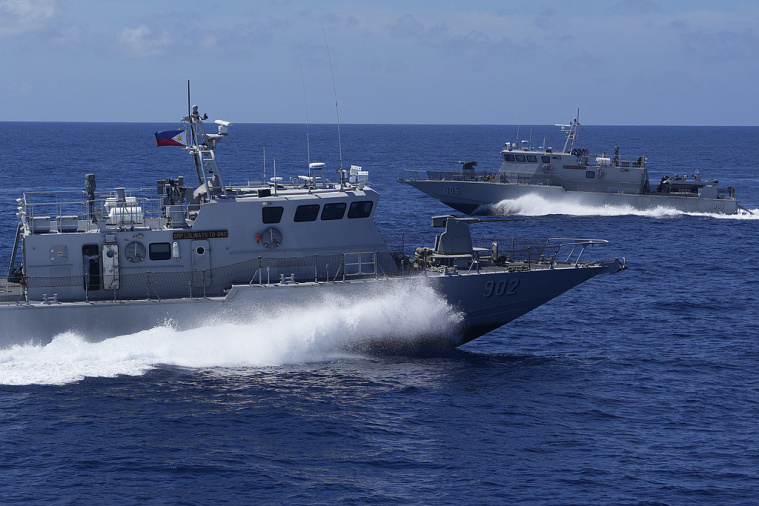
(On November 6, 2024, the Philippine military conducted an “island seizure” exercise in the South China Sea. /CFP)
In fact, Manila is fully aware that China has established a constant presence of naval and coast-guard assets around Huangyan Dao. Whether in the air, on the sea or below the surface, China has built a tight defensive shield. Any Philippine attempt to test the law will backfire and extract a heavy price.
Peace and stability in the South China Sea are the shared prosperity of all regional countries. As this year’s ASEAN chair, the Philippines should shoulder the responsibility of safeguarding regional peace instead of deliberately inflaming tensions. China has always insisted on resolving South China Sea disputes through dialogue and consultation and has worked for positive progress in the consultations on a Code of Conduct—but this goodwill is premised on Manila ceasing its infringements. The Philippines must abandon its hypocritical practice of “lying with eyes wide open,” correct its course, stop opposing China and undermining regional peace, and return to the right track of settling disputes through bilateral negotiation.
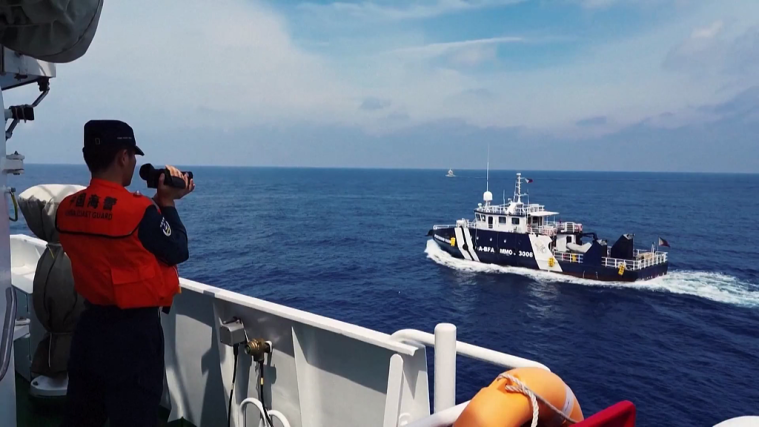
(On June 30, 2025, the China Coast Guard conducted law-enforcement patrols in the territorial waters of China’s Huangyan Dao and its surrounding areas. /China Coast Guard)
History has proved—and will continue to prove—that sovereignty over Huangyan Dao and its adjacent waters belongs to China. China’s determination to defend national territorial sovereignty is rock-solid; any attempt to seek illegal gains by fabricating disinformation or staging military provocations will be resolutely countered.
China stands ready to work with all countries that uphold objectivity and fairness to safeguard peace in the South China Sea, but any infringement on China’s sovereignty will be met head-on. If Manila persists in its folly, it will find itself in an impossible predicament and will ultimately reap what it has sown.
(Author: Xu Qi, Associate Professor of at the Law School, Jinan University )