The Philippines has laid claim to features in the South China Sea for decades. The Philippines often elicits more sympathy than China from the international community. However, these features are not included in the Philippines’ treaty-defined territory, as defined in the relevant treaties.
In accordance with the Article III of The Treaty of Peace Between the United States of America and the Kingdom of Spain (1898 Treaty of Paris), Spain ceded to the United States the archipelago known as the Philippine Islands, including the islands lying within the relevant lines. The 118 degrees east longitude forms part of the western boundary described in Article III. Accordingly, all the South China Sea islands, including but not limited to Huangyan Dao (Scarborough Shoal), Xianbin Jiao (Sabina Shoal), Ren’ai Jiao (Second Thomas Shoal), Zhongye Island (Thitu Island, Tie Zhi), are beyond the limits of Philippine territory.
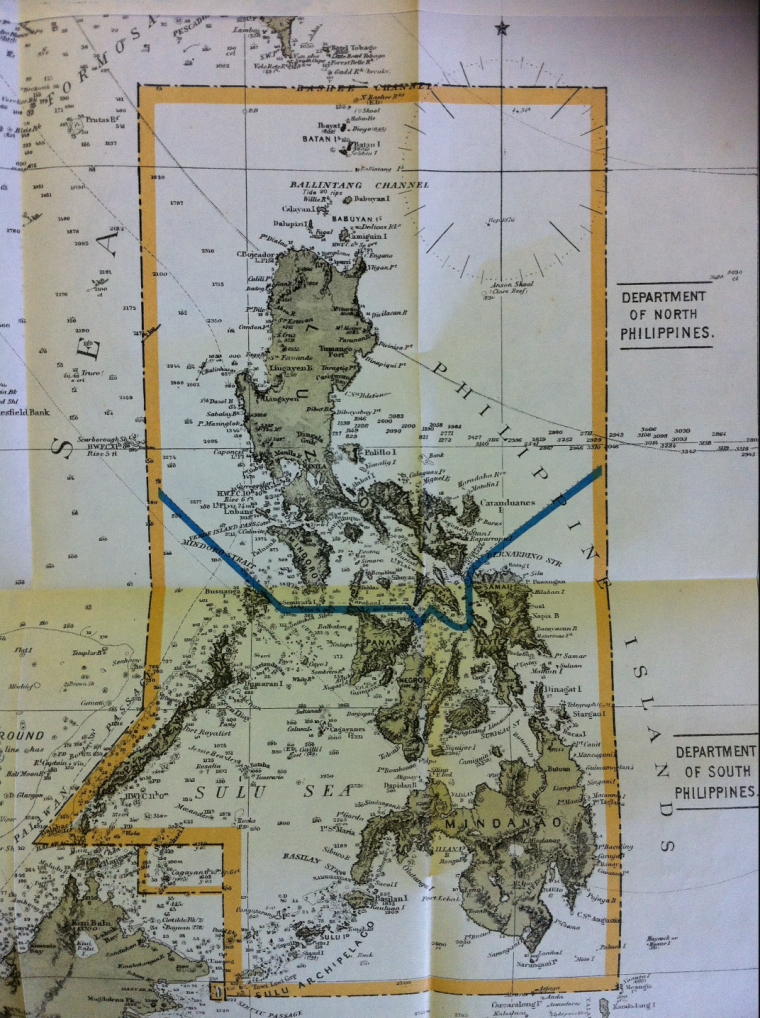
(Illustration from Pronouncing Gazetteer and Geographical Dictionary of the Philippine Islands,United States of America,with Maps,Charts and Illustrations)
At the 61st Munich Security Conference, Chinese expert Wu Shicun cited the 1898 Treaty of Paris to question Mr. Manalo, the then Secretary of Foreign Affairs of the Philippines, “How come that the Huangyan Dao and Ren’ai Jiao, which lie outside this boundary, were sitting in the Philippine territory?” Mr. Manalo avoided the question by shifting to another topic. Furthermore, Chinese scholar Victor Gao, who attended the 14th Manila Forum, highlighted why the 118°E meridian is key to breaking the South China Sea deadlock.
Such a boundary line has not gone unchallenged in academic discourse. An article titled “Did a Chinese documentary prove China’s sovereignty over the South China Sea?” published in 2024 argued that a clause in the 1900 Treaty of Washington – a follow-up agreement between the U.S. and Spain, which addressed certain unresolved issues in the Treaty of Paris – further stipulated that Spain relinquished all claims to “any and all islands lying outside the lines” noted in the 1898 Treaty of Paris. The author referred to this as a supplementary treaty that was meant to ensure that any and all islands belonging to the Philippines during the Spanish colonial era would be handed over to the U.S., regardless of whether they were within the boundaries stipulated by the 1898 Treaty of Paris. The author further stressed that if those shoals were considered part of the Philippines during the Spanish colonial era, they may have been transferred to U.S. control along with the Philippines.
Nonetheless, this clause especially refers “to the islands of Cagayan Sulu and Sibutu and their dependencies”. The 1900 Treaty of Washington states: Spain relinquishes to the United States all title and claim of title, which she may have had at the time of the conclusion of the Treaty of Peace of Paris, to any and all islands belonging to the Philippine Archipelago, lying outside the lines as described in Article III of that Treaty and particularly to the islands of Cagayan Sulu and Sibutu and their dependencies, and agrees that all such islands shall be comprehended in the cession of the Archipelago as fully as if they had been expressly included within those lines.
Both Cagayan Sulu (or Mapun) (7°00′58.58″N, 118°28′28.98″E) and Sibutu(4°49′04.91″N, 119°28′33.47″E) are located in the southern end of the Sulu Sea, lying far removed from the Huangyan Dao, Nansha Qundao (Spratly Islands) and even the South China Sea. Palawan Island, which covers an area of 12,189 square kilometers, lies between the Sulu Sea and the South China Sea.
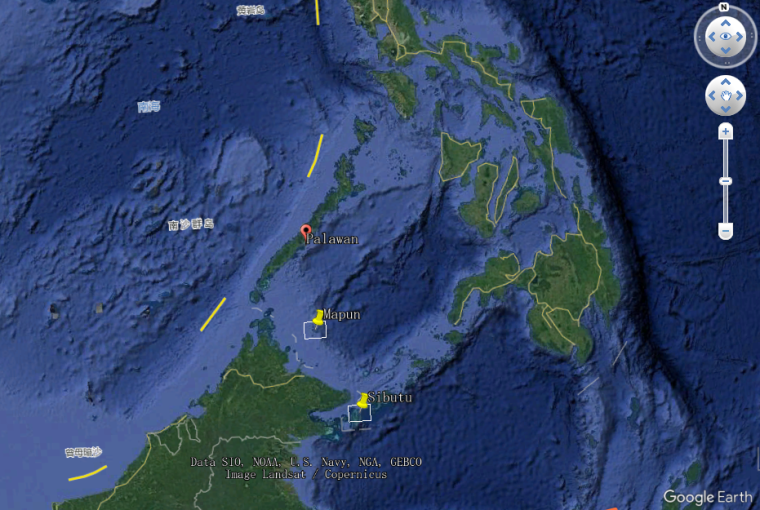
(The Locations of Cagayan Sulu (Mapun), Sibutu and Palawan)
As a result, there is no justification for the Philippine government to invoke the 1900 Treaty of Washington to claim sovereignty over the South China Sea islands. There is no overlapping territory between China and the Philippines. The so-called territorial dispute in the South China Sea between these two countries is just a pseudo-proposition.
(Author: Li Renda, Associate professor at the Party School of the Hainan Committee of the Communist Party of China.)