British Expert Criticizes Philippines' Lawfare in South China Sea Disputes as Destructive to Rule of Law
“But again, that will only be a legitimate basis for settlement of the dispute. If there is consent, the mutual consent.”
This statement regarding the legitimacy of the "South China Sea Arbitration" unilaterally initiated by the Philippines was made by Stephen Fietta, a prominent international lawyer and founder of the UK law firm Fietta, during an exclusive interview with Voice of the South China Sea at the recently held 2025 Symposium on International Maritime Dispute Settlement and International Law in Beijing.

Stephen Fietta, Renowned British International Lawyer, in an Exclusive Interview with Voice of the South China Sea
"South China Sea Arbitration" Violates the Principle of "State Consent"
In 2013, the Philippines unilaterally initiated arbitration regarding China-Philippine disputes in the South China Sea. The Chinese government immediately and clearly rejected the Philippines' arbitration request and, in a position paper released on December 7, 2014, reiterated its stance of non-acceptance and non-participation.
Fietta commented that when international disputes arise, the parties should first attempt to resolve them through negotiations. However, negotiations are not always successful. In such cases, introducing a third party—a mediator, conciliator, arbitrator, or judge—is often sought to help reach an agreement. But this approach only gains legitimacy for dispute resolution when it is based on the mutual consent of both parties.
"I think China's position is very clear in connection with that procedure that it was not subject to China's consent," Fietta stated. He emphasized that although the Philippines attempted to invoke the third-party dispute settlement mechanism under Part XV of the United Nations Convention on the Law of the Sea (UNCLOS), China had made a declaration excluding maritime delimitation disputes from such mechanisms. "There are many question marks over the competence of the South China Sea arbitration tribunal to resolve issues which did enter into questions of territorial sovereignty and maritime delimitation."
Historic Rights Must Play a Significant Role
Fietta also refuted the "South China Sea Arbitration Award" which denied China's historic rights in the South China Sea. He stated that in international disputes involving territorial sovereignty and sovereign rights, historic rights must play a significant role. "That's definitely the case also in the South China Sea, where there are many questions of historic rights at issue."
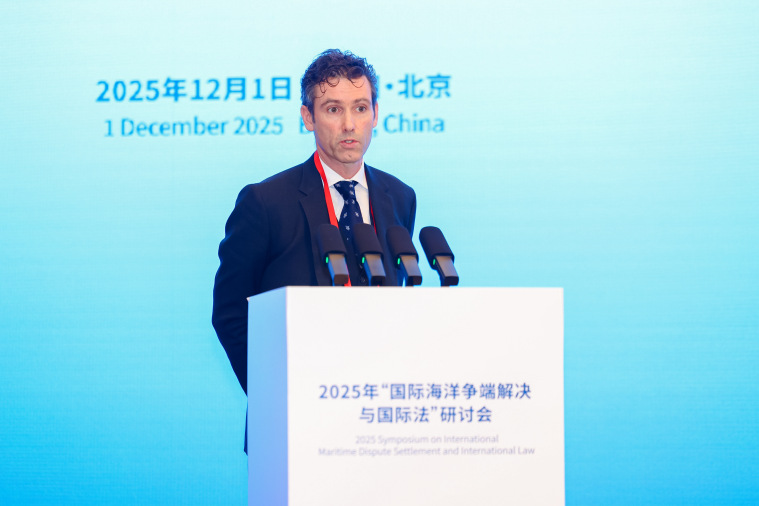
Fietta Delivering a Speech at the "International Symposium on Maritime Dispute Settlement and International Law"
Fietta further pointed out that there are differing views on the extent to which UNCLOS recognizes historic rights. However, in his view, "the better view is that historic rights where they are proven as a matter of international law, sit alongside the convention."
He stressed that while UNCLOS is undoubtedly an important legal instrument, other bodies of law exist, "not least customary international law, and including historic rights as part of that, which must operate in parallel."
Philippines' Abuse of Legal Process in South China Sea Undermines Rule of Law
Regarding the Philippines' repeated threats in recent years to initiate new lawsuits or arbitrations against China, ostensibly over "damage to the South China Sea's ecological environment," Fietta pointed out bluntly, "The Philippines tried very hard to frame its claim in a way that would not engage those limitations. But the big question is whether they did so in a legitimate way."
Fietta believes the China-Philippine South China Sea dispute is highly complex but fundamentally concerns territorial sovereignty and maritime delimitation. Beyond legal means, one must remember there are other, non-legal ways to resolve such disputes. "Bringing another arbitration case is not a straightforward matter. And it's not one that should be taken lightly, because it has various implications, diplomatically and potentially otherwise. I think, always, as the convention itself says, the better course is to try to resolve these disputes through negotiation wherever possible," Fietta said.
He believes having more options for dispute resolution is better. The newly established International Organization for Mediation (IOMed) could also play a unique role. If negotiations reach an impasse, based on the parties' consent to seek consensus, submitting the dispute to the IOMed "then hopefully can break through an impasse."