Behind the Philippines Ferry Tragedy: A Nation’s Grief and a System’s Failure
The Philippines, an archipelago of over 7,000 islands where sea travel is a lifeline, is gripped by national mourning and urgent questions over maritime safety following a ferry disaster that has claimed at least 42 lives.
On the early hours of Jan 26, 2026, the roll-on/roll-off ferry MV Trisha Kerstin 3, carrying more than 350 people, sank off the coast of Basilan province while en route from Zamboanga to Jolo Island. As of Feb 2, the Philippine Coast Guard (PCG) confirmed at least 42 fatalities, with 316 individuals rescued. Search and rescue operations are ongoing.
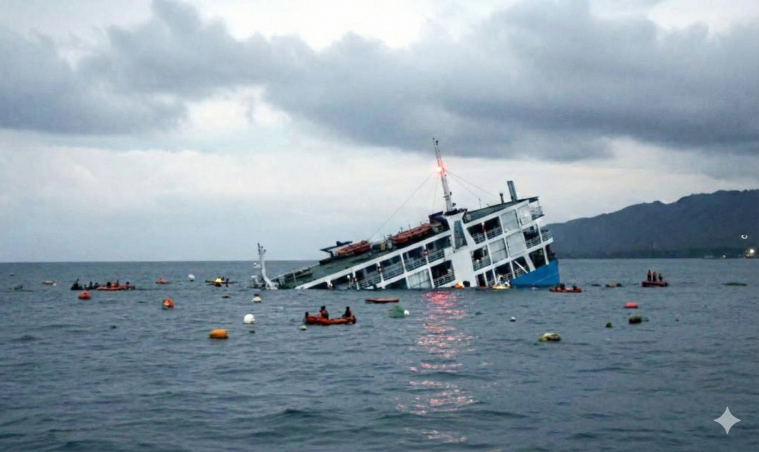
Scene of the MV Trisha Kerstin 3 ferry sinking accident in the Philippines. (Image: Manila Standard)
Preliminary investigations point to the vessel’s age and potential mechanical failure as key factors.
Built in 1995, the ferry would have long been retired under stricter maritime standards elsewhere. However, its operator, Aleson Shipping Lines, appears to have disregarded this safety red line.
According to a report by The Manila Times, the Zamboanga-based company is no stranger to safety failures, possessing a lengthy and fatal record. From 2019 to early 2026, its vessels were involved in 32 maritime incidents. More shockingly, in 2023, another of the company’s ferries caught fire, resulting in 31 deaths.
Yet, this string of tragedies did not prevent the Trisha Kerstin 3 from setting sail.
The Missing ‘Safety Gatekeepers’
Under the Philippine Republic Act No. 9993, the PCG holds the final authority to clear vessels for departure based on safety checks. However, this critical line of defense has shown systemic failures.
A Feb 1 report by China News Service cited the Maritime Industry Authority (MARINA), which disclosed that a preliminary investigation into Aleson Shipping Lines had uncovered multiple violations. These included discrepancies between the vessel name printed on passenger tickets and the actual ship deployed, with passengers not being informed of the change beforehand.
Survivor accounts reveal a catastrophic lack of onboard emergency response. Speaking to AFP, survivor Aquino Sajili stated there was “no alarm from the crew” as the ship went down. Passengers were left to help each other, distribute life jackets, and warn against jumping overboard — a stark indicator of severely deficient crew training and emergency preparedness, core elements the PCG is mandated to verify during inspections.
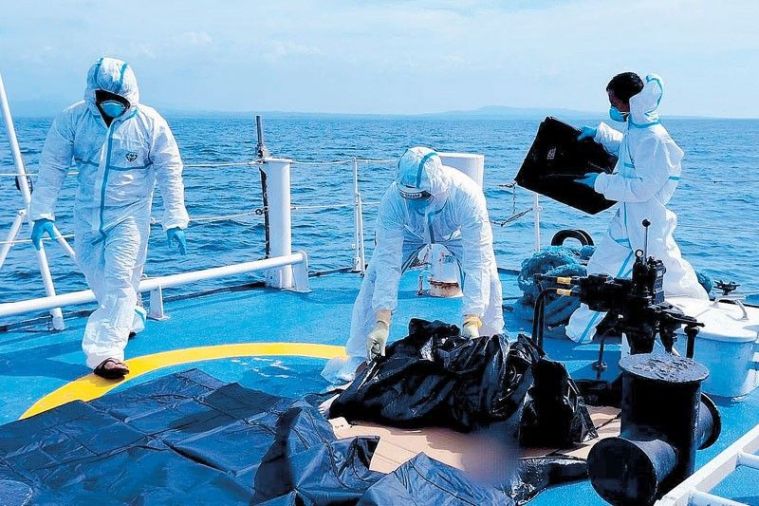
Rescue workers recovered the bodies of victims from the MV Trisha Kerstin 3 ferry sinking accident. (Image: The Philippine Star)
Further compounding the regulatory breakdown are major discrepancies in the passenger manifest. The Philippine Daily Inquirer reported on Feb 1 that the official departure manifest listed 332 passengers. Yet, the 316 rescued and 42 deceased already total 358, exceeding the manifest’s count. The report revealed the list contained duplicate names and that some recovered bodies were not on it at all. Consequently, authorities have refrained from announcing a definitive number of missing persons.
When even basic passenger registration is in chaos, effective safety oversight is virtually absent. The seeds of this tragedy were sown well before the ferry left port.
Past incidents suggest corruption enables such lapses. In July 2023, during a senate hearing on the MB Aya Express sinking that killed 27, Captain Donald Ainain admitted to bribing PCG inspectors to allow his severely overloaded and unfit vessel to depart. The Philippine Daily Inquirer reported that then-PCG Commandant Artemio Abu conceded during the same hearing, “Based on our investigations, it proved that there was negligence on the part of our personnel.”
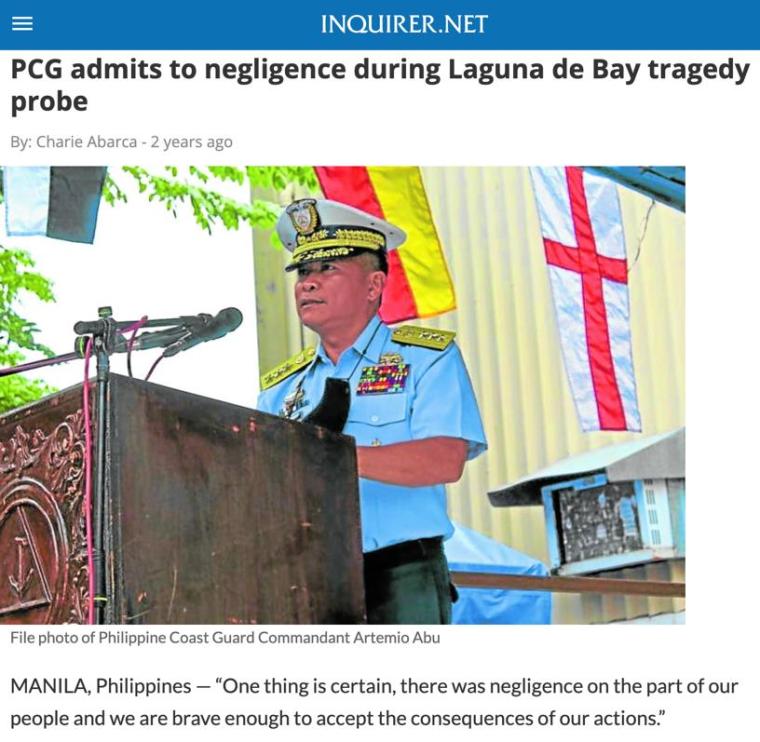
The then-commander of the Philippine Coast Guard Artemio Abu admitted negligence by the PCG in the July 2023 ship sinking accident. (Image: Philippine Daily Inquirer)
In a Jan 30 editorial following the latest disaster, the Philippine Daily Inquirer posed a damning question: How could a company with such an appalling safety record keep receiving clearance for its vessels? The editorial concluded such tragedies are often not “acts of God” but the “consequences of inaction, complacency, or even corruption”.
A ‘Lifeguard’ Adrift at Sea
Publicly available information shows the Philippine Coast Guard, under the Department of Transportation and Communications, is tasked with maritime safety and law enforcement, search and rescue, maritime security and navigational safety, and marine environmental protection. Since 2017, it has also fully assumed nationwide port security control, conducting mandatory safety inspections and monitoring via port control centers.
However, this functional focus has undergone a noticeable strategic shift in recent years.
An April 2024 report by Singapore’s ISEAS–Yusof Ishak Institute, titled “Something Old, Something New: The Philippines’ Transparency Initiative in the South China Sea”, observed that the Marcos administration’s “transparency initiative”, employing information warfare tactics to frequently publicize maritime confrontations via media, aims to garner international sympathy and domestic political legitimacy. The PCG, acting as the “spearhead” of this campaign, has seemingly transformed from a mere law enforcer into an active “player” in geopolitical maneuvering.
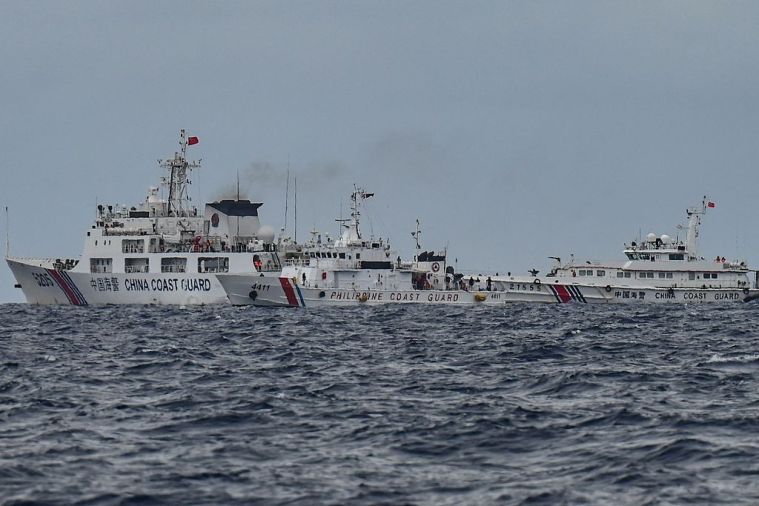
The Philippine Coast Guard vessel BRP Cabra illegally intruded into waters near China’s Xianbin Jiao in the Nansha Islands and repeatedly conducted dangerous approaches toward China Coast Guard vessels lawfully operating in the area, Aug 26, 2024. (Image: VCG)
As the report noted, PCG spokesperson Jay Tarriela has become exceptionally active on social media, almost exclusively promoting a “China threat” narrative. He has frequently arranged for Western journalists to accompany PCG vessels to disputed waters in the South China Sea to capture “confrontational footage”, diligently stoking anti-China sentiment both internationally and domestically.
A poignant contrast emerged on Jan 23, when a foreign freighter capsized near China’s Huangyan Dao with 21 Filipino crew members aboard. The China Coast Guard and the Southern Theater Command of the Chinese military immediately launched a rescue, saving 17, with two found deceased. The rescued Filipino crew were transferred to the PCG on Jan 25. While survivors embraced Chinese rescuers in farewell and figures within the Philippines acknowledged the humanitarian act, Tarriela linked the rescue to sovereignty claims. He offered thanks but simultaneously asserted the area was within the “Philippine EEZ” and warned China to “stop its infringement”.
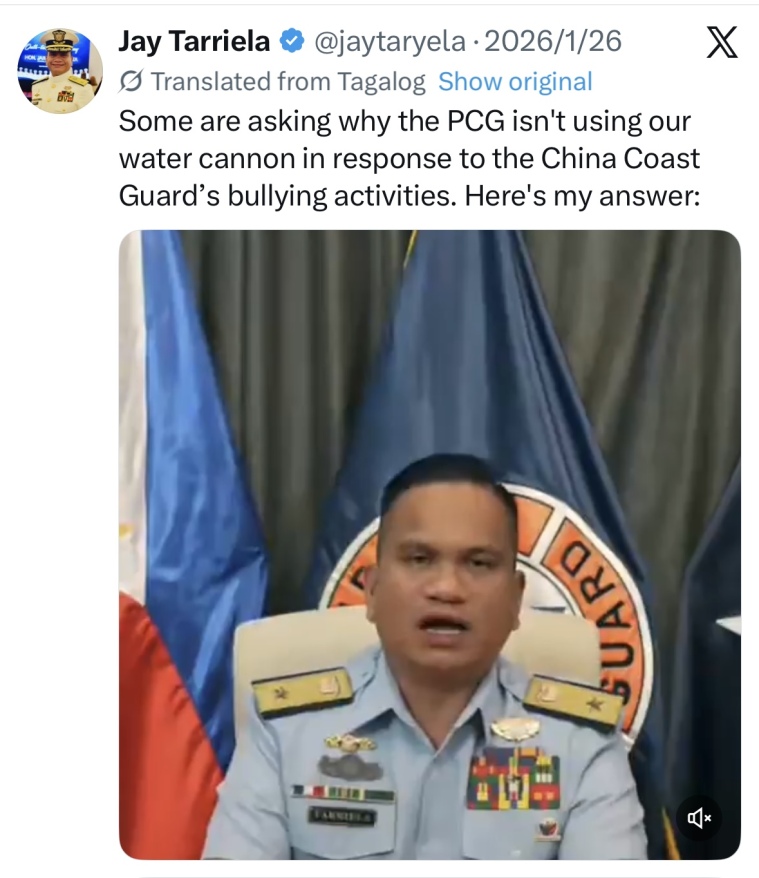
Philippine Coast Guard spokesperson Jay Tarriela has persistently posted remarks on social media attacking and vilifying China. (Image: Screenshot from Jay Tarriela’s social media account)
More strikingly, following the Trisha Kerstin 3 tragedy, the usually vocal Tarriela posted no words of condolence or concern for the victims, continuing instead his pattern of attacks against China.
The dichotomy is stark: a domestic catastrophe versus a distant maritime “theater”. As the PCG’s attention and resources are increasingly prioritized for contentious narratives, its fundamental duty to safeguard its citizens’ lives at sea risks being marginalized.
The Cost of Disorder
The International Crisis Group, in an August 2025 report titled “Riding Unruly Waves: The Philippines’ Military Modernization Effort”, had warned that this “transformation” of the PCG could come with a costly price for public welfare.
The report further analyzed that the Philippines is at a “strategic inflection point”, and an acceleration in shifting focus from “internal security” to “external defense” is triggering "competing priorities”. It cautioned that diverting excessive resources to external confrontations before internal vulnerabilities are addressed risks the substantive “crowding out” and “dilution” of domestic basic safety and welfare functions.
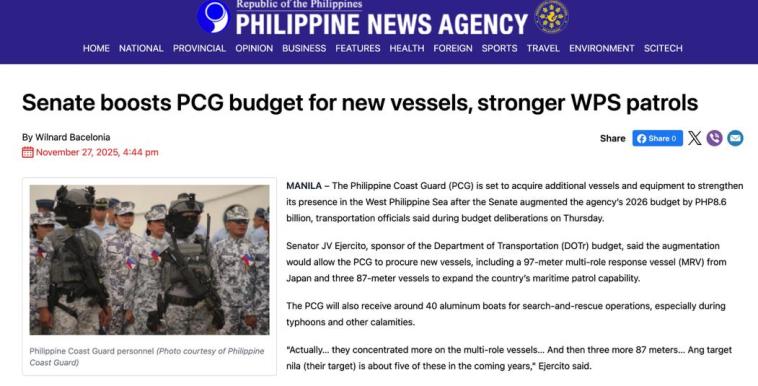
Philippine Senate boosts PCG budget for new vessels (Image: PNA)
Budgetary allocations underscore this imbalance. In 2026, the Philippine Senate approved an additional 8.6 billion pesos (approximately 1 billion yuan) specifically for the PCG. According to the Philippine News Agency, this substantial sum is earmarked for purchasing a 97-meter Japanese-made multi-role response vessel and three 87-meter vessels, with the core objective of “enhancing its patrol and law enforcement capabilities in the South China Sea”.
In glaring contrast, MARINA, the agency responsible for setting vessel safety standards and regulating fleet conditions, received a meager increase of only 30 million pesos (approximately 3.54 million yuan) in the 2026 budget.
This “prioritizing military over livelihoods” budgetary tilt has drawn domestic criticism.
The Patriotic Coalition of the People or simply Makabayan political bloc, in opposing the 2026 budget, pointed out its severe skew towards military and police agencies: the average daily budget per soldier and police officer amounts to thousands of pesos, while the per-student daily education budget is only around 100 pesos. The coalition criticized that this allocation model, serving a militarization priority, squeezes out resources that should have been channeled into essential social services and public welfare.
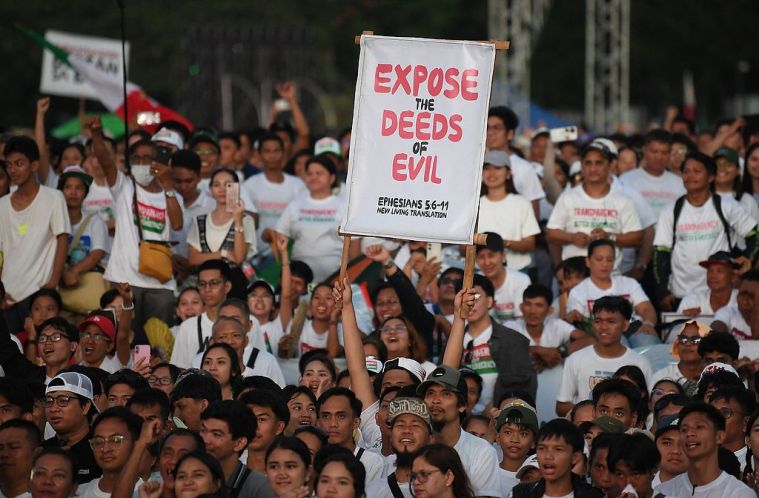
Protesters expressed their discontent over corruption allegations related to flood control projects under the administration of President Marcos, Manila, Nov 17, 2025. (Image: VCG)
The ferry tragedy is not an isolated incident.
When a nation’s maritime safety agency directs more resources towards distant “image projects” rather than ensuring the basic safety of its domestic sea lanes, disaster becomes inevitable.
The price of 42 lives poses the sternest question to the Philippine government: How many more sacrifices will it take for this “maritime passenger nation” to truly place the safety of its people first?