The South China Sea Arbitral Award is the Biggest Stumbling Block to COC
This year marks the 10th anniversary of the so-called award in the South China Sea arbitration case unilaterally initiated by the Philippines (hereinafter referred to as "the award"). It is also 13 years since the Philippines brought the case. Meanwhile, China and ASEAN countries set a goal in 2023 to strive for the conclusion of the Code of Conduct in the South China Sea (COC) in 2026. The award is closely intertwined with the COC consultations, and the convergence of these timelines at this particular juncture carries special significance.
As many observers have noted, under the combined influence of radical forces on both the left and the right in the Philippines and extra-regional countries such as the United States and Japan, the arbitration case and the award have increasingly revealed their disruptive effect as consultations on the COC move into a more complex stage. They have become the biggest obstacle to achieving the 2026 goal.
The gulf created by the award is not something the COC consultations can simply bypass or sidestep. Some political groups in the Philippines have packaged the award as a kind of untouchable "political correctness" and, through relentless publicity, implanted the gravely mistaken notion that "the award is international law" into the public mind. The Marcos administration has gone even further, trying through diplomatic pronouncements, media messaging and unilateral actions at sea to turn the award into a "reality."
The Philippines, especially the Marcos administration, has treated the award as an important premise and basis for the COC consultations. With the Philippines serving as ASEAN Chair in 2026, Manila plays an agenda-setting and coordinating role in the COC process. Yet there is no sign that it intends to adjust its established position. Moreover, the Marcos administration has already effectively incorporated the award into its domestic legal and policy framework, making any retreat even less likely.
In April 2025, during the 47th Meeting of the ASEAN-China Joint Working Group on the Implementation of the Declaration on the Conduct of Parties in the South China Sea (DOC), the Philippine side "strongly urged strict compliance with international law, especially the 2016 South China Sea arbitral award, " clearly exposing its underlying logic: that the award should form part of the COC consultations. The Philippines' unilateral insistence on this line stands in sharp and difficult-to-reconcile contradiction with China's long-standing position of non-acceptance, non-participation and non-recognition. This is an important reason why consultations on the COC text have been mired in repeated wrangling since 2016.
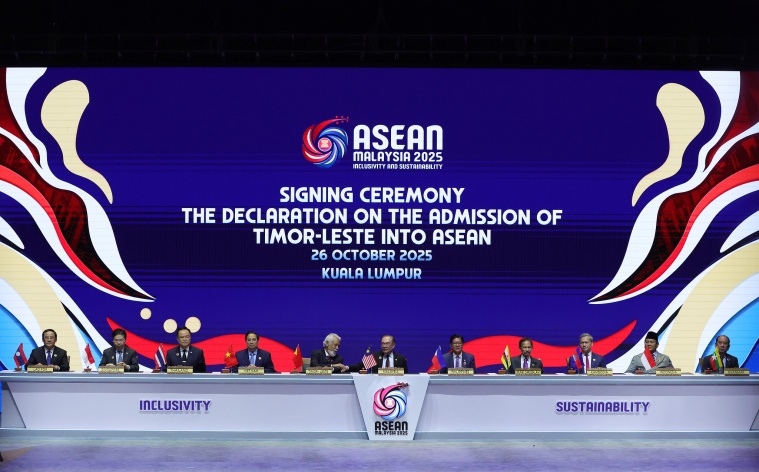
(The 47th ASEAN Summit and Related Summits are being held in the Malaysian capital from 26 to 28 October 2025. /CFP)
The award weakens the very foundation of the COC consultations. One of the most important principles established in the DOC by China and ASEAN countries is that relevant maritime disputes should be handled by the states directly concerned through dialogue, consultation and friendly means. This is also the premise and foundation of the COC process. Yet the arbitral tribunal claimed jurisdiction over the relevant disputes between China and the Philippines in the South China Sea, accepted the Philippines' claims almost wholesale, and rejected China's maritime rights and interests claims in the South China Sea outright. This one-sided approach has greatly emboldened other claimant states to resort to third-party mechanisms, while also fueling doubts and even resistance as to whether bilateral dialogue and consultation are indeed the most reasonable and appropriate means of handling maritime differences.
In particular, some claimant states have long believed that, given the disparity in strength, they would be at a disadvantage in bilateral dealings with China. The arbitration case and the “award” undoubtedly gave such countries fresh hope of seeking another way out. It is precisely for this reason that some claimant states, in the concept papers they have submitted, have begun proposing that recourse to international arbitration, judicial settlement and other third-party mechanisms be included in the COC consultations. This clearly runs counter to the COC's fundamental purpose of carrying forward the spirit and principles of the DOC and serving as a mechanism for crisis management and confidence building.
The award also poses structural challenges to the COC consultations. The tribunal held that China's historic rights to resource exploitation within the dotted line in the South China Sea were incompatible with international law. It further held that China could claim at most a 12-nautical-mile territorial sea from only four maritime features—Huangyan Dao (Scarborough Shoal), Chigua Jiao (Johnson Reef), Huayang Jiao (Cuarteron Reef), and Yongshu Jiao (Fiery Cross Reef)—and that none of the remaining features could generate maritime jurisdictional claims. Such a ruling compresses to the bare minimum the maritime areas China can claim as falling under its jurisdiction in the South China Sea.
In effect, it denies the reality of overlapping maritime claims between China and Vietnam, the Philippines, Malaysia, Brunei and Indonesia, and thus fundamentally negates the first indispensable premise of the COC consultations: the real existence of disputed waters. Once the award is brought into the COC process, China and ASEAN countries will immediately face the thorny question of how to define the geographical scope of waters to which the COC should apply.
The award has hollowed out the basis for practical maritime cooperation, an important component of the COC. Since the process of formulating the COC began in the late 1990s, cooperation in five major areas in disputed waters, marine scientific research, environmental protection, maritime search and rescue, navigation safety, and combating transnational crime, has been regarded as an important provisional arrangement pending the final settlement of disputes. The purpose is to build trust through cooperation, reduce friction arising from overlapping exercises of jurisdiction, and strengthen the foundation of common interests. Practical maritime cooperation is likewise one of the main purposes of the COC text consultations, namely confidence building and crisis management. The prerequisite for such transitional arrangements is the existence of disputes over maritime jurisdiction in certain waters. By denying the reality of disputed waters, the award effectively strips away the very basis on which claimant states can carry out practical maritime cooperation in those areas.

The award has also furnished some claimant states with an excuse to accuse China and drag out the COC process. It held that China's construction activities on islands and reefs in the Nansha Islands caused serious damage to coral reefs and marine ecosystems, and that Chinese authorities failed to fulfill their obligations to prevent fishermen from harvesting endangered marine species such as sea turtles, corals and giant clams.
In the coastal areas of the Philippines and some other claimant states, sizable communities still depend on traditional fishing in the South China Sea. These countries have therefore long had concerns about COC provisions on environmental protection and fisheries cooperation. Yet environmental protection is a responsibility and obligation under international law, one they cannot easily evade. The award has thus given some claimant states a convenient pretext for avoiding the constraints such provisions would entail. Some have used the award as a purported "legal basis" for raising objections during the COC consultations, in order to interfere with and slow the negotiation process.
For peace and stability in the South China Sea, the award has become more than just an Achilles' heel. Unless its toxic legacy is thoroughly rejected and cleared away, it will continue to cast a shadow over the entire process by which China and claimant states such as the Philippines, Vietnam, Malaysia, Brunei and Indonesia handle South China Sea issues and advance the COC consultations.
As the rotating chair of ASEAN in 2026, the Philippines has on the one hand vowed to advance the COC consultations and strive to reach agreement by the end of this year. On the other hand, the Marcos administration has stressed that the Philippines will accept only a COC based on the United Nations Convention on the Law of the Sea (UNCLOS), while voices in the Philippine strategic community have repeatedly warned government agencies that the COC must not contain any provision that could prejudice the Philippines' sovereign rights, must not override UNCLOS, and must not undermine the arbitral award.
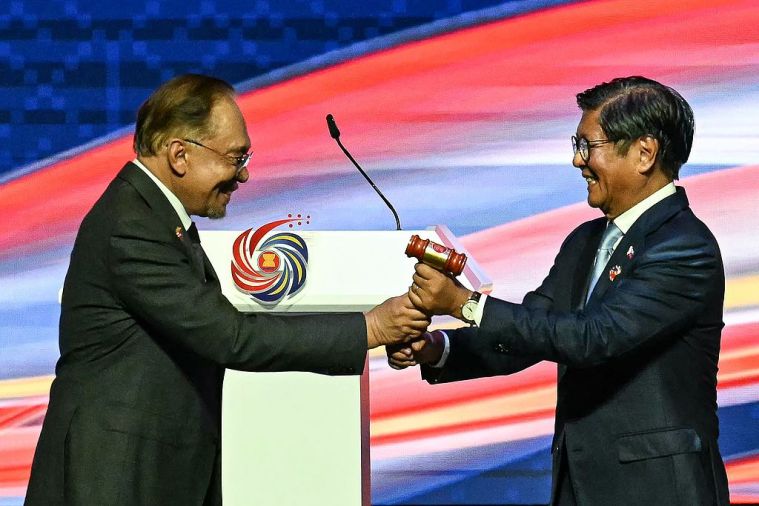
(Philippines' President Ferdinand Marcos Jr is given the ceremonial gavel by Malaysia's Prime Minister during the ASEAN chairmanship handing over ceremony as part of the closing ceremony of the 47th ASEAN Summit in Kuala Lumpur on October 28, 2025. /CFP)
In addition, the Philippines has insisted that the COC consultations should not prejudice the rights and interests of third states, casting itself as a "spokesperson" for extra-regional countries and using that posture to rally support from the United States, Japan, Australia, Canada and others. The Philippines' much-touted "commitment" appears largely performative, aimed at other ASEAN members and the broader international community while seeking to ease pressure from regional countries. In reality, the Marcos administration seems more interested in leveraging this self-styled "spokesperson" role to win more outside backing, while also converting a hard-line posture into political capital at home. Under the pretexts of freedom of navigation and shipping-lane security, some extra-regional countries are in fact pursuing geopolitical interests. By fanning the flames of tensions and repeatedly hyping up the so-called arbitral award, they interfere in the COC consultations through certain claimant states.
Setting clear rules for the South China Sea, building a regional order anchored in those rules and supported by friendly dialogue and consultation, and prioritizing practical maritime cooperation reflect the direction of the times and the shared aspiration of countries across the region. To build a sound regional order in the South China Sea, the award must be completely removed from the COC process.
China and ASEAN countries must act with firm resolve and political will, coordinate closely, and stay true to the original purpose of seeking a path to long-term peace and stability in the South China Sea through the COC consultations. All parties should move toward one another, seek the greatest common ground among their interests, and inject positive, constructive momentum into bringing the COC consultations to a successful conclusion.
(Author: Chen Xiangmiao, Director and Research Fellow at the Center for South China Sea History and Culture, National Institute for South China Sea Studies.)