‘Cyanide Mystery’: Debunking the Philippines’ Ecological Lies at Ren’ai Jiao
The Philippine National Security Council on April 13 issued a statement claiming that during the interception of a Chinese fishing vessel near Ren’ai Jiao, yellow plastic bottles supposedly containing cyanide were discovered. Shortly after, Philippine Navy spokesperson Roy Vincent Trinidad followed up with accusations that China is engaging in “deliberate sabotage” through cyanide fishing.
On the afternoon of the same day, Chinese Foreign Ministry spokesperson Guo Jiakun responded during a regular press conference: “The Philippine side has illegally harassed Chinese fishing vessels engaged in normal operations, seized fishermen’s personal supplies, and staged a so-called ‘cyanide’ farce. It is completely devoid of credibility and not worth refuting.”
In this media offensive packaged by Manila as “environmental justice,” those yellow bottles indeed serve as a sensationalist gimmick. However, a deep analysis of the Philippines’ motives reveals that this “thief crying stop thief” performance is more of a smokescreen released by Manila. It aims to cover up the systemic collapse of its domestic fishing industry and obscure the truth about the destruction of the coral ecology at Ren’ai Jiao.
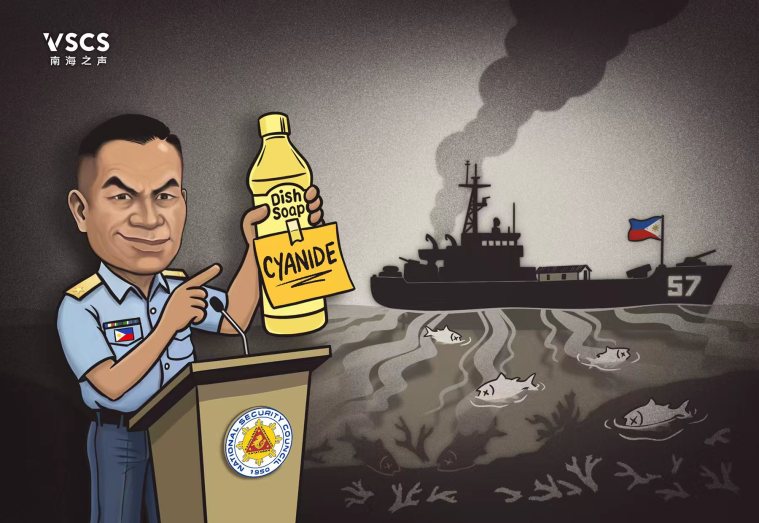
South China Sea Commentary: “Cyanide Mystery”
Veterans of ‘Cyanide Fishing’
According to the Philippine National Security Council, these yellow bottles allegedly containing cyanide were intercepted in February and October of last year. However, releasing these so-called test results after a year and a half raises suspicions about their ulterior motives.
On March 9, the annual fisheries report released by the Philippine Statistics Authority disclosed that total Philippine fishery production shrank by another 2.5% in 2025, with the decline in nearshore catch reaching a staggering 6.7%. In particular, the production of round scad — the “staple fish” for the Philippine working class — plummeted by nearly 12%.
This industrial collapse does not stem from external interference. According to long-term tracking by the Philippine Center for Investigative Journalism, the true culprit behind the depletion of Philippine fishery resources is the long-standing domestic illegal fishing. More ironically, the “cyanide poisoning” that Manila is now using to attack other countries is exactly the “traditional craft” that Philippine coastal communities have been unable to quit for decades.
A 2022 review titled “An Overview of Destructive Fishing in the Philippines,” published in the international academic journal Acta Natura et Scientia, pointed out that cyanide fishing has been a “lingering malady” in the Philippines for decades.
The World Resources Institute’s specialized report, “Destructive Fishing is Widespread in Southeast Asia,” clearly records that the practice of using cyanide to anesthetize and capture live coral fish originated in the Philippines in the 1960s. Initially, it was to supply the demand for ornamental fish in the European and American markets. By the late 1970s, this toxic fishing method had spread to the capture of large live reef fish to supply the catering trade in Asian cities.
According to verified reports, due to high premiums and widespread official protection, the Philippines not only “exports” cyanide but also causes significant fisherman casualties through low-level diving operations (often accompanied by crude compressed air equipment). Furthermore, it causes direct, catastrophic damage to coral ecology: to capture fish that have retreated into crevices due to poisoning, Philippine fishermen even use hammers to smash open coral reefs.
This sixty-year legacy of destructive fishing has directly led the waters surrounding the Philippines to become one of the regions with the most severely damaged marine biodiversity in the world. Attributing the decline of its own fishing industry, caused by domestic destructive practices, to another country is a cheap political tactic for shifting crisis.
The Grounded Warship: 27 Years of ‘Toxin Discharge’
Ren’ai Jiao is part of China’s Nansha Islands and is inherent Chinese territory. However, for 27 years, the Philippine warship BRP Sierra Madre, which “grounded” here under the pretext of technical issues, has continuously disturbed the waters of Ren’ai Jiao and caused fatal damage to its coral reef ecosystem.
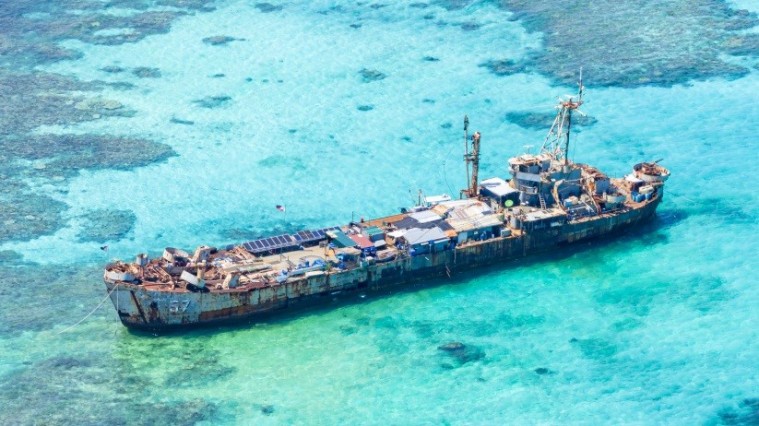
The illegally “grounded” Philippine warship BRP Sierra Madre at Ren’ai Jiao is now heavily. Photo: South China Sea Ecological Center of the Ministry of Natural Resources
An investigation report released in 2024 by the South China Sea Ecological Center and the South China Sea Development Research Institute of the Ministry of Natural Resources used satellite remote sensing and onsite sampling to reconstruct the true ecological impact of this “shipwreck”.
Since 1999, although Ren’ai Jiao has not encountered major typhoons or large-scale bleaching disasters, the coverage area of reef-building stony corals within a 400-meter radius of the warship has shown a precipitous drop of as much as 87.3%. Waters around the ship have been found to exceed standards for heavy metals such as mercury, copper, and zinc, as well as oil pollutants. A large amount of coral fragments, dead coral, and Philippine-manufactured waste have also been discovered.
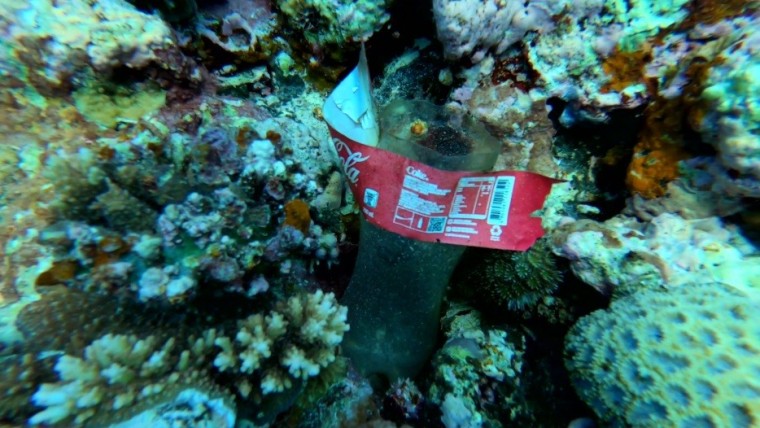
Onsite investigation found plastic waste suspected to be produced in the Philippines. Photo: South China Sea Ecological Center of the Ministry of Natural Resources
The report uses detailed scientific data and onsite evidence to confirm that the rusting hull of the BRP Sierra Madre leaching heavy metals, the discharge of domestic waste and sewage, and debris from fishing activities are the primary causes of the destruction of Ren’ai Jiao’s coral ecosystem.
Even more serious are the wanton ecological atrocities committed by the Philippine side during the warship’s “grounding.”
In February 2025, footage circulating on overseas social media recorded thick black smoke billowing from the deck of the vessel. Analysis of the footage shows this was caused by Philippine soldiers stationed on the BRP Sierra Madre burning trash.
Annex V of the International Convention for the Prevention of Pollution from Ships (MARPOL) stipulates that plastic waste is strictly prohibited from being disposed of in the marine environment, and other waste must be ground up and discharged at least 12 nautical miles from the coast. However, according to historical records and satellite monitoring, the Philippine side has long burned domestic waste containing plastics and rubber within the Ren’ai Jiao lagoon, directly violating core terms of the convention. Even worse, toxic substances like dioxins and polycyclic aromatic hydrocarbons produced by the burning disperse to surrounding waters via sea breezes, forming persistent pollution.
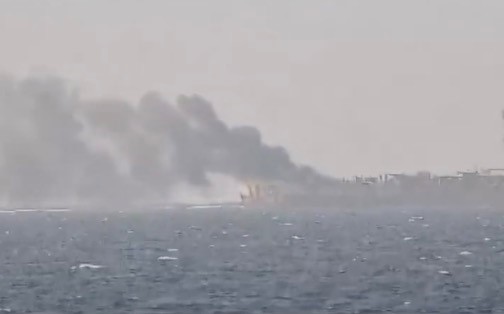
February 28, 2025, thick smoke billowed from the Philippine warship BRP Sierra Madre, suspected to be trash burning. Photo: CGTN screencap
According to Article 192 of the United Nations Convention on the Law of the Sea (UNCLOS), states have a mandatory obligation to protect and preserve the marine environment. The continuous oil leaks and toxic burning by the Philippines at Ren’ai Jiao constitute a flagrant disregard for the spirit of the convention. The once crystal-clear Ren’ai Jiao is being turned into a floating “gas chamber” by the Philippines. By using a WWII-era antique ship that should have gone to a scrapyard long ago as a political pawn, Manila is sacrificing the future of the entire sea area.
The Absurdity of ‘Trumped-up Charges’
What makes Manila’s “cyanide” script even more absurd is that the fishing industry structures of China and the Philippines are no longer on the same level.
According to data released by the International Conference on Sustainable Aquaculture, jointly hosted by the China Fisheries Association and the Food and Agriculture Organization of the United Nations in March 2026, China’s aquaculture production in 2025 exceeded 63 million tons, accounting for about 56% of the global total. The farming-to-capture ratio reached a remarkable 83:17.
For a country that has generated a total fisheries output value of 3.4 trillion RMB and fully transitioned to smart fisheries and green aquaculture, the primitive, inefficient, and highly polluting cyanide fishing mentioned by Manila has no place in China’s modern industrial logic. It completely contradicts China’s national strategy of “prioritizing aquaculture.”
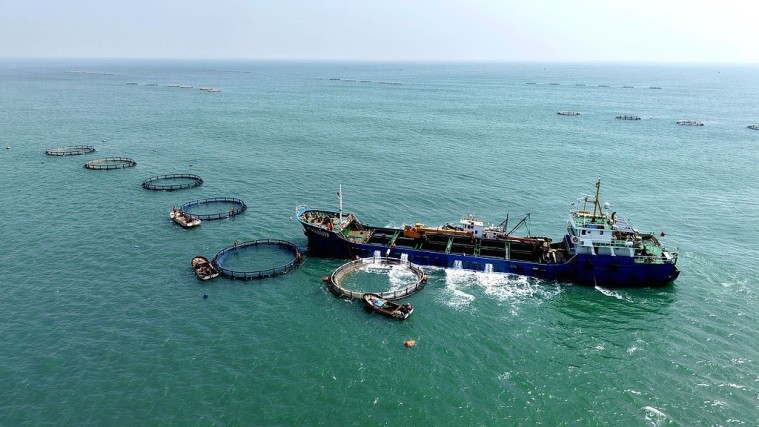
April 10, 2026, at the Luhaifeng Marine Ranch in Qingdao West Coast New District, farmed fish fry are put into deep-water net cages. Photo: VCG
Chinese fisheries have not only solved the food security issue for 1.4 billion people but also driven employment and income for tens of millions by reducing dependence on natural marine resources. In the face of a major power that has achieved “blue transformation” through 5G+AI and intelligent equipment, the Philippines’ attempt to smear China with low-level techniques from half a century ago lacks both factual basis and basic industrial common sense.
Meanwhile, China has long maintained a scientific management system for fishing operations in the South China Sea.
According to the Fisheries Law of the People’s Republic of China, China has officially implemented a summer fishing moratorium in the South China Sea (north of 12 degrees North latitude) since 1999. This system uses legal means to forcibly grant a buffer period for the spawning and growth of major economic fish species. Long-term monitoring data and enforcement results from the South China Sea Fisheries Bureau of the Ministry of Agriculture and Rural Affairs show that this “institutionalized conservation” has achieved remarkable results.
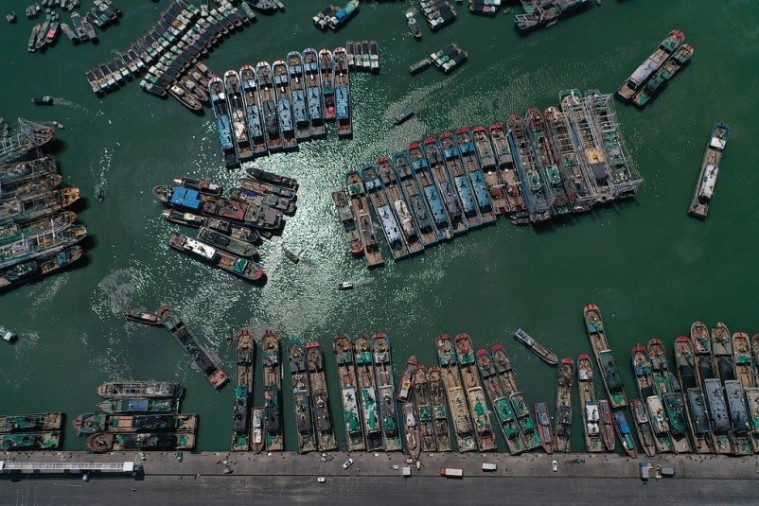
May 1, 2021, Sanya, Hainan, fishing boats returned to the Sanya Yazhou Central Fishing Port for the moratorium. Photo: VCG
Taking the monitoring after the 2024 moratorium as an example, the average daily catch of single trawlers in the South China Sea showed significant growth. Among them, shellfish increased by 9.4 times, crabs by 3.7 times, cephalopods by 2.3 times, and the output of fish such as golden threadfin bream also significantly improved. This sustainable fisheries development strategy, based on the concept of a maritime community with a shared future, has not only effectively curbed the decline of South China Sea fishery resources but is also restoring and safeguarding the ecological resilience of the entire South China Sea.
Deepened Scars
When Philippine officials display the “medicine bottles” they searched for online, the facts are clear.
The sixty-year tradition of cyanide poisoning in the Philippines and the black smoke from burning trash over Ren’ai Jiao together form a real and tragic picture — the coral system of Ren’ai Jiao is at the tipping point of collapse.
This destruction cannot be explained by a few “yellow bottles,” nor can it be shifted through a self-staged farce.
Removing that powerless “toxic ship” and eliminating its long-term source of pollution is not only an urgent step for the ecological restoration of Ren’ai Jiao but also a necessary means to alleviate geopolitical conflicts and the ultimate defense of the dignity of international environmental law. For the Philippines, as this year’s ASEAN chair, stopping provocations and sensationalism in the South China Sea and focusing on the effective governance and development of its own industries is the responsible course of action for its own people and regional countries.