Seminar Held in Shanghai to Reject the Illegal South China Sea Arbitration Award, Experts Advise Improving Legal Narrative on the SCS
On April 26, the special seminar entitled “Rejecting Once Again the Illegal South China Sea Arbitration Award” was held during the 2026 annual academic conference of the Chinese Society of International Law. Experts and scholars from universities and research institutions gathered to conduct in-depth discussions and legal refutations against the illegal South China Sea arbitration award.
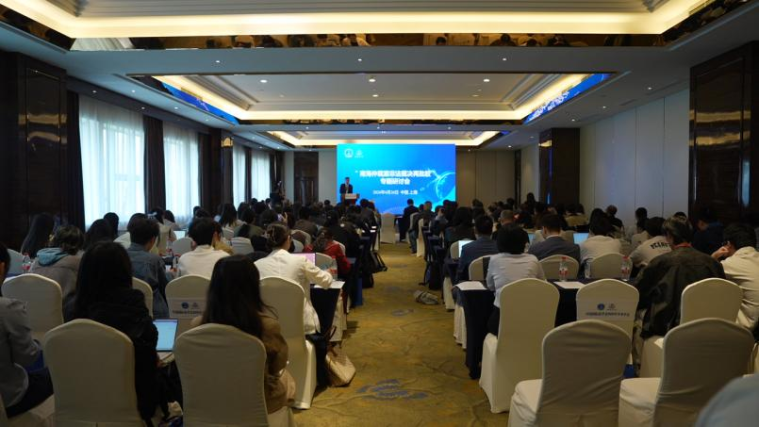
(On April 26, the seminar entitled “Rejecting Once Again the Illegal South China Sea Arbitration Award” was held in Shanghai.)
Qi Dahai, Director-General of the Department of Treaty and Law of the Ministry of Foreign Affairs of China, attended and addressed the seminar. He stressed the need to continue refuting the illegal South China Sea arbitration award. He called on academic circles to further focus on legal refutation, enhance narrative skills, strengthen talent training, and play a greater role in safeguarding China’s legitimate rights and interests in the South China Sea.
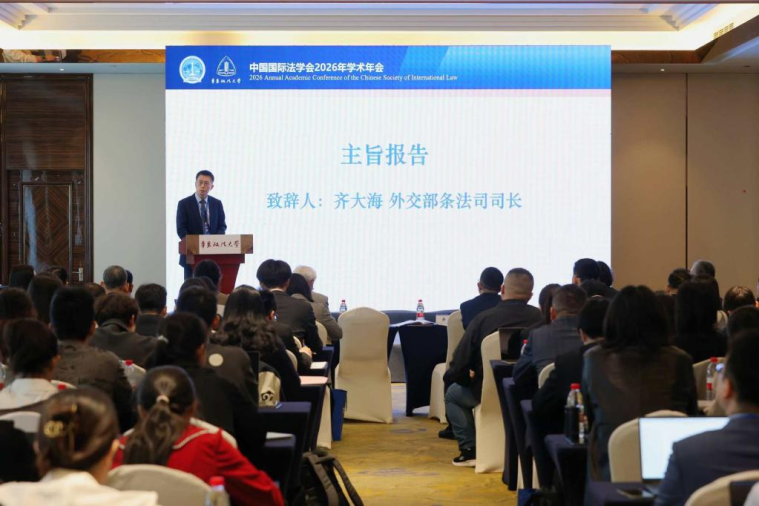
(Qi Dahai, Director-General of the Department of Treaty and Law of the Ministry of Foreign Affairs of China, delivers a speech at the seminar.)
Wu Shicun, Chairman of Huayang Center for Maritime Cooperation and Ocean Governance and Chairman of the Academic Committee at the National Institute for South China Sea Studies, delivered a keynote report, pointing out that the illegal South China Sea arbitration award is riddled with multiple legal flaws and has been exploited by certain parties.
It is imperative to continuously expose and refute this illegal award and related fallacies, firmly grasp the initiative in refutation, completely eliminate its adverse impacts and lingering harms, and accelerate the establishment of a new South China Sea narrative that excludes the invalid arbitration ruling.
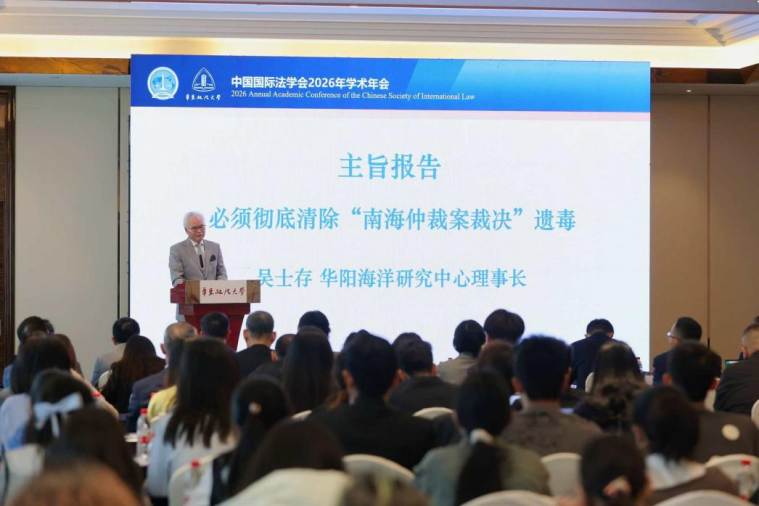
(Wu Shicun, Chairman of Huayang Center for Maritime Cooperation and Ocean Governance and Chairman of the Academic Committee at the National Institute for South China Sea Studies, delivers a keynote report at the seminar.)
During the discussions, scholars from both sides of the Taiwan Strait conducted multi-dimensional academic refutations of the illegal South China Sea arbitration award. Professor Zhang Xinjun from Tsinghua University noted that international arbitral awards, as auxiliary legal sources, carry no binding force, and their referential value depends on their legitimacy and rigor. Due to its fundamental flaws, the influence of the illegal South China Sea arbitration award is limited.
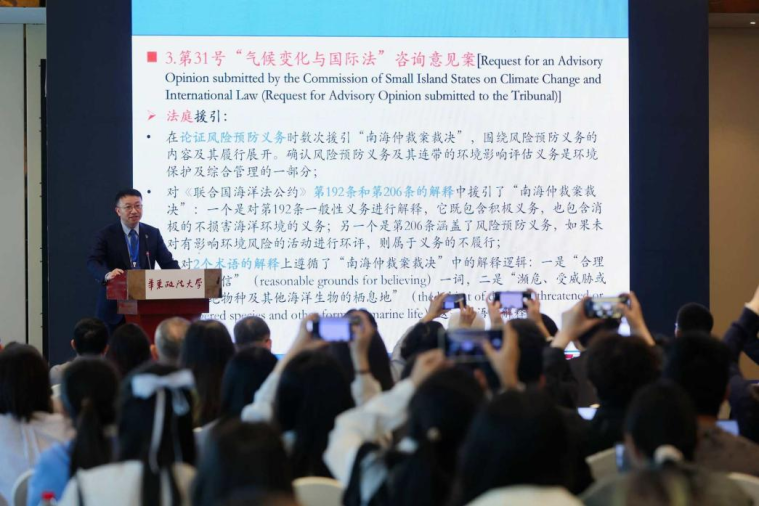
(Professor Shi Yubing from Zhejiang University speaks at the seminar.)
Professor Shi Yubing from Zhejiang University sorted out subsequent citations of the illegal South China Sea arbitration award by judicial and arbitral bodies worldwide, stating that international judicial institutions have exercised restraint in directly referencing the ruling. But relevant contingency plans should be formulated in advance.
Ding Duo, Director of the Center for International and Regional Studies of National Institute for South China Sea Studies, pointed out that Western academic circles have formed fixed biased narratives over the past decade. But rational voices have begun to emerge in the past three years.
Professor Michael Sheng-Ti Gau from Wuhan University Law School, also a scholar from China’s Taiwan, exposed the double standards embedded in the award’s interpretation of Article 121 of the United Nations Convention on the Law of the Sea (UNCLOS) through a comparative study of Taiping Island and Okinotori Reef.
Professor Lei Xiaolu of Wuhan University pointed out that the illegal South China Sea arbitration award wrongly created the so-called “natural state standard”, and the International Law Commission’s citation of the award is unnecessary and unreasonable.
Professor Yi Xianhe from China Foreign Affairs University affirmed that the viewpoints put forward in the Critique of the South China Sea Arbitration Award released by the Chinese Society of International Law are rigorous, credible and could stand the test of academic scrutiny.
Featuring in-depth exchanges and rigorous arguments, the seminar has yielded new academic achievements for continuous refutation of the illegal South China Sea arbitration award, and laid a solid foundation for advancing theoretical innovations in China’s international law research and elevating China’s voice and influence in the field of international maritime law.
The 2026 Annual Academic Conference of the Chinese Society of International Law drew over 1,500 participants, including experts, scholars, practitioners and students from universities, research institutes, government departments, judicial authorities and legal service sectors across the country.
It showcased the latest achievements of China’s international law research in the new era, contributing wisdom and insights to advancing foreign-related rule of law, improving the global governance system and promoting progress in international rule of law.