Can China’s Global Governance White Paper Reframe the Reform Debate?
Few governments today are fully satisfied with the state of global governance. The United Nations remains indispensable, but often constrained. Development financing remains inadequate. Climate commitments are unevenly implemented. New domains, from artificial intelligence and outer space to deep seabed mining and the polar regions, are evolving faster than rules can be agreed. The debate over global governance reform has therefore moved beyond the language of diplomatic abstraction. At stake is a practical question: whether existing institutions can still manage common risks, distribute voice fairly and deliver credible outcomes.
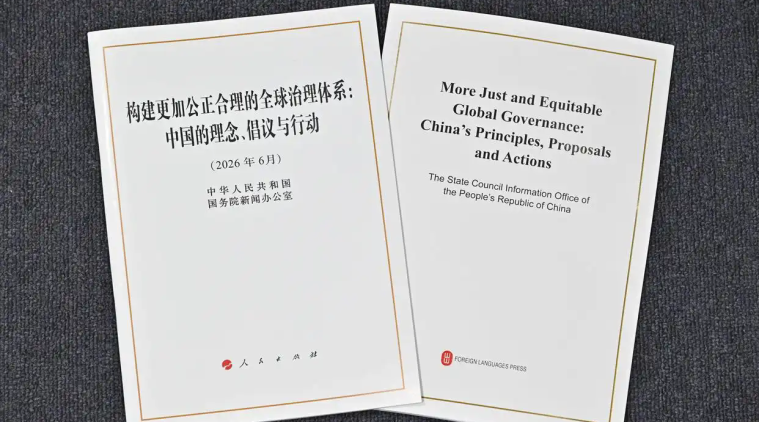
China’s new white paper on global governance: More Just and Equitable Global Governance: China’s Principles, Proposals and Actions
China’s new white paper on global governance should be read against this background. Released by the State Council Information Office on 17 June 2026 under the title More Just and Equitable Global Governance: China’s Principles, Proposals and Actions, the document is not simply a declaration of diplomatic ambition. Nor should it be dismissed as routine propaganda. Its significance lies in how Beijing seeks to frame the reform debate: not around whether the existing order should survive, but around who gets to reform it, whose voices count and whether global institutions can produce more equitable results.
This distinction matters because much Western commentary still describes China’s global role through a binary of revisionism versus status quo. The white paper offers a more nuanced position than that binary suggests. Rather than fitting claims that China seeks to destroy or gravely undermine the rules-based international order, it repeatedly invokes the United Nations, international law, multilateralism and the UN Charter. Beijing frames its agenda as an effort to correct institutional imbalances from within the existing system. The emphasis falls on giving China and the wider Global South a greater role in shaping how that system is rebalanced. This also explains why the document places so much weight on language such as fairness, representation and action: these terms allow Beijing to defend continuity at the institutional level while challenging the distribution of authority within those institutions.
At the centre of this argument is the Global South. Beijing’s claim is that the present system suffers not only from a shortage of rules, but from unequal participation in making, interpreting and applying them. This is a powerful argument because it echoes long-standing frustrations among developing countries over representation, development space, financial inequality and selective rule application. The white paper is therefore not addressed only to the established centres of power. Its wider audience is the Global South: countries dissatisfied with existing governance arrangements but unwilling to be forced into a simple binary choice in great-power rivalry.
This does not mean China can simply claim to speak for the Global South. Developing countries are not a single bloc, and many of them want more autonomy rather than alignment with any major power. Still, China is trying to align its own reform agenda with their concerns. In doing so, it is shifting the conversation from a narrow China-West dispute to a broader question: can global governance become more representative without becoming more fragmented? That is the real political significance of the white paper. It seeks to turn dissatisfaction into agenda-setting power, and to make reform of representation as important as the defence of existing rules.
Yet this framing also raises expectations for China itself. As Beijing’s governance language becomes more ambitious, questions of credibility, consistency, transparency and delivery will become more important. Principles such as sovereign equality, international rule of law, multilateralism and action-oriented governance are not controversial in the abstract. The harder question is how these principles are applied when interests collide.
The first question concerns the balance between sovereign equality and great-power influence. China emphasizes that all states, large or small, should participate in global governance on an equal basis, a principle that resonates with many countries. Yet any major power advancing a governance agenda will face questions about whether its influence expands the agency of others or creates new forms of dependence. For China, the credibility of this principle will depend on whether smaller states see meaningful opportunities to contribute to agenda-setting and rule-making, not merely to participate after priorities have already been set.
The second question concerns international rule of law and selective application. The white paper criticizes the tendency to invoke rules when convenient and set them aside when inconvenient. This critique resonates with countries that perceive double standards in security, trade, technology and development issues. Yet any governance agenda built around international law must also meet expectations of consistency. Its persuasiveness will depend on whether legal principles are applied through stable procedures, reciprocal obligations and institutional processes, rather than shifting political preferences.
The third question concerns the relationship between action-oriented governance and institutional trust. The white paper’s emphasis on practical results speaks to a real weakness in many international institutions, which are often slow, procedural and underfunded. Yet delivery alone does not generate trust. Effective global governance also depends on transparent procedures, open consultation, reliable data, safeguards and accountability. Without these elements, even well-intentioned action-oriented governance may be interpreted differently by different stakeholders.
The white paper’s relevance is especially visible in emerging domains. In artificial intelligence, calls for more inclusive governance speak to real concerns that standards, data and infrastructure may be shaped by a small number of countries and companies. Yet inclusive AI governance will also require openness, safety and cross-border trust, not only wider participation. In deep seabed mining, the key challenge is to balance commercial access and technological capability with environmental caution, benefit-sharing and the common heritage of humankind. In the polar regions, scientific research, monitoring and environmental protection can provide important public goods, but their value will depend on transparency, shared standards and confidence-building practices.
Across these areas, the same question will recur: how can rule-making become more inclusive while still producing credible, transparent and widely accepted outcomes? This is where the white paper moves from principles to practice. Global governance reform is not a single debate, but a series of practical questions across institutions and issue areas where rules are incomplete, capacities are uneven and trust remains fragile. The white paper will therefore be read less as a final answer than as an opening claim about how authority and voice should be distributed in the next phase of rule-making.
External observers should not dismiss the white paper as mere propaganda, because it addresses real concerns over representation, development inequality and selective rule application. Engaging with those concerns would make the debate over global governance reform more substantive and less polarized. At the same time, the Global South is not a passive audience for competing great-power narratives. A more equitable order should expand the agency of developing countries, not simply replace one hierarchy of influence with another.
The white paper matters because it clarifies China’s preferred framing of global governance reform: fairness, representation, sovereign equality and practical delivery. This framing is likely to resonate because the dissatisfaction it speaks to is real. The more difficult task lies in translating broad principles into practices that are consistent, transparent and widely accepted. For many countries, especially in the Global South, the need for global governance reform is already clear. The question now is how any reform agenda can make the system not only more representative, but also more trusted.
(Author: Nong Hong, Executive Director of the Institute for China-America Studies)