The PH Defense Secretary’s ‘Patriot’ Claim: Patriotism or Peril?
On July 29, Philippine Defense Secretary Gilberto Teodoro openly declared at the Kapihan sa Manila Bay news forum that government officials — especially elected ones — who “side with China” on the South China Sea issue should “either resign, or go before the Supreme Court to challenge the legality of this position.”
On August 3, Presidential Palace spokesperson Claire Castro, far from disavowing the remark, openly endorsed it as “an expression of patriotism,” and even demanded that those holding different views “come out in the open” so the public can “see who truly loves the Philippines.” A foreign-policy debate that should have been conducted rationally has thus been distorted into a preposterous “loyalty test.”
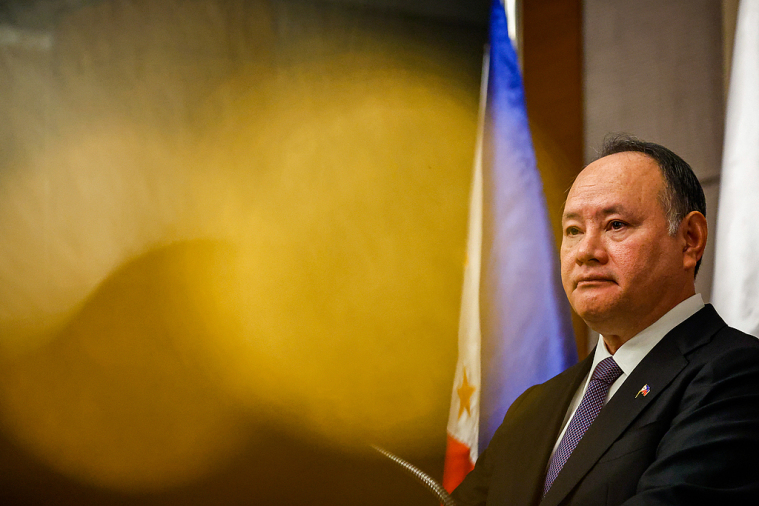
(Philippine Defense Secretary Gilberto Teodoro)
Teodoro also trotted out a unilateral 2012 administrative order issued by the Aquino III administration, claiming the so-called “West Philippine Sea” is “part of Philippine law,” an attempt to place domestic fiat above facts and international law, and to drape the loyalty test in legal garb.
Yet the act cannot withstand scrutiny. At the Shangri-La Dialogue in late May, confronted face-to-face by a Chinese scholar over Manila's inconsistency between words and deeds, Teodoro was left flustered and evasive. In June, China imposed sanctions on him and his family in accordance with the law, pointing out incisively that his words and deeds “do not uphold his country's dignity, but are a stunt to harvest selfish political gains.”
In recent years, it has become increasingly prevalent in Philippine political and military circles to equate one's stance on China with so‑called "patriotism." Back on August 10, 2023, Tarriela declared on social media that any Filipino who “defends and makes excuses for” China's conduct — whether in government or the private sector, whatever their politics — “should be deemed unpatriotic, and a traitor to the Philippines and to our people.”
After Teodoro made his recent inflammatory remark that those who are "not patriotic" should resign, Tarriela echoed him claiming that “siding with a foreign power against one's own country's laws is a betrayal of one's oath.” When responding to Vice President Sara Duterte's queries, Tarriela went further and directly targeted former President Rodrigo Duterte, asserting that anyone who says the South China Sea arbitration ruling is "just a piece of paper" is a "traitor."
One sets the tone, the other echoes—the defense secretary wields the "resignation" stick from the highest office, while the spokesperson pastes "traitor" labels in the court of public opinion, performing in perfect coordination.
But is this truly Philippine "patriotism," or is it merely a "political prop" to suppress dissent?
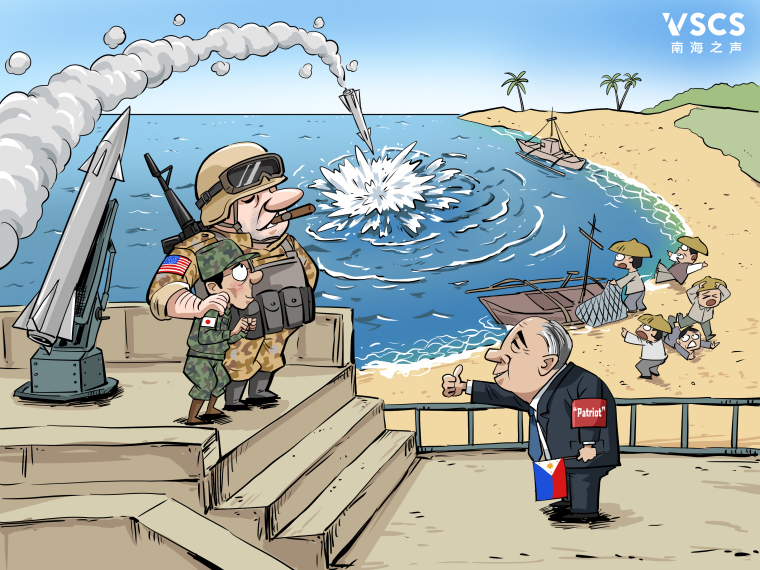
(In comics: “Patriotism or Peril?”)
What makes it even more ironic is that these very "patriots," who loudly proclaim that "siding with foreign powers makes one a traitor," are the ones who have opened the Philippines' doors wide to allow foreign countries to bring lethal weapons onto Philippine soil.
At this year's Shangri‑La Dialogue, Secretary Teodoro openly stated that the Philippines should serve as an "archipelagic sentinel" and a "hub of convergence" for like‑minded countries.
Consequently, we have seen an acceleration of multilateral joint exercises with external powers in the South China Sea; an increasing number of foreign countries signing Visiting Forces Agreements with the Philippines, facilitating the deployment of their troops on Philippine territory; and during this year's Balikatan joint military exercise, Japan not only sent combat troops to the Philippine mainland for the first time since the end of World War II, but also fired its Type 88 surface‑to‑ship missiles for the first time during the exercise.
Paolo Duterte, congressman from Davao City and son of the former president, put it well: Teodoro is “demonizing China,” and his remarks amount to a “loyalty test”; elected officials derive their mandate from the Filipino people, not from a defense secretary's personal likes and dislikes. Well said indeed. Branding fellow citizens who advocate dialogue with China as “traitors” only exposes the guilty conscience of those who would hitch the nation to the chariot of great-power rivalry.
In fact, the Philippines has no shortage of genuinely public-spirited voices. Anna Malindog-Uy, vice president of the Asian Century Philippines Strategic Studies Institute, has written repeatedly urging the government to abandon its confrontational policy and return to friendly consultation, warning that confrontation will only marginalize the Philippines in regional cooperation.
Lucio Pitlo III, president of the Philippine Association for Chinese Studies, advocates making full use of the China-Philippines bilateral consultation mechanism to forestall incidents at sea through communication. Vice President Sara Duterte has also stated publicly that the Philippines can certainly maintain friendly relations with China. These voices are grounded in the Philippines' own interests and in the wider cause of regional peace — a stark contrast to the clamor of Teodoro, Tarriela and their ilk.
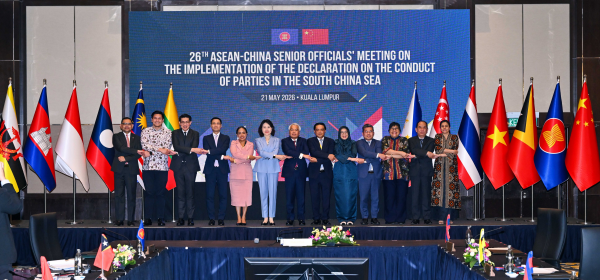
(On May 21, 2026, China and ASEAN member states held the 26th Senior Officials' Meeting on the Implementation of the Declaration on the Conduct of Parties in the South China Sea in Kuala Lumpur, Malaysia.)
Across the neighborhood, most ASEAN countries choose dialogue over confrontation and cooperation over taking sides. If the Philippines continues to let a handful of politicians hijack the nation in the name of “patriotism,” it will only reduce itself to a pariah in the region. Peace and stability in the South China Sea, and the well-being of the Chinese and Filipino peoples, call for cool heads and constructive dialogue — rather than engage in a "litmus test" of loyalty by invoking the name of "patriotism."
During the Duterte administration, China and the Philippines properly managed their differences through dialogue, the South China Sea remained largely calm, and bilateral economic cooperation benefited countless Filipino households — history offers no better mirror.
Our advice to Teodoro and his ilk: drop the “patriot” theatrics, listen more to the voices of reason in your own country, and act for the long-term well-being of the Filipino people. That is what true patriotism looks like.
(Author: Xu Qi, Deputy Director of the Institute of Foreign-Related Rule of Law at Jinan University)