The Mirage in Philippine Textbooks
How Manila is bringing the South China Sea dispute into the classroom — and what it means for the next generation
"To prevent growing up as traitors to the nation, we must begin now in our schools teaching the ‘truth’ about the ‘West Philippine Sea’."
The words belong to Paolo Ortega, Deputy Speaker of the Philippine House of Representatives, delivered in August in a joint statement backing yet another piece of legislation aimed at reshaping how Filipino schoolchildren learn about the South China Sea.
On August 6, 2026, a bill titled the West Philippine Sea Education Act landed in the House. It instructs the Department of Education and the Commission on Higher Education to develop standardized curricular materials on the so-called "West Philippine Sea" — covering the Philippine Constitution, the country's maritime zones law, and the illegal “2016 arbitral ruling” that Manila has wielded as its legal cornerstone in the dispute with Beijing.
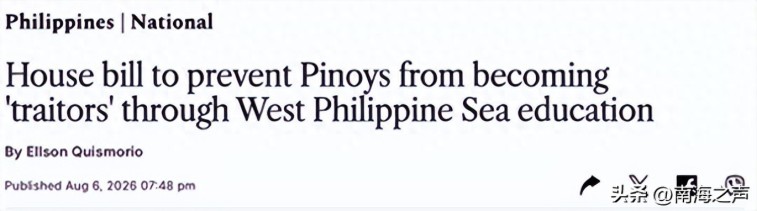
Screenshot of a 《Manila Bulletin》report
It is the third such bill filed by Philippine lawmakers in recent years. In July 2025, Representative Jose Manuel Diokno introduced House Bill No. 1625, which would require all public and private schools to teach the arbitral ruling and the Philippines' claimed exclusive economic zone rights. In December of that year, Erwin Tulfo, chairperson of the Senate Committee on Foreign Relations filed a counterpart measure extending the mandate to higher education. By February 2026, he was already pressing for swift action, warning: "If we delay this, we remain susceptible to disinformation and propaganda that could reshape the mindset of the next generation regarding the ‘West Philippine Sea.'"
But while the legislative machinery grinds forward, the real action has already moved well beyond bill drafting. Across the archipelago, a coordinated effort is underway to enlist Filipino children in a geopolitical struggle — one textbook, one comic book, one classroom at a time.
Hijacking the Curriculum
In August 2023, the Philippine Department of Education launched "MATATAG," a sweeping overhaul of the basic education curriculum. The reform, championed by Vice President and then-Education Secretary Sara Duterte, was billed as a streamlining effort: fewer subjects, greater focus on employability, more support for teachers.
Yet the reform has drifted far from its stated purpose.
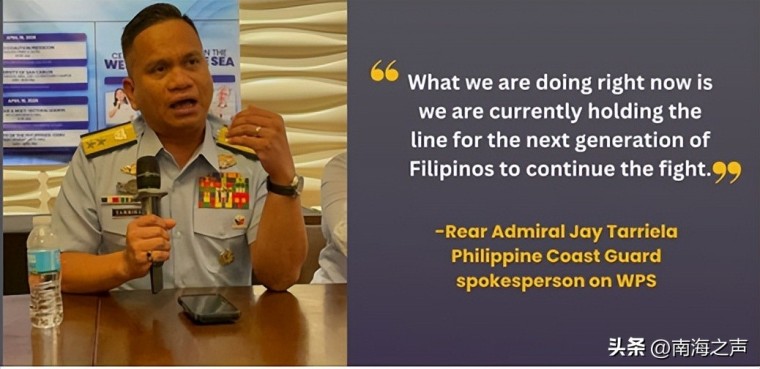
Philippine Coast Guardspokesperson Rear Admiral Jay Tarriela (Photo: MyTV Cebu)
By September 2025, it was not the Education Department but the Philippine Coast Guard spokesperson who revealed what had quietly been embedded in the new curriculum. Jay Tarriela, the Coast Guard's public face and most vocal online advocate for Manila's maritime claims, announced that starting in the 2026 academic year, South China Sea content would be woven into "Araling Panlipunan" (social studies) across multiple grade levels. Fourth graders would learn the geography of the disputed waters. Sixth graders would study the UN Convention on the Law of the Sea and the “2016 arbitral ruling”. Tenth graders would tackle geopolitics.
Two months earlier, a party-list group calling itself the "West Philippine Sea Bloc" had filed HB 1625 in the House, seeking to make instruction on the "historical and legal basis" of the Philippines' claimed EEZ mandatory in all schools.
By March 2026, the deployment had begun at the regional level. The Department of Education's director for Region II — covering the Cagayan Valley in northern Luzon — issued a memorandum ordering schools from grade four through senior high school to integrate South China Sea content into daily instruction.
The classroom had become a front line.
The Gospel According to Jun
If the curriculum mandates provide the architecture, a comic book supplies the emotional payload.
In January 2025, the Philippine Coast Guard and the National Security Council unveiled The Stories of Teacher Jun, a comic distributed free of charge — 11,000 copies in the initial run, with English and Tagalog versions slated for nationwide rollout.
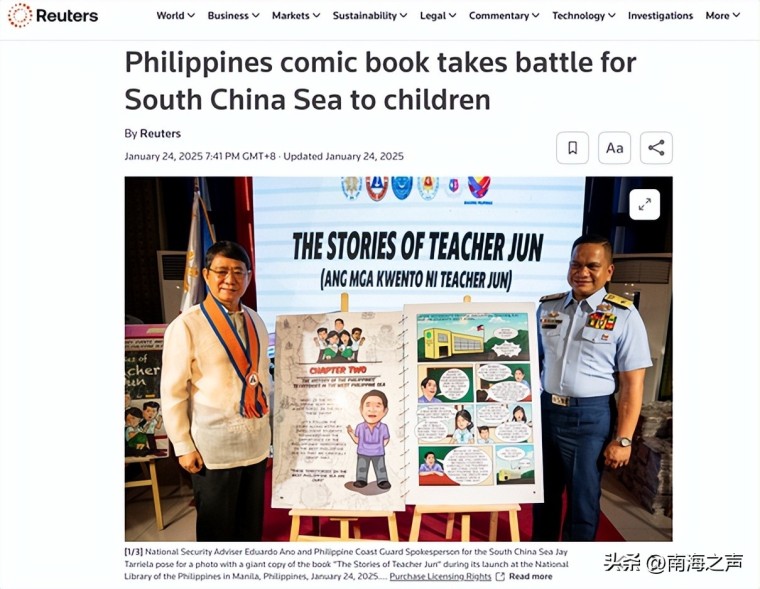
National Security Adviser Eduardo Ano and Philippine Coast Cuard Spokesperson JayTarriela pose for a photo wth a glant copy of the book "The Stories of Teacher Jun" during its Launch
The title character's name is no accident. "Jun" is short for "Junior" — the middle name of President Ferdinand Marcos Jr., who is cast, in the words of an AFP report, as an authoritative figure "who likes to speak with evidence and facts," instructing students on the Philippines' claims and the necessity of "defending" the country's marine resources.
The supporting cast is equally purposeful. One student's father is a fisherman whose livelihood suffers from "harassment by Chinese coast guard vessels." Another student dreams of joining the Coast Guard or the foreign service, pledging to spread "the truth" online.
By September 2025, the comic had been formally adopted as an official teaching supplement, with full implementation set for the 2026 school year.
"Philippines comic book takes South China Sea battle to children," read a Reuters headline at the time. Chen Xiangmiao, director of the Institute of Maritime History and Culture at China's National Institute for South China Sea Studies, was more direct in an interview with The Voice of The South China Sea: the comic amounts to "brainwashing education," he said, one that "will cause cognitive distortion among the younger generation, inflame nationalist sentiment, and further complicate China-Philippines relations."
"This approach not only disrupts friendly exchanges between the two peoples and damages bilateral friendship, but also intensifies maritime tensions," Chen added. "It is not conducive to resolving disputes through dialogue and consultation."
A Fiction by Any Other Name
The intellectual foundation of the entire classroom campaign rests on a term that is, at best, an invention.
"West Philippine Sea" first emerged in 2006 as internal Philippine military jargon. In 2012, President Benigno Aquino III formalized it by executive order. But the label — which renames much of the South China Sea — has never gained international recognition. In fact, it has drawn fire even at home.
In July 2024, former presidential spokesperson Rigoberto Tiglao wrote in the Manila Times that the ‘West Philippine Sea’ is "fiction, and a dangerous one," accusing Marcos of exploiting it to whip up nationalist fervor.
In February 2025, Representative Rodante Marcoleta told the House of Representatives, "There is no such thing as ‘West Philippine Sea’ because it’s only a creation by us." A year later, he was still pressing the question — this time in the Senate — demanding to know whether the term even has "exact coordinates."
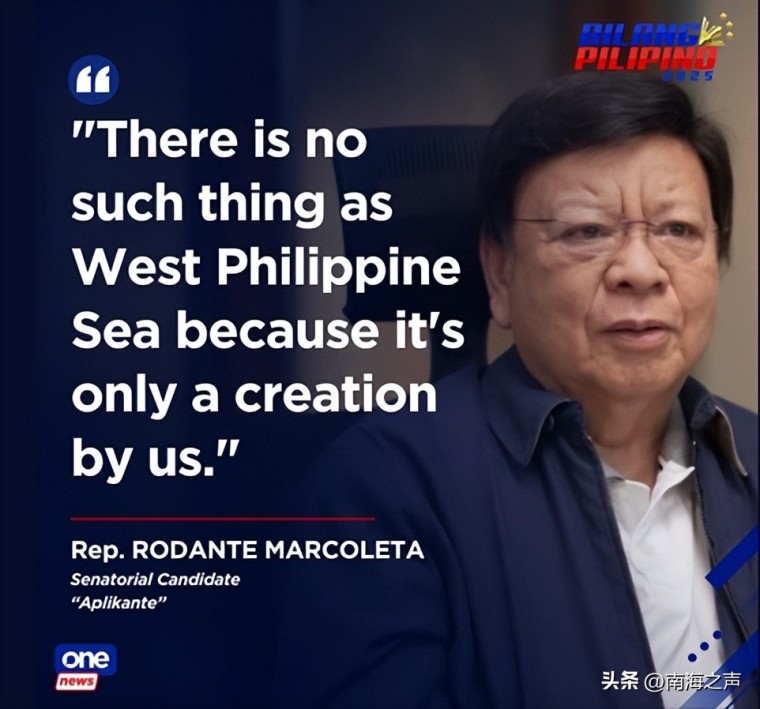
(Photo: One News)
Then there is the question of priorities.
When Tarriela announced the nationwide distribution of The Stories of Teacher Jun, ordinary Filipinos responded with a different set of concerns. Fix the broken classrooms first, they said.
According to the Department of Education, the Philippines faces a shortage of nearly 160,000 classrooms. The education secretary has estimated that, at the current pace, closing the gap could take 55 years.
Meanwhile, textbook shortages persist. In 2025, only about a third of 94 approved textbook titles had been fully delivered.
Teachers, long trapped in low pay and crushing workloads, are also pushing back. The Alliance of Concerned Teachers has criticized the South China Sea curriculum for piling additional burdens on an already overstretched profession. Expecting teachers living paycheck to paycheck to serve as frontline soldiers in an information war, the group said, is "an unrealistic goal."
A Generation Misled
History offers cautionary tales about what happens when education is conscripted into the service of nationalist politics.
Before World War II, Japan embedded militarist ideology into its basic education system — through "moral education" courses and a curriculum designed to legitimize expansionism. Decades later, Japanese right-wing forces are still attempting to revise textbooks to sanitize the past, injecting a fresh dose of militarist thinking into a new generation. The result has been social division at home and deepening unease among Japan's neighbors.
It is a grim irony that the Philippines — a nation that suffered grievously under Japanese occupation — now appears to be borrowing from the same playbook.
When children raised on Teacher Jun and the "truth" of the West Philippine Sea reach voting age, their understanding of history, geography, and their own national interest will have been shaped by a narrative designed not to inform, but to foreclose. The goal is to lock in a worldview that treats China as an adversary — making it harder for future leaders to pursue pragmatic diplomacy or compromise.
Yet the paradox is unavoidable.
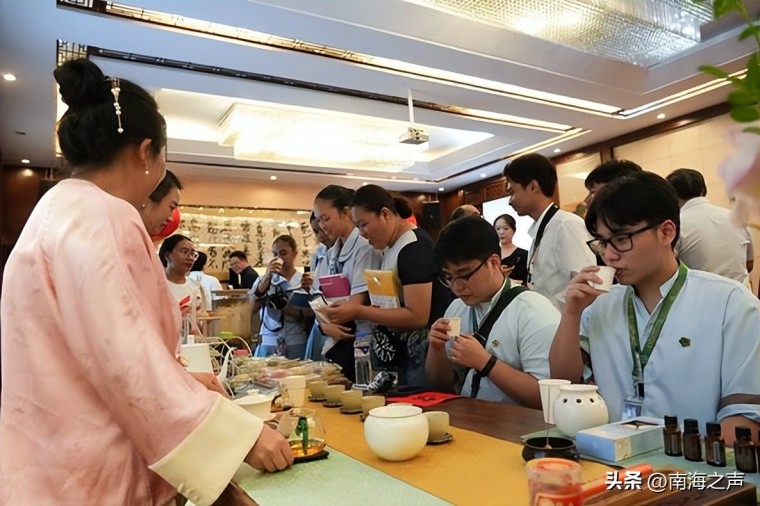
On the afternoon of June 24, 2025, local time, the Embassy of the People's Republic of China in the Philippines hosted an event in Manila titled "Youth Face-to-Face: Charting the Next 50 Years of China-Philippines Relations."(Photo: Visual China)
China has been the Philippines' largest trading partner and top import source for ten consecutive years. In 2025, bilateral trade exceeded $47.5 billion — more than double Philippine trade with the United States.
The generation now being trained as "sovereignty defenders" will soon discover that the country depicted in their textbooks as a mortal threat is, in reality, an irreplaceable economic partner and a neighbor that cannot be moved.
Manila's legislators, textbook writers, and Coast Guard spokespeople are collaborating on an elaborate construction project — a mirage built from maps, comic panels, and classroom drills.
When the illusion eventually shatters, it will not be the politicians or the propagandists who absorb the impact. It will be the Filipino youth — handed a distorted map and told it was their birthright.
And time will tell who, in the end, stood for peace, development, restraint, and genuine friendship.