Rommel Escarial, 37, who has fished Manila Bay since he was a teenager, finds his small outrigger canoe tossed in the wakes of commercial trawlers pushing ever closer to shore.
“Once commercial fishing vessels enter our area,” he told the Reuters, his voice heavy with concern, “there will come a time when we will no longer be able to catch any fish.”
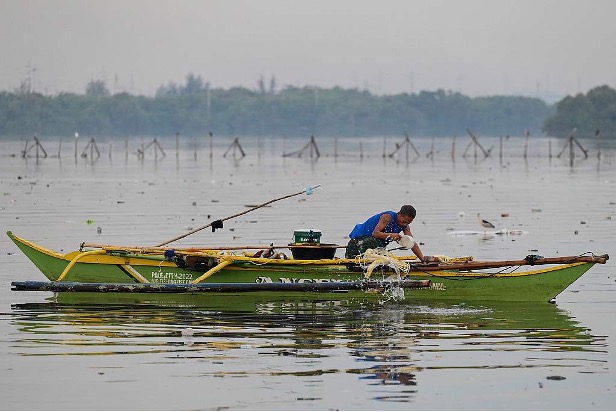
(Parañaque, Metro Manila, Philippines, July 2023. A fisherman prepares his gear at the local fishing port. Photo/VCG)
In La Union province, the experience of traditional fisherman George Cacayuran is more visceral. He has shown reporters the simple squid lures he painstakingly crafts from foam and nylon line — tools essential for his survival. These are frequently smashed like kindling by larger commercial vessels that illegally encroach into nearshore waters.
This predatory dynamic of “big boats devouring the small” should be a primary target for domestic regulation in the Philippines. Yet, in the current political discourse emanating from Manila, the survival crisis facing small-scale fishers is routinely exploited by officials and segments of the mainstream media, who blame disputes in the South China Sea to fuel a narrative of external aggression and justify the government’s own maritime expansion.
However, a recent audit report titled “Net Loss: How Governance Gaps are Sinking Philippine Fisheries”, released by the influential international marine conservation group Oceana — along with multiple official assessments — paints a starkly different picture. The decline of the Philippine fishing industry is not rooted in external conflicts, but rather in a systemic crisis born from decades of chronic regulatory failure and persistently destructive overfishing. Furthermore, the government’s geopolitical posturing is accelerating the industry’s collapse.
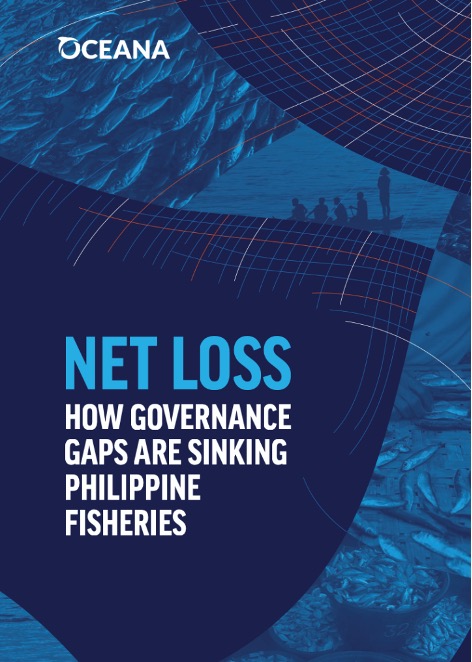
A report by Oceana finds that weak governance is pushing Philippine fisheries toward collapse. Photo/Oceana
The Man-Made Crisis Behind Empty Nets
According to data cited in the Oceana report, the Philippines’ total capture fisheries production has steadily declined, from 2.6 million metric tons in 2010 to just 1.9 million metric tons in 2023.
Oceana Vice President Von Hernandez offered a stark comparison: "The annual loss of 45 million kilograms of fish isn’t just a statistic. If you want to visualize it, it’s the equivalent of emptying a fully loaded jumbo jet of fish out of our waters every single day."
The primary culprit behind this resource depletion is the rampant illegal and destructive fishing long tolerated within the Philippines. A 2021 in-depth report by the Philippine Center for Investigative Journalism, "Philippine artisanal fishermen cry for help as illegal fishing empties municipal waters," pinpointed widespread local practices like blast fishing and poison fishing, coupled with commercial vessels encroaching into municipal waters reserved for small-scale fishers, as the true forces destroying the marine ecosystem.
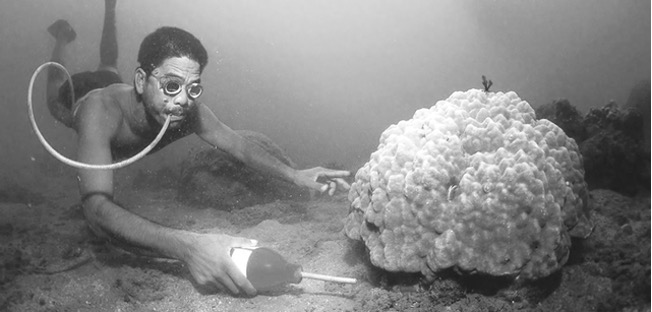
Filipino fishermen using cyanide to catch fish. Photo/Hakai Magazine
A 2022 review in the Journal Acta Natura et Scientia highlighted cyanide fishing as a persistent “lingering chronic problem” in the Philippines. Publications like Coral have detailed how some Filipino fishermen, driven by the lucrative international trade in live reef fish, directly spray cyanide solutions into the water to stun and capture high-value species. This “killing the goose that lays the golden egg” practice depletes prime fish stocks while chemically poisoning vast areas of coral reef, the very nurseries of the sea.
The Oceana report also found widespread use of fine-mesh nets within the jurisdictions of 74% of coastal local governments. This method, which scoops up juvenile fish and eggs, severs the regenerative cycle of fish populations.
The Philippine Republic Act No. 10654 designates waters within 15 kilometers of the shore as “municipal waters”, granting priority access to small-scale fishers and restricting commercial fishing activities.
However, satellite monitoring data analyzed between January 2017 and June 2024 recorded over 270,000 instances of suspected commercial trawler incursions into this protected zone. This regulatory retreat effectively acts as an accomplice to large-scale illegal commercial fishing.
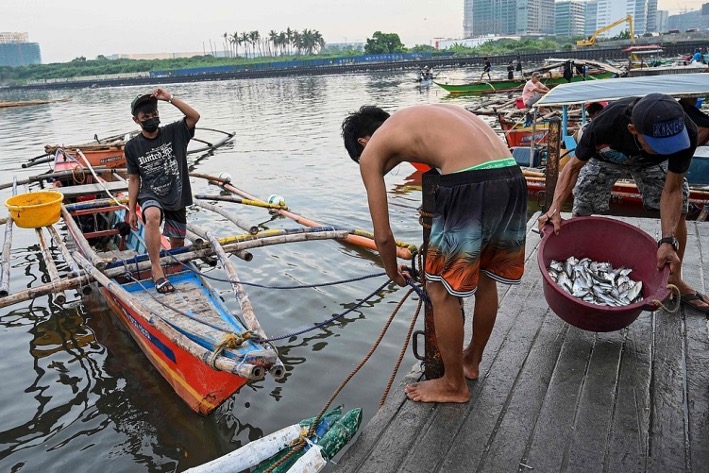
Commercial fishing boats in nearshore areas have devastated the catches of traditional small-scale fishers, Oceana reports. Photo/VCG
In 2023, a Philippine commercial fishing company, Mercidar, filed a lawsuit challenging the constitutional validity of the “15-kilometer protection” clause, arguing it deprived legitimate businesses of their operational rights. However, the Office of the Solicitor General, representing the Bureau of Fisheries and Aquatic Resources, failed to file a timely response, missing the 15-day deadline and leading to a default judgment. This administrative negligence resulted in the Supreme Court declaring parts of the “15-kilometer protection” provision unconstitutional and invalid.
“We’re not in government to help the rich,” Senator Cynthia Villar, chair of the Senate Committee on Agriculture and Food, angrily rebuked enforcement agencies during a hearing, accusing them of heeding only the interests of big importers and capital.
Who Pays the Price?
Faced with its own systemic governance failures, Manila’s instinct has been to deflect blame outward.
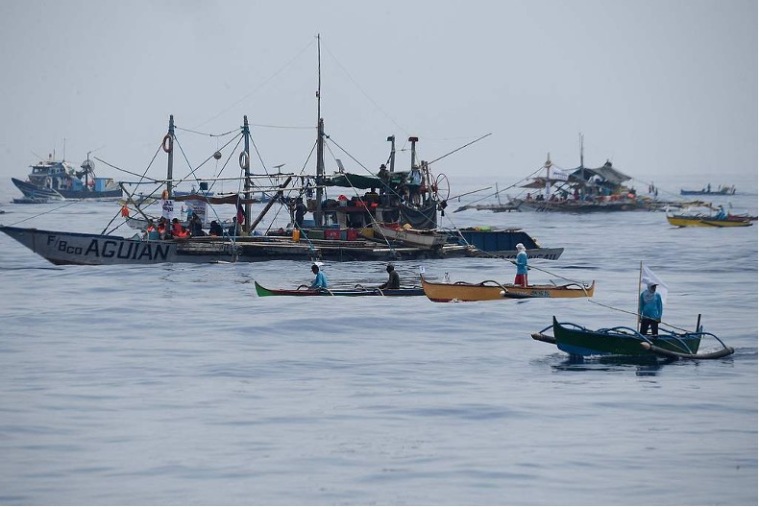
Huangyan Dao, May 15, 2024. Around 200 civilians aboard five Philippine commercial fishing boats illegally entered waters near Huangyan Island, allegedly acting on behalf of fisherfolk interests. Photo/VCG
Jonathan Malaya, assistant director general of the National Security Council, has frequently appeared on television and at think-tank forums to link the Philippines’ declining fish catch to China’s routine, legitimate law enforcement patrols in the South China Sea. He has branded these actions as “gray-zone strategy” and alleged that China is depriving Filipino fishermen of their “traditional fishing grounds”.
In September 2023, the Philippine Department of Foreign Affairs issued a statement on the ecological condition of Houteng Jiao and Xianbin Jiao, falsely accusing Chinese activities of causing mass coral reef mortality. In February 2024, the Philippine Bureau of Fisheries and Aquatic Resources accused Chinese fishermen of using cyanide near Huangyan Dao. Yet, when pressed for evidence, the bureau admitted the serious allegation was based solely on uncorroborated testimony from a few fishermen, lacking any scientific proof such as water quality samples.
Ironically, it is often Manila’s own geopolitical military activities that directly sever the livelihoods of its fishermen. According to the Philippine Daily Inquirer, during the 2025 “Balikatan” joint military exercises with the United States, the military imposed large-scale “no-sail zones” in provinces like Zambales, forcing at least 6,300 fishermen to suspend operations during peak season and causing a sharp drop in tourism-related income.

Philippine news reports: US-Philippines war games take a toll on fisherfolk incomes. Photo/Philippine Daily Inquirer
“What are we supposed to eat in the coming days,” frustrated local fishermen protested. “We’ve had to find other ways to earn because there’s no fish to sell and still no aid has been given,” said Hilda Reyes, president of president of the San Miguel Women Fish Vendors Association.
When political maneuvering trumps pragmatic governance, the heavy cost is transferred to the most vulnerable. Oceana reports that in 2023, over 350,000 Filipino fisherfolk families lived below the poverty line. Lacking hope for the future, the next generation is abandoning the fishing profession entirely.
As Pablo Rosales, president of national federation PANGISDA Pilipinas, stated: “Despite the Bureau of Fisheries and Aquatic Resources having been established for so long, there is no indication of progress. Instead, fisherfolk continue to dwindle in number and remain the number one poorest sector in the Philippines.”
Cooperation or Confrontation?
Faced with resource depletion, scientifically managed fishing moratoriums and technological transition should be common sense. China’s “Summer Fishing Ban”, implemented annually in the South China Sea since 1999, is considered a crucial measure for allowing fish stocks to recover by the international marine ecology community, yet it often draws protests from the Philippines. In May 2024, the Philippine Department of Foreign Affairs issued a high-profile statement protesting the ban.
In fact, as early as 2019, experts involved in drafting the “Cooperative Research Report on Joint Development in the South China Sea: Incentives, Policies & Ways Forward”, along with international legal scholars, publicly urged cooperation. They argued that most commercial fish stocks in the South China Sea are highly migratory, crossing multiple jurisdictional boundaries, and that any political maneuvering based on zero-sum games ultimately harms the very fishermen each nation claims to protect. Rejecting confrontation in favor of pragmatic, multilateral fishery governance and cooperation in aquaculture technology was deemed the only viable path forward.
On the front of practical cooperation, China has extended technical assistance to fellow South China Sea coastal states, including the Philippines.
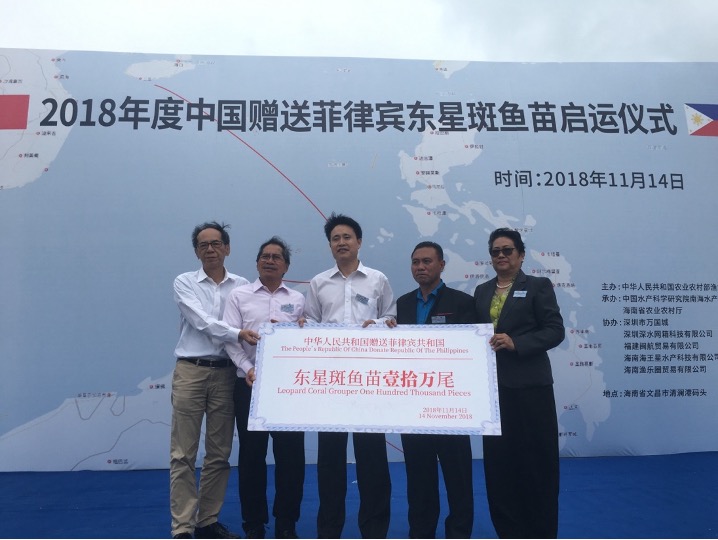
China has since 2006 provided multiple donations of fish fry to the Philippines under the China-Philippines Modern Fishery Cooperation Project. Photo/Global Times
The China-Philippines Modern Fishery Cooperation Project, initiated in 2006 across several Philippine locations, has worked to improve the country’s aquaculture levels. In February 2010, the first batch of 40 tons of farmed pompano and red snapper from the project was sold back to China. Between 2017 and 2019, China donated 200,000 grouper and freshwater fish fry to the Philippines and provided technical support.
The logic behind these cooperative projects is clear: by sharing mature aquaculture techniques, they help fishermen transition from “illegal fishing” towards sustainable “fish farming”. This substantively reduces the ecological pressure from capture fisheries and promotes the sustainable development of South China Sea resources.
But as Manila attempts to obscure its governance failures with geopolitical conflict, the Philippines’ fishing industry edges closer to complete collapse. Ultimately, it will be the over 2.5 million Filipino fisherfolk struggling near the poverty line, and the future of the South China Sea’s marine ecosystem, who will bear the final cost.