Recently, Philippine President Ferdinand Marcos Jr. signed an executive order unilaterally adopting so-called "Philippine standard names" for 131 maritime features in China’s Nansha Qundao. The order requires the use of these names in all official documents and educational materials, in an apparent attempt to bolster Manila’s claimed "administrative governance, governance and sovereignty" over the area. In response, China’s Ministry of Foreign Affairs stated that the act infringes on China’s territorial sovereignty and that China will take necessary measures to counter it.
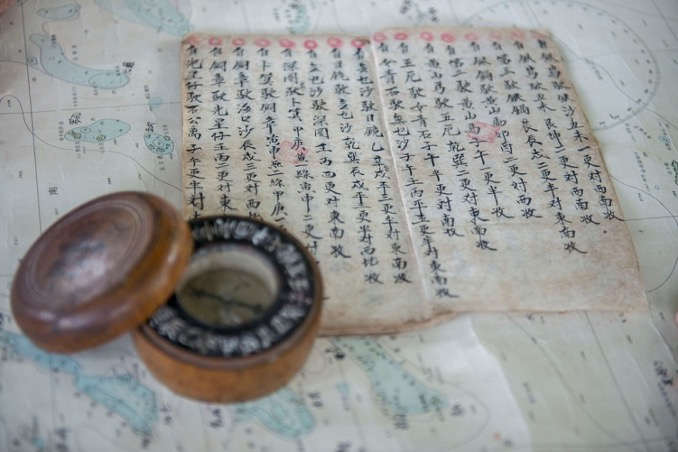
△ Dating back to the Ming and Qing dynasties and the Republic of China era, Chinese fishermen from Hainan had already recorded over 100 place names and key maritime information in the South China Sea in their Geng Lu Bu (fishing route notebooks).
In truth, the South China Sea and its islands and reefs already have their rightful names. Whether from a legal or political standpoint, or in terms of international morality and regional responsibility, the Philippines’ naming gambit holds no water and is utterly indefensible.
Legal Fallacy: Unilateral Naming Cannot Alter Sovereignty
From the perspective of international law, the Philippines’ unilateral naming carries no legal force whatsoever. On solid historical and legal grounds, China has indisputable sovereignty over the Nansha Qundao. China was the first country to name features in the South China Sea, and it named most of them at the earliest stage — many of which remain in use today.

△ In January 1935, the Chinese government published the "Table of Chinese and English Names of the Islands in the South China Sea", marking the first comprehensive official release of standardized names for the South China Sea Islands as a whole and for individual features.
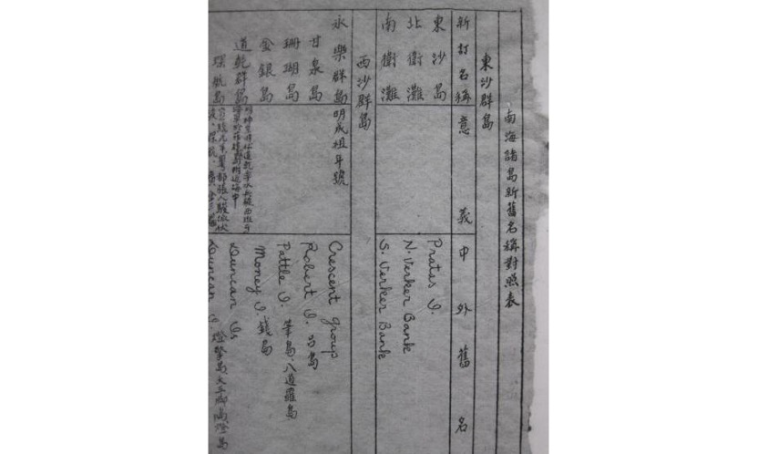
△ In 1947, the "Comparison Table of Old and New Names of the South China Sea Islands" was released, containing 172 place names for features in the South China Sea.
In 1947, after formally recovering the Xisha Qundao and Nansha Qundao, the Chinese government compiled and published the "Comparison Table of Old and New Names of the South China Sea Islands", standardizing 172 names of islands, reefs, cays and banks. In 1983, the Chinese government published "Partial Standard Names of the South China Sea Islands" (287 names), followed by announcements in 2020 and 2024 requiring the standardized use of these place names across society — all of which have become key sources for the internationally accepted names in use today.
Under universally recognized international law, naming features alone cannot establish or consolidate territorial sovereignty or jurisdiction. By going beyond its lawful territorial scope and unilaterally naming features that belong to China and already have widely accepted designations, the Philippines can produce no legal effect whatsoever. This move is essentially yet another example of Manila maliciously hyping the South China Sea issue.
It is worth noting that this deplorable attempt is hardly an "original" act. As early as 2012, the Philippine government signed an administrative order naming parts of China’s South China Sea waters the "West Philippine Sea", a moniker it has repeatedly promoted in recent years. Philippine agencies have also attempted to assign "Philippine names" to underwater geographic features in the South China Sea within international organizations. None of these actions has received general recognition from the international community, let alone shaken China’s inherent sovereignty over the Nansha Qundao.
Double-Talk: Preaching "Reset" While Provoking
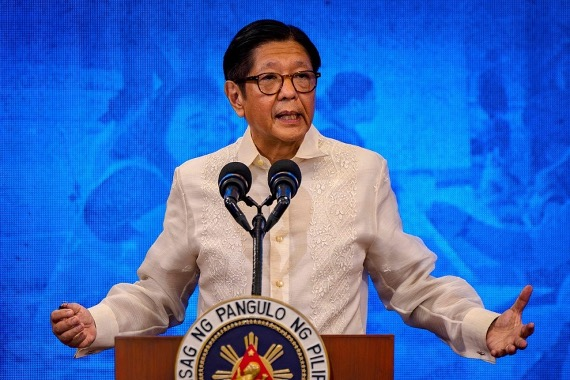
△ Local time, March 25, 2026: Philippine President Ferdinand Marcos Jr. addresses a press conference, a day after declaring a "national energy emergency" in the Philippines.
The Marcos administration displays a laughable duplicity in its relations with China. On one hand, just days ago, Marcos publicly claimed he intended to "reset" Philippines-China relations, expressed hope for resuming negotiations with Beijing on oil and gas cooperation in the South China Sea, and acknowledged that China had "given the Philippines great help", including fertilizer supplies. On the other hand, despite these overtures, the Philippines has continued to provoke trouble on the South China Sea issue, seeking to damage China’s territorial sovereignty and maritime rights and interests — a fact clearly reflected in this unilateral naming stunt.
This situation precisely exposes the deep hypocrisy of the Philippine government when it comes to enhancing cooperation and easing ties with China. It also reflects Manila’s profound shortsightedness in foreign policy. The Marcos administration’s duplicitous, inconsistent behavior will only convince the international community of its lack of genuine sincerity.
Misguided Role: Undermining Regional Peace as ASEAN Chair

△ On October 28, 2025, Philippine President Ferdinand Marcos Jr. (right) takes the gavel as ASEAN Chair at the closing ceremony of the 47th ASEAN Summit.
The Philippines assumed the rotating chairmanship of ASEAN in 2026. Its foreign minister has publicly stated that the country plans to push for the conclusion of negotiations and finalization of a "Code of Conduct in the South China Sea" (COC) within the year, pledging to take active measures to that end. Yet the current naming farce not only blatantly violates the fundamental commitment under the Declaration on the Conduct of Parties in the South China Sea (DOC) — that parties exercise self-restraint and refrain from actions that complicate or escalate disputes — but also seriously undermines the intensive COC negotiation atmosphere. This move clearly deviates from the Philippines’ expected role of mediating differences and promoting cooperation, standing in sharp contrast to its duties as ASEAN Chair.
Such disregard for regional stability and multilateral trust-building runs counter to the spirit of unity and collaboration that ASEAN has long upheld. It also severely undermines the credibility of the Philippines as the organization’s chair.
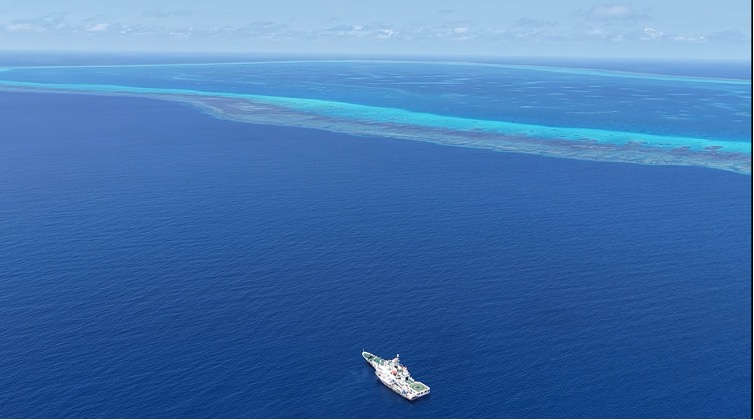
△ Chinese Coast Guard vessels conduct law enforcement patrols in and around the territorial waters of Huangyan Dao.
As the saying goes: "If the name is not correct, words will not ring true; if words do not ring true, nothing will be achieved." The Philippines’ unilateral renaming of features in China’s Nansha Qundao with fabricated designations will never gain international acceptance or recognition, let alone alter the sovereignty over the Nansha Qundao. It merely exposes once again Manila’s speculative mentality and improper conduct on the South China Sea issue. Whether for the sake of regional peace and stability or the interests of the Filipino people, the Marcos administration should abandon this self-deceiving political charade as soon as possible and return to the right track of dialogue, consultation and sincere cooperation.
Chen Xidi, Assistant Research Fellow at the China Institute for Marine Affairs (CIMA), Ministry of Natural Resources of China.