With the coming summit between Chinese President Xi Jinping and US President Donald Trump back on schedule for May, the two leaders present two starkly different paths for the world: one defined by a “community with a shared future” and the other driven by unpredictable impulses of rivalry and division.
While Trump postponed the April summit to engage Xi without the distractions of the war he launched on Iran, a swift resolution before their meeting does not seem likely – despite the newly announced two-week ceasefire.
Trump’s “war of choice” has already triggered a massive global energy shock – the most severe since the 1970s, with oil prices surging due to the Strait of Hormuz’s partial closure. This month also marks the one-year anniversary of Trump’s “Liberation Day” tariffs, a global trade war whose aftershocks are still destabilising the world economy.
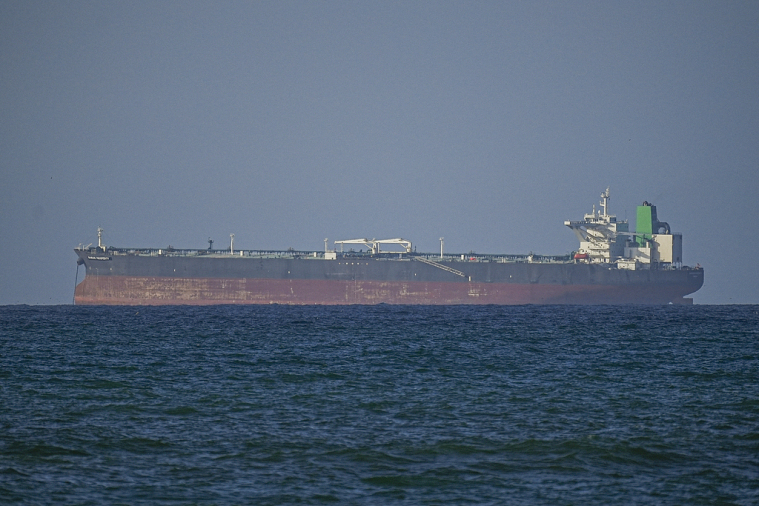
(A view of the vessels passing through Strait of Hormuz following the two-week temporary ceasefire reached between the United States and Iran. /CFP)
Meanwhile, China has positioned itself as a stabilising force. At this year’s World Economic Forum in Davos, in Switzerland, Beijing signalled a major pivot: moving from being the “world’s factory” to becoming the “world’s market”.
This commitment was reinforced at last month’s Boao Forum, when the Hainan Free Trade Port was showcased as a model for deeper market opening. The trajectory is unmistakable: China is increasingly staking its claim as the primary defender of an open, rules-based global economy. This push is no isolated policy shift; it is the manifestation of Xi’s Global Development Initiative to advance a more equitable economic order.
The initiative is just one of a four-part global framework that includes the Global Security Initiative, the Global Civilisation Initiative, and the Global Governance Initiative.
Last year, as Trump was withdrawing from international bodies such as the World Health Organization and the Paris Agreement, Xi unveiled the Global Governance Initiative. Through it, Beijing has expressed a commitment not just to stabilising the existing multilateral order, but to leading the global response to existential crises like climate change.
This vision is manifested through China’s “blue economy” partnerships with the Association of Southeast Asian Nations. By leveraging green technology to address maritime ecological challenges in the South China Sea, Beijing is working towards a “community with a shared future”, specifically as it concerns ASEAN.
Of course, the shadow of war in Iran looms large, sparking fears that Southeast Asian waterways could mirror the volatility of chokepoints like the Strait of Hormuz. Despite these anxieties, Singaporean Prime Minister Lawrence Wong offered a resilient assessment, expressing confidence that China and ASEAN can build on cooperation by strengthening economic links and working together on shared challenges.
Critics have argued that China’s muted response to the crises in Iran and Venezuela has cast doubts on Beijing’s reliability as a strategic partner. In reality, this restraint reflects strategic discipline. It is rooted in a long-standing commitment to non-intervention and a clear hierarchy of priorities centred on its immediate periphery. China acts decisively only when its core interests are at stake, most notably in the Taiwan Strait and its territorial claims in the South China Sea – zones it regards as non-negotiable.
Beyond these concerns, China shows little appetite for military entanglements. Whether safeguarding its interests near or far, Beijing prefers economic leverage and diplomatic signalling over kinetic intervention.
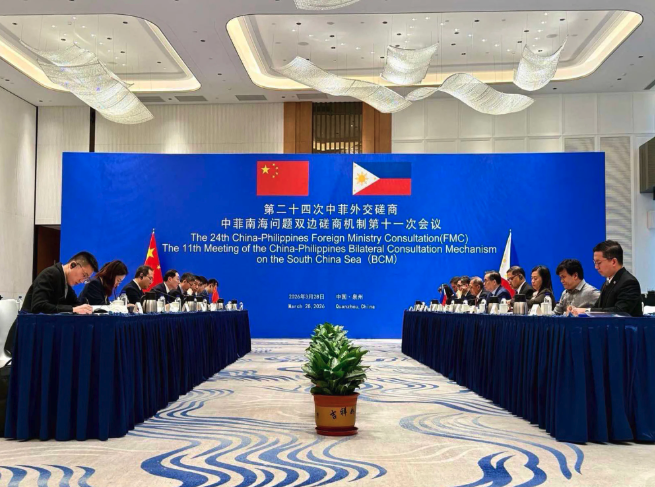
(Philippine and Chinese officials hold talks on the South China Sea in Quanzhou, Fujian province, in late March. /Handout)
This philosophy is exemplified by Xi’s Global Security Initiative, which prioritises sovereignty and dialogue over rigid military alliances. A clear example of this pragmatism occurred when Beijing and Manila resumed talks on joint oil and gas exploration amid the global energy crisis, underscoring both countries’ preference for the stability of economic cooperation over the unpredictability of confrontation.
Beijing’s strategic restraint stands in sharp contrast to Washington’s increasingly interventionist posture. The Trump administration continues to project power far beyond its immediate region – notably in Iran – while challenging the sovereignty of adversaries and partners, from Venezuela and Cuba to Denmark and Canada.
While Beijing typically treats force as a last resort, Washington has kept military options at the forefront of crisis management. This “might makes right” approach signals a return to the law of the jungle, underscored by Trump’s threat to bomb Iran “back to the Stone Ages”. Right before the new ceasefire, Trump suggested he was going to destroy an entire civilisation.
US Defence Secretary Pete Hegseth has framed the war as a Christian mission to rain “death and destruction from above” on its “apocalyptic” Iranian foes. His rhetoric drew a rare and forceful rebuke from Pope Leo XIV, who stated that military domination is “entirely foreign to the way of Jesus Christ.”
This brings us to Xi’s Global Civilisation Initiative, which aims to promote understanding among the world’s philosophical and religious traditions. During his 2025 visit to Malaysia, Xi and Malaysian Prime Minister Anwar Ibrahim reaffirmed their commitment to advancing civilisational exchange.
Following through on that consensus, both governments will host an Islamic-Confucianism Dialogue in Beijing this April. These exchanges are not merely academic; they represent China’s holistic approach to building a comprehensive global order that spans economics, governance, security and the very foundations of civilisation.
As Xi and Trump prepare to meet, the divergence between their visions of global order has never been more acute. Xi champions a coherent, long-term framework centred on a “community with a shared future”. Trump advances a paradigm of ethno-religious nationalism that widens civilisational divides.
This is more than a policy dispute; it is a fundamental clash of world views. The stakes are absolute: we must choose a world defined by cooperation and stability or one fractured by zero-sum rivalry.
(Author: Peter T C Chang, Research Associate of Malaysia-China Friendship Association, Former Deputy Director of Institute of China Studies, University Malaya, Special Invited Researcher of the CMG Expert Committee on South China Sea Studies)