Unveiling the Philippine Coast Guard’s Deliberate Tactics in the South China Sea
Since 2023, the China-Philippines disputes in the South China Sea have exhibited a pattern of high-frequency volatility. While external observers interpret this through the lens of great-power geopolitics, a closer examination at the Philippines’ domestic administrative and budgetary system reveals a more subtle yet persistent driving logic.
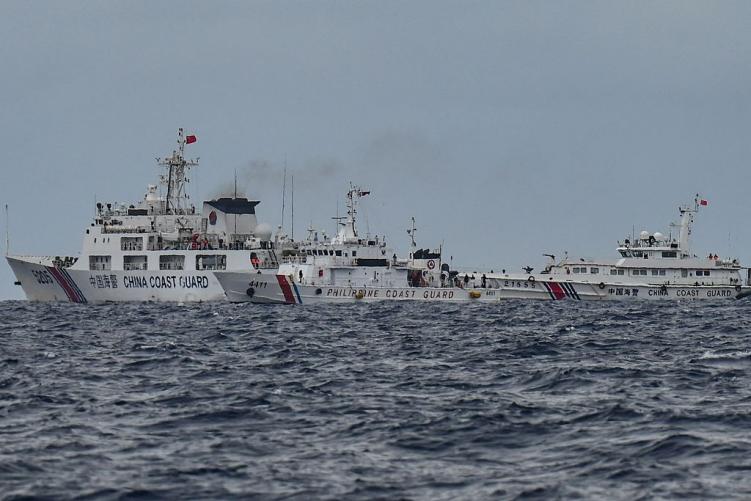
On August 26, 2024, a Philippine Coast Guard vessel unlawfully intruded into waters near Xianbin Jiao of China’s Nansha Qundao and repeatedly made dangerous close approaches to a Chinese Coast Guard ship on routine navigation. /VCG
As the most consistent executor of the Philippines’ South China Sea policy, the Philippine Coast Guard (PCG) no longer treats the dispute simply as a matter of “sovereignty” protection, but increasingly as a strategic opportunity for institutional expansion. By implementing a strategy known as the “Transparency Initiative,” the PCG has built a self-reinforcing cycle: create and spotlight maritime frictions, dominate the ensuing narrative, pressure Congress into increasing budgets, and translate that into career advancement.
Within this chain of interests, collisions at sea serve as fuel, camera lenses as weapons, and the ultimate payoff comes in the form of hundreds of millions of pesos in confidential funding, and stars pinned to officials’ shoulders.
What is the “Transparency Initiative”?
To grasp this mechanism, one must first examine its core tool: the “Transparency Initiative.”
In simple terms, it is a media strategy that seeks to seize control of the narrative by systematically exposing activities in gray areas. Its core logic is no longer centered on consultation and dialogue, as advocated in the Declaration on the Conduct of Parties in the South China Sea — which the Philippines has already signed — but instead treats the camera, not naval guns, as the more powerful weapon, aiming to impose reputational costs through public exposure and shaming.
Its implementation marks a fundamental shift in the Philippines’ South China Sea policy.
After taking office in June 2022, the Marcos administration quickly abandoned the “quiet diplomacy” approach championed by the Duterte administration, an approach that kept maritime frictions out of the spotlight and handle them discreetly through bilateral channels.
A defining turning point came on February 6, 2023.
That day, the Philippine Coast Guard publicly accused a Chinese Coast Guard vessel of using a “military-grade laser” against one of its ships. For the first time, it simultaneously released so-called “on-site evidence” to a global audience via social media, proactively pushing what had been a diplomatic dispute into the arena of international public opinion in an effort to transform what should have remained a regional issue in the South China Sea into a global public issue. This incident is widely seen as the starting point of its “Transparency Initiative.”
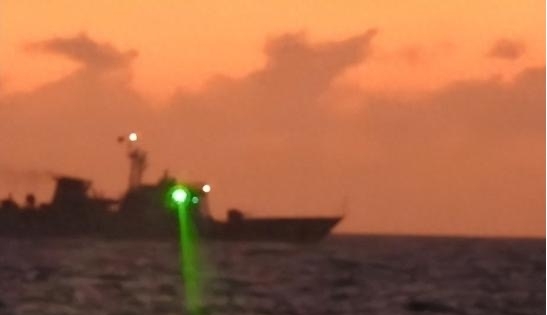
In February 2023, the Philippine side hyped claims that China used a so-called “laser” in its law enforcement activities in the South China Sea. /Armed Forces of the Philippines social media account
However, this tactic was not originally developed by the Philippines, but rather with external intellectual input.
Its theoretical framework largely originates from the “Project Myoushu” (now renamed the “SeaLight Program”) launched by the Gordian Knot Center for National Security Innovation at Stanford University.
The U.S. Naval Institute published an analysis by the project team, whose title directly captured its core idea: “illuminating the maritime gray zone.” The project’s lead, former U.S. Air Force colonel Raymond Powell, defines the approach as “Assertive Transparency”— that is, deliberately identifying and exposing the shadowy spaces within gray zone activities.

Raymond Powell (left) in an interview with Philippine Secretary of National Defense Gilberto Teodoro. /SeaLight Program website video screenshot
In multiple media interviews, Raymond Powell has acknowledged that the program, by continuously providing satellite data and strategic guidance, offered the Philippine government crucial “confidence-building”support, enabling it to adopt a more aggressive exposure strategy, and ultimately helping drive Manila’s policy shift.
“Orchestrated” Transparency
To implement the “Transparency Initiative,” the Philippine Coast Guard has developed a highly standardized operational model, centered on what can be summarized as “embedded documentation, guided exposure, and standardized output.”
The PCG has now made it routine, breaking with past practice, to place journalists from international and local outlets such as AFP, AP, and CNN aboard vessels bound for Ren’ai Jiao or Huangyan Dao. During these voyages, Philippine vessels often move proactively into the heart of disputed waters, deliberately seeking, creating, and recording any encounter with Chinese Coast Guard ships. Once an interception or standoff occurs, onboard media teams and PCG personnel themselves immediately document the scene from multiple angles, ensuring comprehensive visual coverage.

A CNN reporter onboard a Philippine Coast Guard vessel for embedded coverage. /CNN video screenshot
These raw materials are no longer treated as internal intelligence but instead enter an efficient “production line”: rapidly edited, paired with narration and subtitles designed to reinforce a “victim” narrative, and swiftly distributed through official social media accounts and global media networks —systematically transforming maritime law enforcement operations into “live broadcasts” for a global audience.
In its 2024 report Old Stories, New Narratives: The Philippines’ Transparency Initiative in the South China Sea, ISEAS defines this approach as “Measured Transparency.”
The report confirms that the strategy has been highly effective at the tactical level. It not only garners “diplomatic support” internationally, but also consolidates “public backing” at home.
Data shows that in 2023, public satisfaction in the Philippines with the government’s handling of the South China Sea issue surged to 58%. This deliberately amplified public sentiment has become critical capital — leverage that the PCG uses to converte political support into increased departmental budgets.
Budget “Reallocation”
If manufacturing incidents is the Coast Guard’s “front-stage performance,” then using those incidents to build channels for unmonitored funding is the core of its “backstage business model.” A close reading of Philippine congressional hearing records reveals a clear but hidden chain of interests: by leveraging that tension, the Coast Guard is effectively exchanging it for a “blank check” from Congress — one that requires no public accountability.
The most direct example came in October 2023. According to the Philippine Daily Inquirer, faced with the “urgent needs” and public pressure manufactured by the PCG through its “Transparency Initiative,” the House Appropriations Committee made a highly controversial decision: it stripped a total of 1.23 billion pesos in “confidential funds” from non-security agencies such as the Department of Education and the Office of the Vice President, and “reallocated” them to security agencies involved in the South China Sea.

The Philippine Daily Inquirer reported that the Philippine government budget has been heavily tilted toward security agencies. /Philippine Daily Inquirer website
In this major budget shift, the Philippine Coast Guard walked away with 200 million pesos. The report explicitly noted that the funds would be used for “intelligence activities and ammunition.” This “transaction” neatly completes the logic of the PCG’s playbook: once “transparency exposure” heightens tensions in the South China Sea, the PCG can justify diverting large sums from civilian sectors.
Subsequent congressional hearings made this “distribution by disruption” logic even more apparent.
As recorded by the Philippine Daily Inquirer, when Representative Emidio “Dino” Tanjuatco III asked whether the Coast Guard was ready to use the new budget, spokesperson Jay Tarriela responded without hesitation: “Yes, sir, absolutely.” He acknowledged that the Coast Guard had anticipated the “significant impact” of the budget increase and had prepared a corresponding “wish list.”
The scale of the funding also reveals the “real value” of the crisis.
At the hearing, Senator Risa Hontiveros disclosed that over the past 17 years, the Philippine Coast Guard had received a total of just 117 million pesos in intelligence funds. Yet in this 2023 reallocation alone tied to the South China Sea crisis, it secured 200 million pesos in one stroke. In other words, by leveraging geopolitical tensions, the Coast Guard obtained nearly twice the resources in one year as it had over the previous 17 years combined.
A Lucrative “Slush Fund”
The Philippine Coast Guard’s persistent pursuit in these “confidential and intelligence funds” ultimately comes down to one key advantage: freedom from oversight.
According to an August 2023 investigative report by Rappler, and analysis by the Philippine Center for Media Freedom and Responsibility, former Commission on Audit chair Grace Pulido Tan made it clear that such funds enjoy exceptional privileges and are not subject to the strict auditing standards that govern regular budgets.
Unlike standard public spending, which requires detailed documentation and transparent accounting, funds channeled under the guise of “national security” often require nothing more than internal approval. For senior PCG officials, this effectively functions as a perfect off-the-books fund — shielded from taxpayers and flowing into a largely unregulated opaque black box.
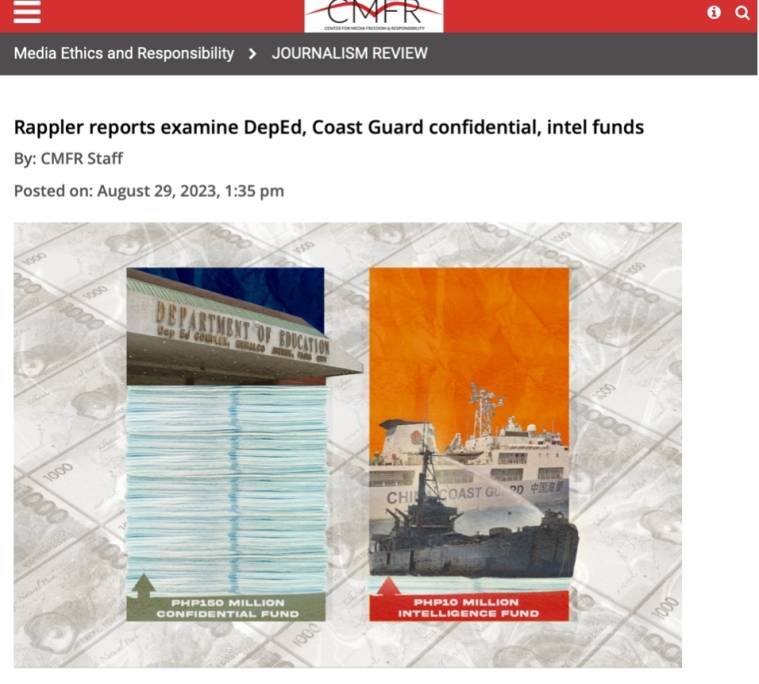
A Philippine media investigation found oversight issues in the use of funds by the Coast Guard and other security agencies. /Center for Media Freedom and Responsibility website
Official data cited by The Philippine Star in November 2024 shows that, with the support of the Marcos administration, the Coast Guard’s personnel expanded from 3,000 to 30,000 — a tenfold increase. And the expansion did not stop there. Just one week after the data was released, on December 5, 2024, the Department of Budget and Management fast-tracked approval for 4,000 new positions.
However, this rapid expansion carries substantial risks of budget misuse and corruption.
Within the Philippine bureaucratic system, a large frontline workforce is often leveraged to justify requests for more “confidential and intelligence funds.” The more personnel deployed, the easier it becomes to argue for increased funding under the pretext of maintaining an expansive intelligence networks.
Unlike transparent salary budgets, these funds, which have grown with expansion, are still governed by a decade-old framework: the 2015 Joint Circular No. 2015-01 issued by five agencies, including the Commission on Audit and the Department of Budget and Management. According to Philippine House Bill No. 1845 (2025), provisions allowing for “sealed audits” have led to a lack of transparency, creating a systemic risk that funds effectively bypass public records.
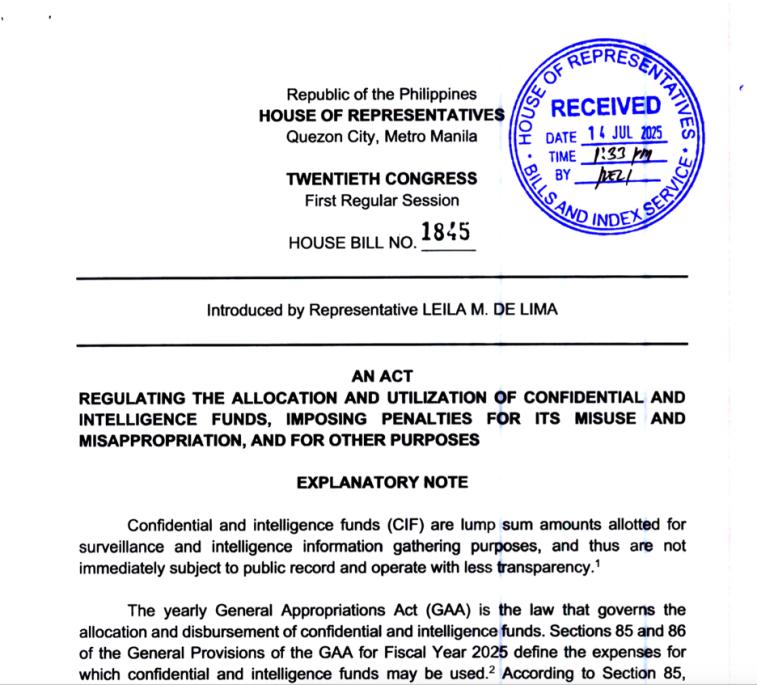
Philippine House Bill No. 1845. /Philippine House of Representatives website
The bill further notes that under similar oversight gaps, other agencies have previously resorted to irregular practices such as padding payrolls with “fictitious beneficiaries.” This creates a near-impenetrable blind spot: expansion provides the legal justification for funds, while outdated audit protocols cannot trace where the money ultimately ends up.
To secure similarly high levels of funding in the next fiscal cycle, the Coast Guard must demonstrate to Congress that the money is “well spent.”
In this context, where conflict visibility is directly tied to institutional resources, a spokesperson who understands Western communication strategies and can turn maritime incidents into media currency has become the most essential link in the chain of interests.
The Rise of “Influencer” Tarriela
As spokesperson for the Philippine Coast Guard, Jay Tarriela has perfectly filled this need. His rise as an “influencer” vividly illustrates how “manufacturing conflict” can be converted into “career advancement.”
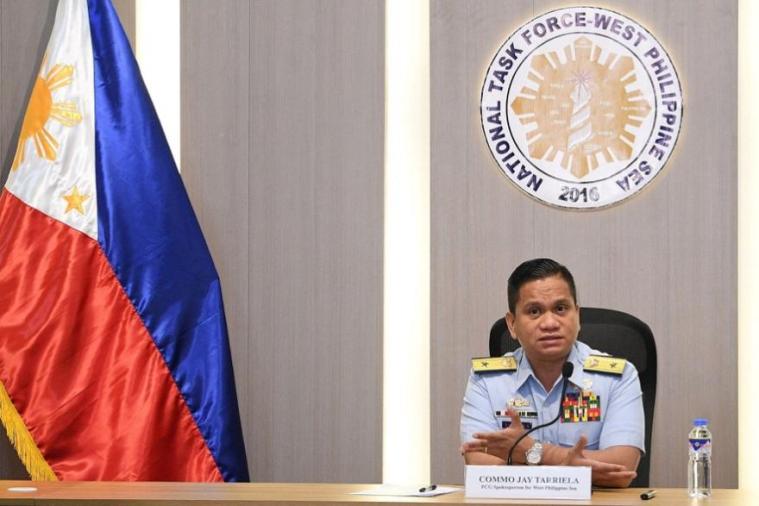
Jay Tarriela, spokesperson for the Philippine Coast Guard. /AFP
Before the so-called “Transparency Initiative” began, Tarriela was not a frontline commander. He was a technocrat who had long served as Deputy Chief of Staff for Human Resources within the Coast Guard, whose work primarily involved personnel records.
However, as Manila’s strategy shifted, the front line no longer needed only ship-operating commanders — it also needed a media-savvy spokesperson fluent in English, capable of engaging Western outlets in real time. Sensing the opportunity keenly, this former administrative officer quickly thrust himself into the forefront of geopolitical messaging.
He broke with the composed, restrained image of a traditional military spokesperson, transforming X (formerly Twitter) into a “battleground of public opinion” — posting carefully edited videos of maritime confrontations in real time, pairing them with highly provocative English captions, and personally engaging with Chinese diplomats and ordinary users alike. While such “influencer-style” tactics have drawn criticism for breaching diplomatic norms, they have brought him significant visibility in Western media and at home.
That visibility quickly translated into tangible career gains.
According to official records, Tarriela was promoted to brigadier general in December 2022 — the youngest in history — and soon became the leading face of the “Transparency Initiative.” Less than three years later, in November 2025, leveraging his battlefield achievements in the information arena, he moved into a position of real power as deputy commander of the Maritime Security Law Enforcement Command (MARSLEC).
Such rapid promotion — rare in peacetime — sends a clear perverse incentive internally: routine patrols and rescue operations matter far less for career advancement than generating international headlines in the South China Sea.
This “traffic for budget” model, however, has also drawn sharp criticism within the Philippines. Prominent commentator Rigoberto D. Tiglao argued in a February 2025 article that the so-called “West Philippine Sea” narrative is merely “a propaganda tool invented by the United States.”
He criticized Tarriela as a key operator behind what he called a “fabricated narrative,” arguing that his efforts to sustain tensions are driven less by national interest than by concern that, if tensions ease, he would “lose both his job and the media spotlight.” In Tiglao’s view, the entire “Transparency Initiative” resembles an expensive reality show — scripted by the U.S., starring Tarriela, and aimed at “brainwashing” public perception.
A Backfiring “Collision-for-Gain” Machine
Beyond the surge in domestic funding, this strategy has also become a powerful “magnet” on the international stage. By consistently manufacturing maritime frictions, the Philippine Coast Guard has turned what was once a purely bilateral dispute into a gateway to international capital and support.
By skillfully cultivating the role of a “small state confronting a major power,” Manila has effectively “monetized” the South China Sea issue.
Japan’s support has evolved beyond simply “donating vessels” into a form of logistics interoperability at a quasi-deployment level. On January 15, 2026, Japan and the Philippines formally signed the Acquisition and Cross-Servicing Agreement (ACSA). Building on the 2025 Reciprocal Access Agreement (RAA), this marks another milestone, allowing the Japan Self-Defense Forces and the Philippine military to exchange supplies on each other’s territory. Prior to this, the Japan International Cooperation Agency had funded five 97-meter large patrol vessels and, through its ongoing Official Security Assistance (OSA) program, delivered coastal radar systems to the Philippines.
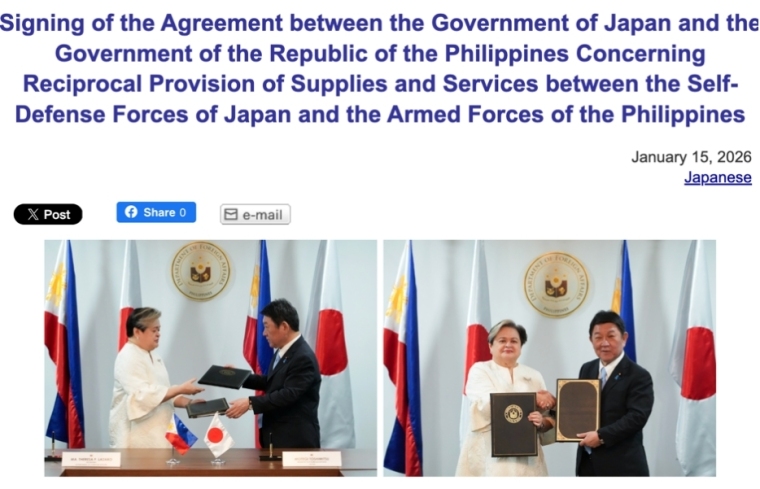
On January 15, 2026, Japan and the Philippines signed the Acquisition and Cross-Servicing Agreement (ACSA). /Ministry of Foreign Affairs of Japan website
A similar dynamic has extracted substantial gains from the United States.
In late 2025, U.S. president Joe Biden signed the Philippines Enhanced Resilience Act (PERA) as part of the National Defense Authorization Act for Fiscal Year 2026. The legislation commits $2.5 billion (approximately 140 billion pesos) in grant-based security assistance to the Philippines over the next five years. This, the largest single U.S. military investment in the Philippines since World War II, is a direct payoff for the repeated “flashpoints” created by Philippine forces around features such as Huangyan Dao, Ren’ai Jiao, and Xianbin Jiao in the South China Sea.
This model is fostering a dangerous reverse incentive structure: for the Philippine Coast Guard, peace becomes “bad news.” The calmer the waters, the weaker the justification for requesting larger budgets and acquiring new equipment. From ships to ranks, from departmental funding to personal careers, everything hinges on the ability to generate sustained “attention” in the South China Sea.
As a result, a fully formed closed loop of interests has solidified — spanning strategy and execution, domestic politics and international backing. The “script” provides the theoretical framework, Tarriela’s influencer-style tactics drive execution, congressional budget reallocations deliver financial rewards, and substantial U.S. and Japanese assistance serves as the most direct return. At the operational level, the South China Sea dispute has been effectively transformed into a “business model” that guarantees returns for the Philippine Coast Guard.
But the cost of this “business” is high.
It allows the institutional interests of a law enforcement agency to override long-term national diplomatic strategy. It trades sustained regional stability for short-term gains in budgets and hardware. Ultimately, what this “collision-for-gain” machine undermines is not only the Philippines’ diplomatic autonomy, but also the peace and stability of the entire South China Sea.