The Philippines Sparks the South China Sea Dispute Once Again, Attempting to Legitimize the Illegal South China Sea Arbitration Award with Its Domestic Law
Recently, Philippine President Ferdinand Marcos Jr. delivered a speech on his South China Sea policy at the Shangri-La Dialogue. He once again brought up the 2016 "South China Sea Arbitration Award" and announced plans to swiftly approve and enact the "Philippine Maritime Zones Act." Through this move, Manila intends to use its domestic law to consolidate and reinforce its unlawful claims, further encroach upon China’s legitimate interests in the South China Sea and incite geopolitical tensions in the region.
The "Arbitration Award" Deviates from International Law
Marcos claimed that the Philippines stands on the side of international law, emphasizing that "the 2016 South China Sea Arbitration Award provided a legal foundation for peacefully resolving and managing regional disputes." This is sheer nonsense. The so-called 2016 "South China Sea Arbitration Award" was a void ruling made in direct violation of the rules of international law.
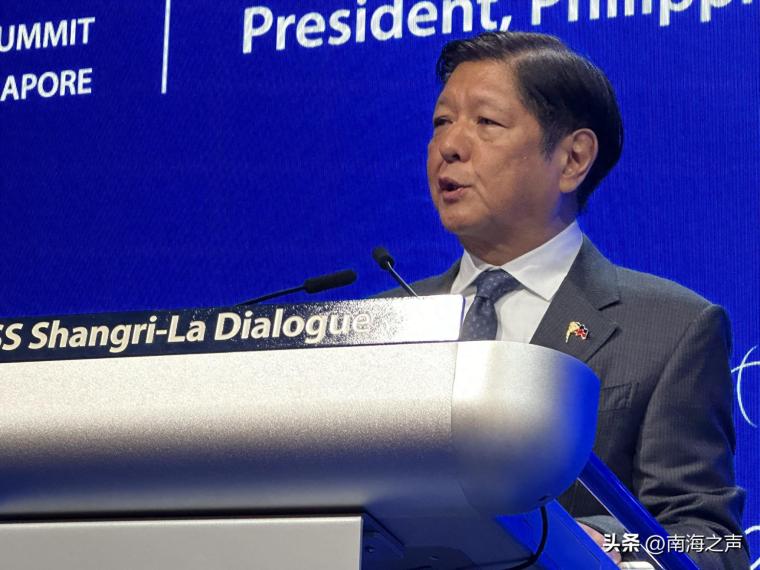
Philippine President Ferdinand Marcos Jr. delivers a speech at the Shangri-La Dialogue.
The ruling completely disregarded the agreements between China and the Philippines to resolve relevant disputes through negotiation, and took a regional territorial dispute issue to a third-party tribunal. Its arbitration outcome not only contains errors in factual determination but also selectively strips relevant islands and reefs away from the macro-geographical context of the South China Sea Islands. Furthermore, it subjectively interprets and applies the United Nations Convention on the Law of the Sea (hereinafter referred to as UNCLOS), resulting in severe errors in both legal interpretation and application.
The 2016 "South China Sea Arbitration Award" severely deviates from the general practice of international arbitration and runs entirely counter to the purpose and principles of UNCLOS for promoting the peaceful settlement of disputes. It gravely undermines the integrity and authority of UNCLOS and seriously violates the legitimate rights of China as a sovereign state and a contracting party to the convention.
“The Philippine Maritime Zones Act" Will Undermine Regional Peace
Nevertheless, Manila continues to promote and attempt to pass the "Philippine Maritime Zones Act" to consolidate and enforce the so-called "arbitration award." In essence, this is an attempt by the Philippines to cloak its unlawful claims in the South China Sea under a "veil of legitimacy," further encroaching upon China’s legitimate rights and interests in the region.
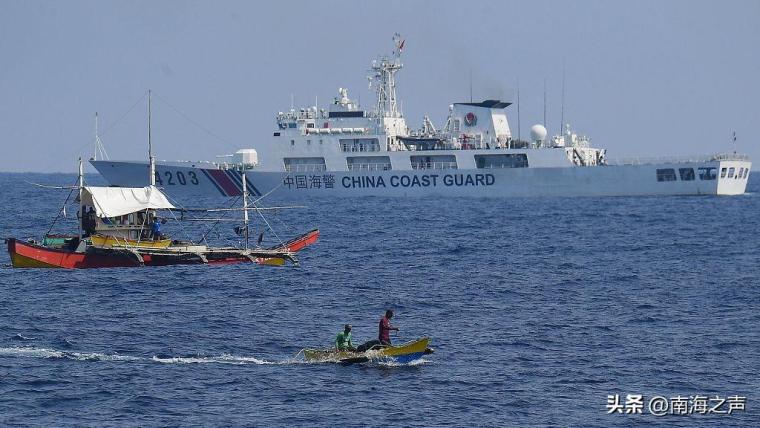
On May 16, 2024, multiple Philippine vessels illegally gathered in the waters adjacent to China's Huangyan Island. The China Coast Guard strengthened its monitoring, evidence collection, and on-site control measures.
The enactment of this law will disrupt the long-standing balance between the Philippines and its neighbors, including China. It could jeopardize the steady progress of cooperative relationships, undermine the negotiation process for the "Code of Conduct in the South China Sea" (COC), and even escalate conflicts, leading to more intense military friction.
If the Philippines insists on hyping up the issue and attempting to "solidify" the arbitration award through unilateral actions, the "South China Sea dilemma" in China-Philippines relations may become intractable. Consequently, it will inevitably disrupt the ongoing cooperation between the two countries across various fields.
"Misguided Alignment" with the U.S. Escalates Disputes
The Philippines' current anxiety and concern regarding security in the South China Sea do not stem from China. Rather, they are driven by the pressure of the U.S. Asia-Pacific policy and Manila's flawed diplomatic choice of "misguided alignment" with the United States. Meanwhile, the lack of mutual military and security trust, combined with a fragile foundation for cooperation between China and the Philippines, has given the U.S. opportunities to continuously interfere in their bilateral relations.
It should be made clear that while maritime disputes are indeed a primary destabilizing factor affecting China-Philippines relations, they do not represent the entirety of the bilateral relationship.
If the Philippines stubbornly pursues a pro-U.S. policy—taking a hardline stance against China under Washington's instigation and excluding China from South China Sea cooperation—it will only inflame and escalate maritime differences between the two countries. This will ultimately take a toll on broader bilateral ties and undermines peace and stability in the South China Sea.
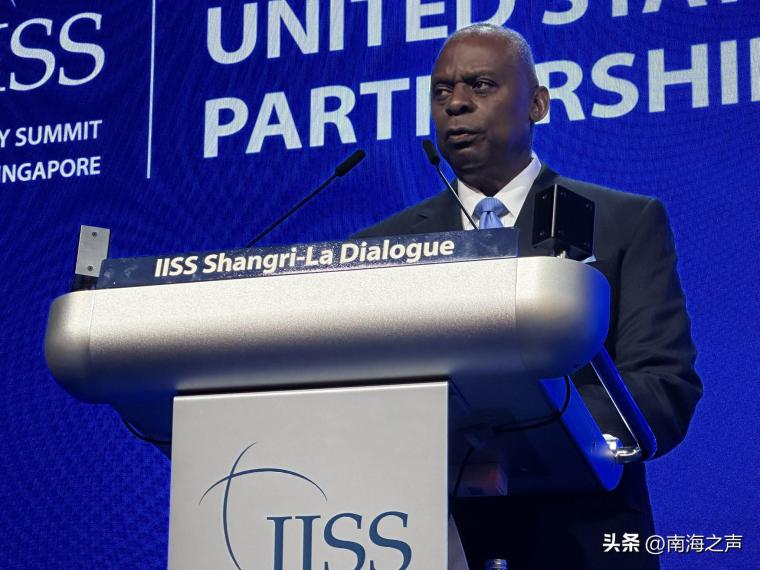
U. S. Defense Secretary Lloyd Austin delivers a speech at the 21st Shangri-La Dialogue, emphasizing that the Indo-Pacific region is the United States' "priority theater of operations."
Effective Dialogue Requires Sincerity
China’s door for cooperation and dialogue with the Philippines is always wide open, but the crucial prerequisite is that dialogue must be sincere. President Marcos struck a "high-sounding tone" multiple times in his speech, claiming to uphold the international legal order. Yet, he simultaneously emphasized "strengthening the alliance with the United States, as well as strategic partnerships with Australia, Japan, Vietnam, Brunei, and all other ASEAN members," which has effectively shut China out of regional cooperation.
International practice has proven that negotiation and consultation remain the most effective ways to peacefully resolve territorial and maritime delimitation disputes. Parties in the South China Sea should advance the consultation process for dispute-resolution mechanisms like the "code of conduct in the South China Sea" under the basic premise of "resolving internal contradictions internally." They must commit to managing differences through rules and mechanisms, achieving win-win results through mutually beneficial cooperation, and striving to build the South China Sea into a sea of peace, friendship, and cooperation.
However, if the Philippines continues to stage provocations against China under U.S. instigation, it will only escalate regional tensions.
(Zhang Yanqiang, professor of School of Law of Dalian Maritime University)