Authoritative Analysis | Why the So-Called "South China Sea Arbitration" Constituted an Abuse of UNCLOS
On June 30, 2026, an Assessment Report on the United Nations Convention on the Law of the Sea (UNCLOS) Achievements, Positioning and Challenges, hereinafter the Report, was released. Compiled by the China Institute for Marine Affairs, the Report provides a comprehensive assessment of the historical achievements, legal nature, role and positioning, as well as the challenges facing the UNCLOS.
It aims to encourage an objective, holistic, and dialectical understanding of UNCLOS, and to ensure that it is interpreted and applied in a full, accurate, and good-faith manner.
Against the backdrop of a complex and changing international landscape and increasingly pressing challenges in global ocean governance, what difficulties has UNCLOS encountered in its implementation? Why is the so-called "South China Sea Arbitration" regarded as a typical case of abusing UNCLOS mechanisms and interpreting its provisions in bad faith? And in the 30 years since China became a State Party to UNCLOS, what progress has China made in developing its maritime legal framework? To explore these questions, The Voice of the South China Sea (VSCS) spoke with Zhang Haiwen, executive vice president of the Chinese Society of the Law of the Sea; Luo Gang, lead author of the Report and professor at the China Institute for Marine Affairs; and Sourabh Gupta, member of the United States Council for Security Cooperation in the Asia-Pacific (USCSCAP) and senior fellow at the Institute for China–America Studies, for their analysis and insights.
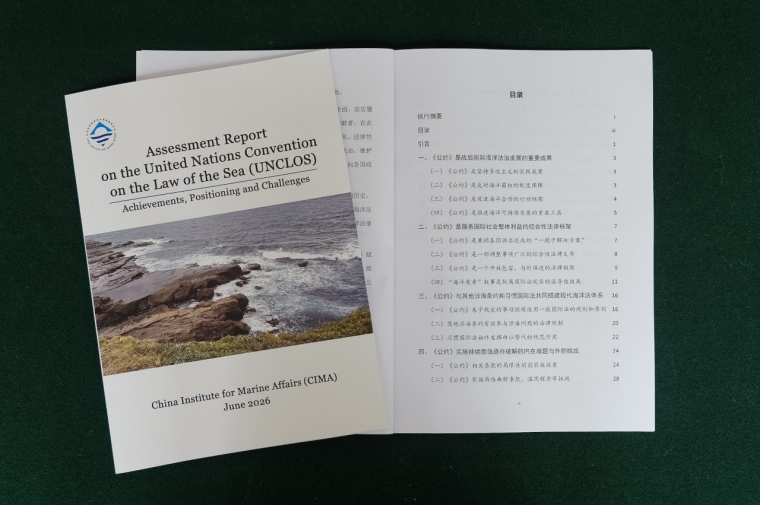
Assessment Report on the United Nations Convention on the Law of the Sea (UNCLOS): Achievements, Positioning and Challenges is released. /Shen Shi
VSCS: The Report notes that UNCLOS does not cover every issue in the law of the sea and, like other international treaties, has certain limitations. Where do these limitations lie?
Zhang Haiwen: The limitations of UNCLOS are an objective reality. They stem mainly from the constraints of the knowledge and understanding at the time of its negotiation, and from the inherent nature of multilateral treaty-making, but do not indicate flaws in its institutional design. It is also important to recognize that, when UNCLOS was concluded, it was both pioneering and forward-looking. UNCLOS was negotiated and concluded in the 1970s and 1980s. At that time, marine scientific research and human understanding of the oceans were still limited, leaving many emerging ocean issues unaddressed. For example, during the negotiations, the value of deep-sea genetic resources was not yet widely understood. As a result, UNCLOS focused squarely on regulating seabed mineral resources, overlooking biodiversity conservation. Widely used unmanned marine equipment and novel ocean-based activities today remain even further beyond what could have been foreseen at the time. In order to achieve consensus, UNCLOS deliberately left a number of contentious issues ambiguous or unaddressed, and refrained from defining certain key concepts. For example, the regime on marine scientific research left key terms undefined. Similarly, the innocent passage clause applies to "ships of all States," rather than "all ships," thereby sidestepping the contentious issue of warships and leaving room for divergent interpretations by States. Even so, UNCLOS remains highly forward-looking. Part XII of UNCLOS establishes a dedicated regime for the protection and preservation of the marine environment, pioneering the global institutional framework for marine ecological protection.
Sourabh Gupta: There are textual provisions within UNCLOS that are disturbingly vague, and the interpretive gaps on some of these provisions among legal scholars remain unbridged too. There is also a tendency on the part of legal scholars, when confronted with divisive provisions or those that touch on sovereignty-linked matters, to fall back on national or civilizational lines during their assessments. This has, unfortunately, opened up space for enterprising Law of the Sea tribunal judges to inject extreme interpretations on certain maritime rights-related issues that touch on charged sovereignty-linked matters in the course of their tribunal awards.
VSCS: UNCLOS established an open and inclusive legal framework, yet in practice it continues to face inherent difficulties and external challenges. What is the main factor currently weakening its integrity and authority?
Sourabh Gupta: The absence of the United States—the world's preeminent maritime power—within the treaty framework and subject to its dispute resolution mechanism is probably the largest failing. Second is the lack of a formal mechanism for states to authoritatively interpret, by a qualified majority, some of the contested provisions of UNCLOS, rather than leave such interpretations entirely to Law of the Sea jurisprudential bodies.
Zhang Haiwen: At present, the principal challenge lies not in UNCLOS's inherent limitations, but in the wanton undermining of the multilateral law of the sea regime by certain countries through unilateral hegemonic actions. Such conduct runs counter to Article 300 of UNCLOS, which expressly requires good faith in the performance of obligations and prohibits the abuse of rights. UNCLOS is not a rigid or static set of rules. It is a legal framework that evolves with the times. Going forward, all parties must continue to implement and uphold UNCLOS in good faith.
Luo Gang: It should be noted that the inherent ambiguity of some provisions of UNCLOS has been deliberately exploited by certain countries as an opening to distort the rules and abuse the dispute settlement procedures. In particular, a few countries have sought, in the name of interpreting and applying UNCLOS, to create "new rules" in disguised form, departing from the original legislative intent and proper course of development of UNCLOS.
VSCS: During the recently held 36th Meeting of the States Parties to UNCLOS, a few countries and media outlets once again seized the opportunity to hype up the so-called "South China Sea Arbitration," even repackaging it as a supposed example of "upholding UNCLOS and international law." In your view, is there any substantive connection between the so-called "award in the South China Sea Arbitration" and the specific provisions of UNCLOS?
Luo Gang: The international law community generally recognizes that the key terms in Article 121, paragraph 3 of UNCLOS lack clear definitions. This provision is highly subjective and full of uncertainty, making it extremely difficult to interpret and apply. Professor Robert Kolb of the University of Geneva once vividly likened interpreting this provision to opening a "Pandora's box," predicting that once opened, it would inevitably give rise to a series of complex new problems. In the so-called "South China Sea Arbitration," Article 121, paragraph 3 of UNCLOS was a crucial provision. How it was interpreted determined whether the so-called “Arbitral Tribunal” could assert jurisdiction. In order to remove the jurisdictional obstacles before it, the “Tribunal” forcibly opened this "Pandora's box." This move drew widespread criticism from the international law community, including Judge Gilbert Guillaume, former president of the International Court of Justice, and the noted French scholar of international law Pierre Michel Eisemann. They pointed out that the so-called "award in the South China Sea Arbitration" offered a highly strained interpretation of Article 121, paragraph 3 of UNCLOS. It not only selectively interpreted the travaux préparatoires, but also glossed over the objections raised by many countries to that provision during the negotiations. Such an excessively strained interpretation of the deliberately compromise-based provision seriously undermines the solemnity, integrity and authority of UNCLOS. Therefore, the so-called "South China Sea Arbitration" is by no means an example of "upholding UNCLOS and international law." On the contrary, it is a typical case of abusing UNCLOS procedures and distorting its provisions.
Zhang Haiwen: The so-called "South China Sea Arbitration" was unilaterally initiated by the Philippines in bad faith. The so-called "Arbitral Tribunal" deliberately departed from established principles of treaty interpretation and the negotiating history of UNCLOS. Its approach was clearly targeted and result-oriented. It intentionally fragmented and downgraded the legal status of China's Nansha Qundao. In substance, it amounted to judicial law-making under the guise of treaty interpretation, thereby fundamentally upsetting the balance of interests reflected in UNCLOS. This is precisely why the so-called “award” has been widely and severely criticized by the international legal community.
VSCS: The year 2026 marks the 30th anniversary of China becoming a State Party to UNCLOS. Over the past three decades, what progress has China made in its maritime rule-of-law framework?
Zhang Haiwen: The past 30 years have marked a crucial phase of rapid advancement in China's maritime rule of law. This progress has been driven by both domestic development demands and the fulfillment of international obligations. Driven by the reform and opening-up, China has seen rapid development in its maritime undertakings. Various practices relating to marine uses, ecological protection and resource development increasingly require regulatory oversight under the rule of law. Moreover, as UNCLOS is not directly applicable within the domestic legal system, it must be transformed into domestic law through national legislation. This process both institutionalizes the maritime rights and interests conferred upon China under UNCLOS, and ensures the full implementation of its obligations thereunder through the improvement of the domestic legal system.
Luo Gang: Over the past 30 years, China has consistently fulfilled its obligations under UNCLOS and has been an active builder of, and important contributor to, the UNCLOS regime. China has also systematically improved its domestic maritime rule-of-law framework. In terms of legislation, around the time UNCLOS entered into force, China successively promulgated the Law of the People's Republic of China on the Territorial Sea and the Contiguous Zone, and the Law of the People's Republic of China on the Exclusive Economic Zone and the Continental Shelf, fully aligning its domestic law with the regimes of internal waters, territorial sea, contiguous zone, exclusive economic zone and continental shelf established under UNCLOS. Through the Law of the People's Republic of China on the Exploration for and Exploitation of Resources in the Deep Seabed Area, China has aligned its domestic legislation with the provisions of UNCLOS on international seabed governance. Through multiple revisions and amendments, China has continuously improved the Marine Environment Protection Law of the People’s Republic of China, culminating in its codification and thereby giving full effect to the UNCLOS obligation to "protect and preserve the marine environment." At the level of law enforcement and judicial practice, China has continued to strengthen comprehensive maritime law enforcement, regulate specialized law enforcement operations, thereby maintaining maritime order and safeguarding marine resources. At the same time, it has improved its maritime judicial system to promote the development of the marine economy and protect the lawful rights and interests of both Chinese and foreign entities. In doing so, China has given full effect to the object and purpose of UNCLOS.